Community Corner
The Fascinating History of Fort Ninigret, Part 4: A Piece of Charlestown's History Worth Remembering
More than an old fort, Fort Ninigret tells a story that deserves to be remembered.


Over the past three installments, we have explored the history of one of Charlestown's most intriguing historic sites.
In Part 1, we asked a seemingly simple question: Who Built Fort Ninigret? Was it the Dutch, the Niantic people, or someone else?
In Part 2, we examined the evidence behind the mystery, including the archaeological discoveries and historical accounts that help explain the site's origins.
Find out what's happening in Charlestownfor free with the latest updates from Patch.
Then, in Part 3, we followed Fort Ninigret's journey from an Indigenous fortification to a historic landmark, looking at the events that led to its preservation in 1883 and its eventual listing on the National Register of Historic Places in 1970.
Now, as we reach the final chapter, there is one question worth considering:
Find out what's happening in Charlestownfor free with the latest updates from Patch.
Why does Fort Ninigret still matter to Charlestown today?
A historic site hiding in plain sight
Located off Fort Ninigret Road, just south of Old Post Road, Fort Ninigret is easy to overlook if you do not know what you are looking at.
There is no reconstructed wooden fortress, no towering stone walls and no elaborate visitor center.
Instead, visitors encounter a relatively quiet historic landscape overlooking Ninigret Pond.
The earthworks, embankments and perimeter fencing mark the outline of a fortification that once served a very different purpose.
The original defenses included wooden posts set vertically into long ditches. Over time, the wooden structures disappeared, but portions of the earth-and-stone embankments remained.
The site is a reminder that history does not always survive in the form of buildings. Sometimes, the landscape itself is the historical record.
The archaeological importance of Fort Ninigret
One of the reasons Fort Ninigret deserves continued attention is what archaeologists have discovered there.
Investigations conducted by New York University in 1976 and 1977 uncovered artifacts that provided a more detailed picture of life at the site.
Among the discoveries were Indigenous pottery, iron hoes and hatchets, fishhooks, knives, nails, pieces of brass kettles, glass beads, buttons and fragments of clay smoking pipes.
These objects help tell a story that written accounts alone cannot fully capture.
They demonstrate the presence of Indigenous communities and provide evidence of contact and trade with Europeans.
The collection also reminds us that the early history of southern New England was not isolated from the rest of the world. Trade, relationships and competing interests were already shaping life along the coast.
Fort Ninigret was part of that larger story.
It is also important to remember that archaeological evidence does not answer every question. The precise origins of the fort remain a subject of historical discussion, and the site's significance is not dependent on proving that one particular group built every part of it.
Its importance comes from the layers of history represented there.
A memorial and a complicated history
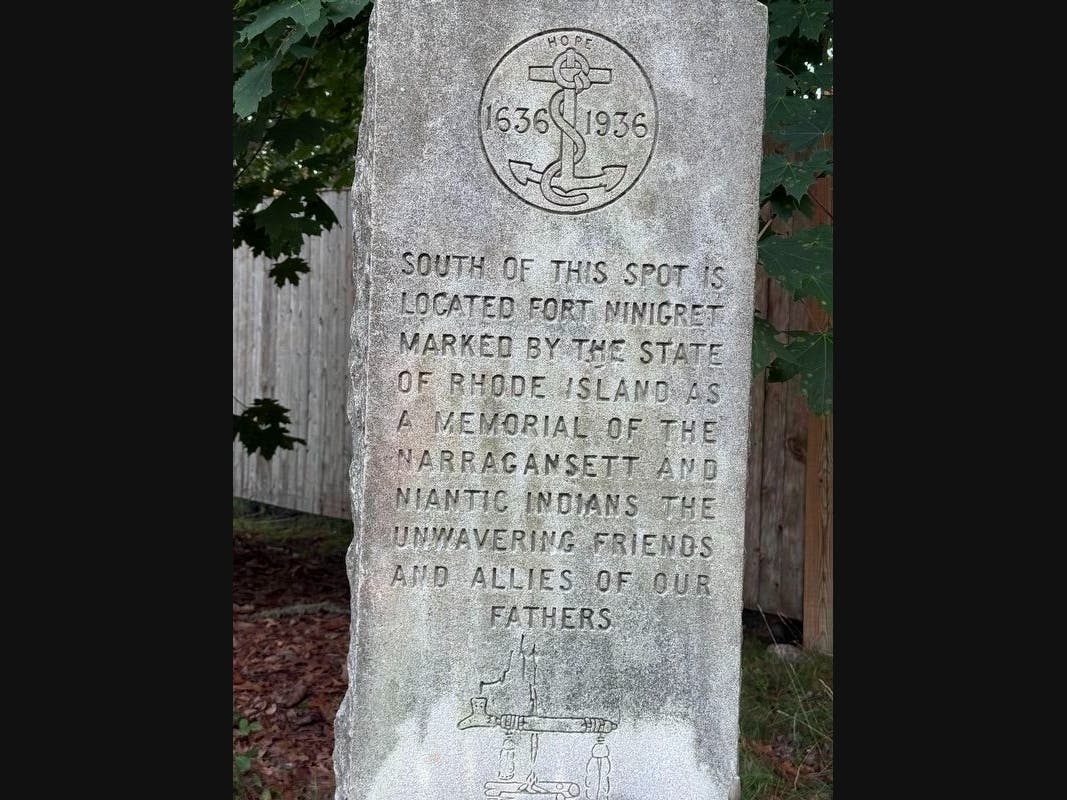
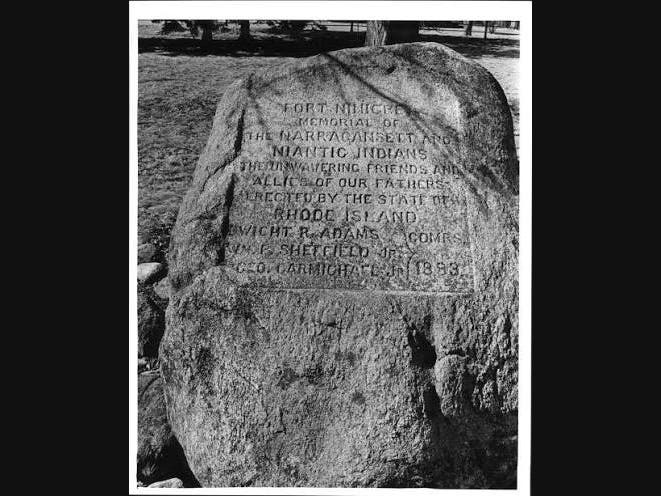
One of the most recognizable features of Fort Ninigret is the commemorative boulder located within the enclosure.
The memorial was erected by the State of Rhode Island on August 30, 1883, honoring the Narragansett and Niantic Indians.
Its inscription describes them as the "unwavering friends and allies of our fathers."
That language reflects the perspective of the period in which the memorial was created. It is worth remembering that the monument was installed during a time of significant change and hardship for Indigenous communities.
The memorial is part of the site's history, but it is not the whole story.
The people whose history is represented here existed long before the monument, long before the town of Charlestown and long before Rhode Island became a state.
Their history should not be reduced to a commemorative inscription.
Fort Ninigret offers an opportunity to recognize that deeper history and consider the experiences of the Indigenous people who lived, traded, traveled and maintained communities throughout this region.
A place on the National Register
Fort Ninigret received another important recognition on April 28, 1970, when it was added to the National Register of Historic Places.
The designation recognizes the site's importance in Native American history, commerce and military history.
It also places Fort Ninigret among the historically significant properties officially recognized in Charlestown.
For a community with such a rich history, that is an important distinction.
The Rhode Island Historical Preservation and Heritage Commission continues to identify Fort Ninigret, also known as the Niantic Fort, as a National Register property.
The designation is more than a line in a historical directory. It acknowledges that the site has significance beyond the boundaries of Charlestown.
What should visitors take away?
Perhaps the most important thing visitors can take away from Fort Ninigret is a different perspective on the history of Rhode Island.
We often think about local history through familiar landmarks, colonial homes, old churches, town halls and the stories of European settlers.
But Rhode Island's history began long before those structures existed.
The Indigenous communities of this region had their own political relationships, traditions, trading networks and systems of protection.
Fort Ninigret gives us a physical connection to that history.
It also provides an opportunity to think about how historical interpretation changes as new evidence becomes available. The questions surrounding the fort's origins have been debated for generations, and archaeological research has helped add important context to the discussion.
There is still much to learn.
The history is bigger than the fort
After researching Fort Ninigret for this four-part series, one thing has become increasingly clear: the significance of this site extends far beyond the earthworks that remain today.
It connects Charlestown to the Niantic and Narragansett people, to early European trade, to the conflicts of the 17th century and to the preservation efforts that helped protect the site for future generations.
It is easy to drive past a small historic landmark without giving it much thought.
But places like Fort Ninigret remind us that the history of a community is not always found in its most prominent buildings or busiest public spaces.
Sometimes, it is found in a quiet corner of town, where a few remaining earthworks tell a story that began centuries ago.
And perhaps that is the greatest reason to keep Fort Ninigret on our radar.
Not simply because it is old, or because it has a place on the National Register, but because it represents a chapter of Rhode Island history that deserves to be understood and remembered.
Fort Ninigret is more than a historic site. It is a connection to the people, events and relationships that helped shape the place we call Charlestown today.
I hope the series has encouraged readers to take another look at this historic corner of town and perhaps make a visit of their own.
Historical sources used
The article draws on the following historical references:
- Rhode Island Historical Preservation & Heritage Commission: Fort Ninigret National Register documentation. preservation.ri.gov+1
- Society of Architectural Historians: Fort Ninigret. SAH Archipedia 2.0
- National Park Service: Fort Ninigret registration. NPGallery
- Charlestown Historical Society: Fort Ninigret.