Politics & Government
Aquidneck Island Communities Send Officials to Jamestown to Fight LNG
A series of work sessions are now planned for October to strategize an opposition campaign.

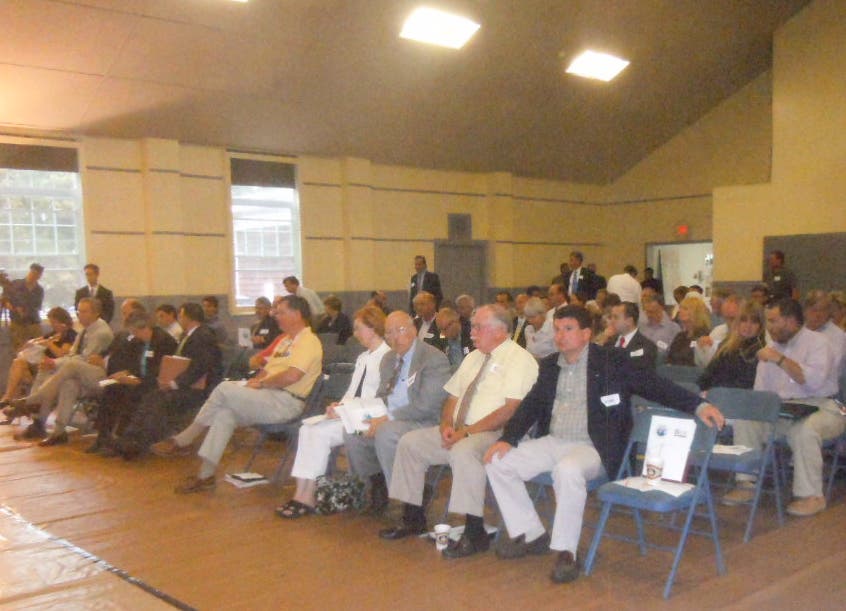


More than 100 concerned residents and elected state and local officials representing Aquidneck Island, southern Rhode Island and Massachusetts turned out in Jamestown Wednesday to show a unified front in the fight against a proposed liquefied natural gas (LNG) off-shore facility in Mount Hope Bay, with a terminal in Fall River.
The Congress of Councils, a non-partisan environmental advocacy organization, hosted the community forum at the Jamestown Recreation Center, beginning with a 7:30 a.m. breakfast and followed by a lineup of speakers that included U.S. Senator Sheldon Whitehouse, Attorney General Patrick Lynch, Save the Bay Executive Director Jonathan Stone, Newport and Bristol County Convention and Visitors Bureau Executive Director Evan Smith, and Dianne Phillips, who specializes in LNG issues and serves as counsel for the city of Fall River. Also in attendance was state Rep. Lou DiPalma (Dist. 12).
Among those representing Newport was Councilman Justin Mclaughlin.
Find out what's happening in Newportfor free with the latest updates from Patch.
Lynch issued a report in 2005 stating his case against LNG facilities in urban areas, citing them as a security risk. Copies of his report, along with papers produced by the Aquidneck Island Planning Commission, and the Rhode Island Turnpike and Bridge Authority, which supported the LNG opposition arguments, were in no short supply at Wednesday's meeting of the councils.
A study funded by the Aquidneck Island Planning Commission noted that both the Newport (Pell) and Mount Hope bridges must close whenever LNG tankers pass underneath and that the new project, if approved, would produce a bridge closure on average every 2.5 to 3.5 days, impact traffic and also limit access to and from Newport Hospital, Aquidneck Island's only hospital.
Find out what's happening in Newportfor free with the latest updates from Patch.
Although no action was taken, Wednesday's event was an opportunity to bring together the various municipalities to discuss the proposal's environmental impacts and develop general goals of working together to fight the project.
The Weaver's Cove LNG proposal calls for a terminal to be built in Fall River to serve natural gas customers in southeastern Massachusetts and Rhode Island, with a Hess Corp. LNG berth in Mount Hope Bay.
LNG tankers—among the largest ships on the sea—would approach the terminal via Mount Hope Bay from the East Passage between Newport and Jamestown, to dock at a proposed berth near Spar Island. Liquified natural gas would then be pumped through a large underwater pipeline to a facility on the Taunton River in Somerset.
On Monday, the U.S. Coast Guard announced it had again denied Weaver's Cove Energy's appeal of a 2007 decision that determined some waterways leading to the proposed offloading facility were unsuitable for LNG tanker traffic. But locals continue to fight the project because Hess and Weaver's Cove have since moved on to an alternate proposal that calls for a floating terminal in the middle of Mount Hope Bay.
Rhode Island's Save the Bay chapter says the project would require extensive dredging from the bottom of Mount Hope Bay, permanently destroying local fish habitat, endangering the livelihoods of local fishermen, and rendering much of the bay's waterways off-limits to the public.
The community of Jamestown has been one of the key players and driving forces behind forming a united coalition of municipalities to keep the LNG facility out of Mount Hope Bay. Not mincing words, Jamestown officials have formed an "LNG Threat Committee" to focus on fighting the project and spent the recent summer attending town hall and city hall meetings throughout Rhode Island and southern Massachusetts, building a coalition town-by-town and city-by-city.
On Wednesday, the Jamestown Town Council called upon each community at the forum to appoint one or two town representatives, or legal counsel, to participate in four upcoming work sessions, a sort of "war room," to strategize its opposition campaign.
The work sessions will be held on Aquidneck Island at locations to be determined and are tentatively scheduled for:
- Wednesday, Oct. 6
- Thursday, Oct. 7
- Wednesday, Oct. 13
- Thursday, Oct. 14
"This effort is intended to assist the municipalities in our states who depend on our bays for their livelihoods and recreation," said Jamestown Town Clerk Cheryl A. Fernstrom in a prepared statement, "so that we may better craft strategies, both long-term and short-term, in opposing the Weaver's Cove Energy LNG terminal."
At the end of July, a Jamestown council member made an official appeal to Newport to join them in solidarity at a Congress of Councils meeting.
Most of the municipalities represented at the forum have already drafted a resolution—or sometimes even more than one resolution in Newport's case—in strong opposition to the proposed LNG off-shore facility. Newport's City Council most recently passed a resolution on June 23 voicing opposition to Hess' application to build in Mount Hope Bay a berthing facility for the delivery of LNG, citing concerns with the fact that the tanker transits "will permanently degrade the character of Narragansett Bay, while undermining the economy of businesses already on its shores and posing major environmental and safety risk while failing to increase the energy security of the United States or New England."
Get more local news delivered straight to your inbox. Sign up for free Patch newsletters and alerts.