Arts & Entertainment
Little Compton Historical Society Prepares for New Season
Among the society's holdings are a collection of dolls dating back to the 1700s.
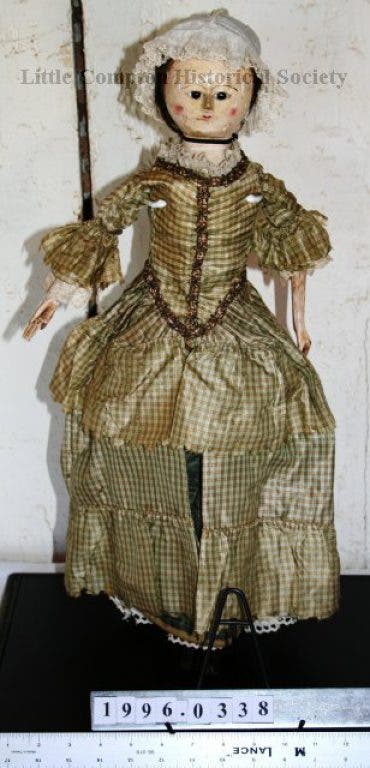

Tucked inconspicuously in a narrow “dead space” beside a second floor bedroom fireplace, her small round eyes peer out from behind the protective glass. She neither moves nor breathes, but she has probably experienced much since she originally came from England in the 1700s. Her stare is steady, her expression, wooden – literally. And she has probably never changed her clothes.
She is a beautifully preserved Queen Anne doll whose companions include over 13,000 items inventoried at the Little Compton Historical Society at 548 West Main Road. She is one of hundreds of “recreational artifacts” that include doll clothing and furniture as well as a variety of dolls.
Most of the dolls owned by the Historical Society are in storage, according to Director Marjorie O’Toole, but the Queen Anne doll is one of the few that remain on permanent display at the Wilbor House Museum. Wilbor House, c. 1690, is the former home of Dorothy Paine Brayton, who donated the house to the society in 1955. Much of the society’s holdings are on display here.
Find out what's happening in Tiverton-Little Comptonfor free with the latest updates from Patch.
O'Toole says the Historical Society is excited to open its doors again for the summer. She looks forward in particular to the annual Fourth of July Family Day, which is set for this Saturday and is again expected to draw in record numbers. Last year, over 1200 people attended the event and O’Toole says she expects success again this year.
Since the Historical Society began its collection of artifacts, current and former residents of Little Compton have steadily donated items.
Find out what's happening in Tiverton-Little Comptonfor free with the latest updates from Patch.
“Ninety-five percent of what we have has a Little Compton connection,” O'Toole said. “We unfortunately cannot display everything.”
O’Toole adds that “we do strive for variety in the collection, but at a certain point we sometimes have to stop accepting donations.”
Nevertheless, among all that the society holds, O’Toole admits she has a special fondness for the Queen Anne doll, acquired as a purchase by the society in 1996 from Elizabeth McIntyre, who according to the society’s records, retired in Little Compton and restored dolls.
As O’Toole discusses the doll, she leans in toward its spot in the southwest bed chamber as one would lean closer to a cherished pet or a small child. She grins as if to say, “It’s me again; I’ve come to visit.”
In her five years as director, O’Toole says it is “almost impossible to come up with a favorite [item], but I do like the Queen Anne Doll very much.”
The slender, 23-inch tall doll, dressed in a long green and white checked gingham dress and white cap, is rarely moved and has remained where she is since 2009, when according to O’Toole she joined a “Time to Play” summer program. It is noteworthy, O’Toole points out, that despite the name of her last outing, this particular type of doll would not have been used for play.
“Queen Anne dolls were used as ladies’ accessories similar to the ways ladies might carry around a small dog today,” she said, adding that they might change the doll’s clothing or other adornments to match their own outfit. At the time, the dolls were apparently considered stylish.
At the opposite end of the spectrum, another doll on permanent display in the Wilbor House Museum is an Izannah Walker doll, which was named Peggy by its original owner — identified in the society’s records as “Grandmother Snow.” “Izannah dolls” were meant to be played with.
Peggy was donated to the society in 1970 by Mrs. Robert Snow of West Road, Little Compton. Created nearly a century after the Queen Anne doll, Izannah Walker dolls, with their round fabric faces hardened with paste, were invented by native Rhode Islander Izannah Walker, who was born in Bristol in 1817. Unlike the Queen Anne dolls, they were meant to be played with and the woman who invented them made that intention clear.
One of America’s Earliest Doll Makers
At the age of 56, Walker applied for a patent to produce the dolls she may have been already making for some time prior to her application. Her patent application describes her dolls as “inexpensive, easily kept clean, and not apt to injure a young child which may fall upon it.”
Records show that Walker, who lamented that she was not born a man, also made doll furniture and household gadgets. She also created a parlor heater and sold real estate. However, it is her dolls that have earned her the most fame.
Notably, every one of her dolls is different and they also vary in size. She made both pink-faced and a smaller number of black-faced dolls. The black faced dolls had wool hair as opposed to the simpler painted-on hair of the pink-faced models. Several boy dolls have also been found. Among collectors online they are considered a highly desirable item. Although Peggy may not be O’Toole’s favorite, young girls today might find her a precursor to the very popular American Girl dolls.
A Doll for Everyone
Of course, not everyone (then or now) can afford store-bought toys, even those considered inexpensive. Homemade rag dolls were very popular according to O’Toole and the Society has one donated by Persis Simonds that is tucked away on a top shelf in the archival barn. Probably made in the 1800s, she is made entirely of cloth by an unknown artist. Yet, though her peach-colored dress is faded and worn, her black velvet cape held at the center with a little pearl button shows that loving hands created her for a child who may have loved her well. From her black hair net to her knitted gray booties trimmed with miniature red stitches, it is perhaps sad that in the nature of saving things they must also be kept tucked away.
Looking Forward to a Successful Season
O’Toole says she hopes more children from local schools will come to the Historical Society on field trips this year. Last year, she notes, all of Tiverton’s fifth graders, about 150 students, participated in a day organized by the society that included time at the Wilbor House Museum and the adjacent buildings (which include an old corn crib), as well as a visit to the Friend’s Meeting House also maintained by the society.
The Wilbor House Museum is open June through August, Thursday-Sunday, from 1 to 5 p.m. Private tours by appointment may be scheduled at (401) 635-4035 or via e-mail at lchistory@littlecompton.org .