Crime & Safety
Sheriff's Candidates Debate Issues
Clark, Whitten and Morgan speak on sheriff's office's budget and needs, school safety and federal funds


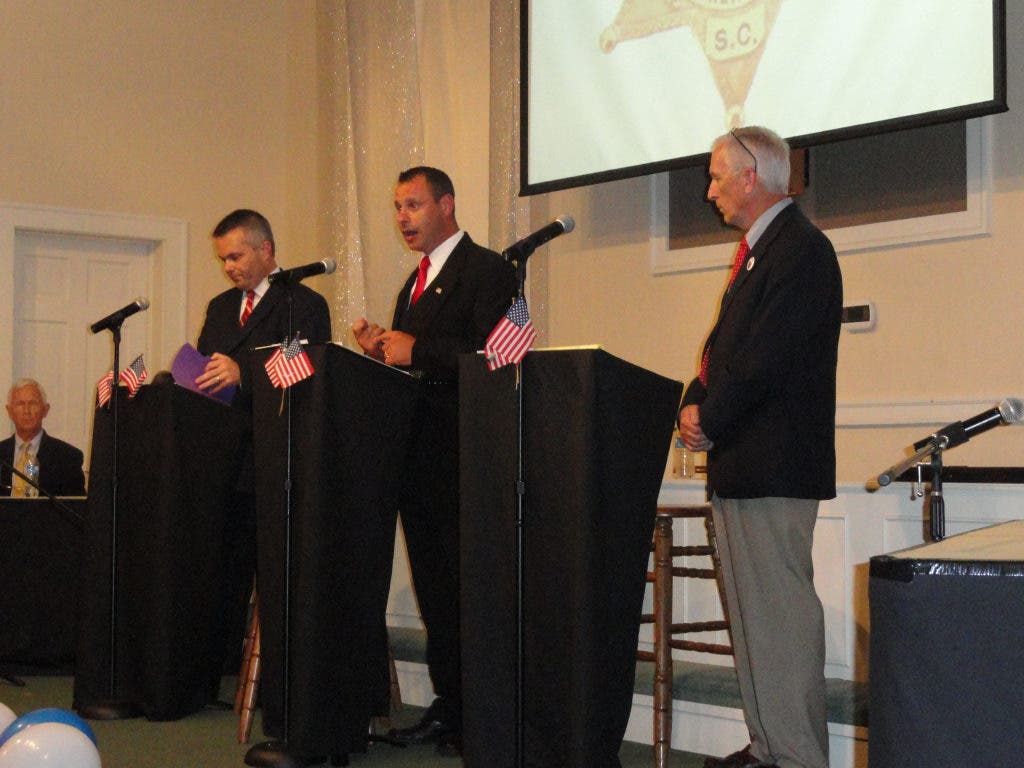
The three men campaigning to be the county’s next sheriff tackled the issues Tuesday night during a special debate.
Rick Clark, Stan Whitten and Tim Morgan debated the issues, answering questions both audience members and questions submitted by a variety of groups from around the county.
“We all realize that the United States of America is at a critical point in time, there’s no question about that,” said moderator David Merck. “South Carolina is facing a lot of critical situations. Here in Pickens County, for the first time in over 40 years, we will be electing a new sheriff for Pickens County. One of these three men will be the new sheriff and we want you to be an informed citizenry when you go to the polls in November. In order to do that, we want the candidates to have a forum to tell you what you think, where they stand, what they anticipate doing in the event they win the election.
Find out what's happening in Easleyfor free with the latest updates from Patch.
“We need a sheriff who will take seriously his oath to defend the Constitution of the United States of America,” Merck continued. “We need a sheriff who will stand with the people of Pickens County, not against us. We need a sheriff who will protect and serve. We need a sheriff, most importantly, who will love mercy, and do justly and walk humbly with his God.”
The debate was the first of many planned by organizers before November 6. Check back with Easley Patch for more information on these debates as they're announced.
Find out what's happening in Easleyfor free with the latest updates from Patch.
Question: What are the top two things you would like to change in the sheriff’s department?
Morgan said Pickens County needs an ordinance that would regulate pawn shops and scrap metal dealers.
“We developed one, submitted it to County Council and it’s presently in committee,” Morgan said. “A lot of the thieving that takes place, they go to the scrap metal yards or it ends up in the pawn shops. We have the technology available now to check from the patrol car pawn shop transactions anywhere in the United States. That’s a great asset, but we need an ordinance to force the pawn shop dealers and scrap metal dealers.
A law regulating pseudoephedrine is also needed, Morgan said.
“10 percent of the people are buying 90 percent of the Sudafed … for making methamphetamine,” he said. “The states that have passed that, there’s been a decrease in methamphetamine use. I think 90 percent of the people using Sudafed wouldn’t mind getting a prescription to do it, if it’s going to help us out on the meth problem.”
Clark said Pickens County needs intelligence-led policing, which he said leads to crime decreases through law enforcement agencies sharing information.
“We’re not in our community, and we’re not telling our deputies what’s going on in our communities,” Clark said. “We’re ignoring our police departments. 6 percent of people account for 60 percent of the crime on average. What we do not do is share information instantaneously with our police departments. We’re chasing the same thugs, we just don’t know about it.”
“We’ve got to collect our data from our available sources, everything from out on the street to our records maintenance system to the cities records maintenance system, even jail interviews,” he continued. “But we’re not doing it. Then we’ve got to work with our public, and integrate all this into a form where the deputies see it, have it at their fingerprints on the road, and know their mission – to put thugs in jail.”
Whitten said he’d reduce the size of the patrol areas
“Right now there’s three very large patrol areas in Pickens County, about 170 square miles each,” he said. “I would like to cut down to about eight smaller patrol areas. Right now there’s 7 deputies, a sergeant, a lieutenant covering 512 square miles in Pickens County. Under my realignment, there’d be eight smaller patrol areas of about 50-60 square miles and 14 deputies without going to County Council and asking for a dollar or a deputy. Response times would immediately increase. Deputies can start making cases, develop leads on their own and get out there and start making cases.”
He said his concern with intelligence-led policing.
“It’s law enforcement sensitive,” Whitten said. “If you’re in a traffic stop, you’re never going to know if your name goes into a database, because it is law enforcement sensitive.”
Morgan was given a chance for a rebuttal, and said the sheriff’s office was already participating in intelligence-led policing.
“As far as the landmass, it’s still 507 square miles, I don’t care how you break it down,” Morgan said. “It’s still the same number of people and it’s the same landmass.”
Clark was given time to respond to Morgan.
“Intelligence-led policing today is a map on the wall and they stick pins in it,” Clark said. “It’s not telling you anything. Intelligence-led policing will give deputies what they need in the car.”
Question: How can you make the sheriff’s office budget most cost effective?
“That’s easy,” Whitten said. “Let the people what the budget is, exactly where the money is being spent. $9.2 million for fiscal year 2013. I don’t know where the money is being spent. For me to answer that question, I’d have to look at the budget and tell you that the sheriff’s office can live within that budget.”
He said the sheriff’s office is too top-heavy.
“There are five captains at the sheriff’s office,” he said. “I’m talking about realigning personnel, I’m not talking about simply doing away with positions. That’s where I’m going to get the personnel to turn around and put these deputies back on the road in smaller patrol areas. Uniform patrol is the backbone of the sheriff’s office. Everything happens there. Deputies’ response times are going to increase with more deputies on the road. You have to put people where they’re going to be most effective.
Morgan said he’s prepared more than thirty budgets for the sheriff’s office.
“I know them inside and out ….every nook and cranny,” he said.
Incorporating more intelligence-led policing will be extremely expensive, Morgan said.
“You’re talking $84,000,” Morgan said, adding the department’s records maintenance system is not compatible with that.
“What’s wrong with a map where every deputy can come in and see the red pins and know where the burglary areas are, where the high crime areas are?” Morgan asked. “Why do you have to have that on a piece of electronics? To infer that we don’t exchange information … we communicate daily with shift change meetings with what we’re looking for, with detective meetings with what we’re looking for.”
He said there are some positions that could be looked at.
“We have gone through that budget year after year and we’ve never gone back to county council to ask for more money,” Morgan said.
Clark said intelligence-led policing did not have to be expensive and did not have to require computer upgrades.
“Our deputies are not efficient now because they don’t know what they’re looking for,” Clark said.
Excel and Word are free or already paid for.
“Look what it’s telling me – for free, through email,” Clark said, holding up communication he receives from Anderson County every day. “When we start combining this type information with our cities, so we know the same 6 percent that we’re hunting, and sharing our resources and sharing our tax dollars to become more efficient that’s how we’re going to make ourselves more cost effective for every tax dollar.”
Intelligence-led policing gives police “targets to look for,” he said.
“Tell us where we need to be saturating a certain area, if we’re looking for a certain truck or if we’re seeing a pattern. Intelligence-led policing is about patterns.”
Question: How do you feel about accepting federal grants for the sheriff’s department?
Morgan said the Sheriff’s Office actively pursues federal grants.
“We’re looking at the possibility we’ll have to build a new jail at some time,” Morgan said. “That’s going to be down the road, but housing federal prisoners is another source of money to take the burden off of Pickens County taxpayers.”
He estimated that since, the Sheriff’s Office has received more than $1.5 million in federal money.
“It’s a great asset,” Morgan said. “The money’s out there. It’s all our tax money, there’s no such thing as free money. But it saves the local taxpayers’ dollars when we can get that federal money.”
Clark said he had concerns about federal money coming in, but as a Liberty City Councilman, he had a simple choice.
“Do I get it for my town, for my infrastructure that’s failing apart, or do I give it to New York or Los Angeles?” Clark asked. “I’m going to take it.”
Federal grant money enabled the City of Liberty to pay only $18,000 for its new fire station.
That enabled the city to better its ISO Rating, which saves residents money by lowering their insurance rate.
“We can use tax dollars through grant money to lower the cost of owning a home in our service area,” he said.
Whitten said grants are necessary in some cases, but “before we start going after grants, I would like to see, and would like to show you as sheriff, where the money is going.”
“There’s other way to generate money in the sheriff’s office,” Whitten said.
He used as an example money seized through dope house busts.
“The deputies on the road can be going after those dope houses up to and including getting search warrants and kicking down the door and going in and seizing $10,000 - $12,000 in cash. That money stays within the sheriff’s office,” Whitten said. “And that is free money.”
Question: As sheriff, what would be your plan, in working closely with resource officers in schools around our district, towards school-related school security issues and criminal offenses with our students?
Clark said he teaches police how to respond to active shooters in schools.
“We do not have the training and the response mechanism in Pickens County for a school shooting,” Clark said. “One thing we don’t understand in the sheriff’s office, is we’re responsible for city schools too, we need to be training them too. If we have a large event, we need to train together.
Clark said school resources officers are a great asset.
“We have to train with them and start looking for the pre-indicators of violence,” he said. “In about every school shooting I’ve studied, the indicators were there. A lot of times we don’t put our best people in the resource officer positions, I’ve seen across the state, because we’re not taking it seriously enough. This is our front line in saving people and saving kids, and hopefully catching them before they go off and do something violent.”
Whitten said the sheriff’s office needs to take an active role in schools and be visible.
“The deputies on the road need to understand the layout of the schools, they need to have maps in their car in case something does happen where they have to respond” Whitten said. “That’s what parents in this county expect, that we respond and we respond diligently.
“With our kids in these schools, the intervention the sheriff’s office can give these children is very important,” he continued. “(School resource officers) can be teaching. Prevention starts with them.”
He said he would like to bring back Police Camp.
“Get them involved with the sheriff’s office, let them hang out, shoot guns,” Whitten said. “Mentor those children. Teach them. That’s what these children need.”
He said the district’s Alive at 25 program is “fantastic.”
“It’s taught by law enforcement,” Whitten said. “It teaches them safety.”
Morgan said school resource officers have great communication with teachers and students.
“They interact,” he said. “If we see that there’s a kid that’s beginning to have a problem, the grades are slipping, we do Knock and Talks.”
Deputies go to the homes and speak to parents.
“We let them know there are behavior changes, the grades are dropping, they have a new association of friends,” Morgan said. “We try to nip it at that point in time and do something about it before it’s too late.
He said sheriff’s office training is open to the cities.
“We offer it to them but we can’t make them participate,” Morgan said.
He said the sheriff’s office works together with a number of officials and agencies, including teachers and administrators.
“It is a different world that we live in,” Morgan said. “We’re making every effort to make sure a school stays the safe place that it is.”
The entire debate can be viewed here.
Get more local news delivered straight to your inbox. Sign up for free Patch newsletters and alerts.