Health & Fitness
Lexitecture: Lexington Traffic
Why is Lexington Traffic so bad? What can we do about it? Lexitecture explains this and more.



Let me begin by saying that I am not a traffic engineer. An architect’s perspective on traffic values separating and enhancing car and pedestrian environments, instead of maximizing speed at all costs.
The majority of Lexington’s traffic problems originate from one basic principle that, when broken countless times, results in the crawling traffic we experience today on our roads. I call it linear traffic loading vs. alternative traffic loading.
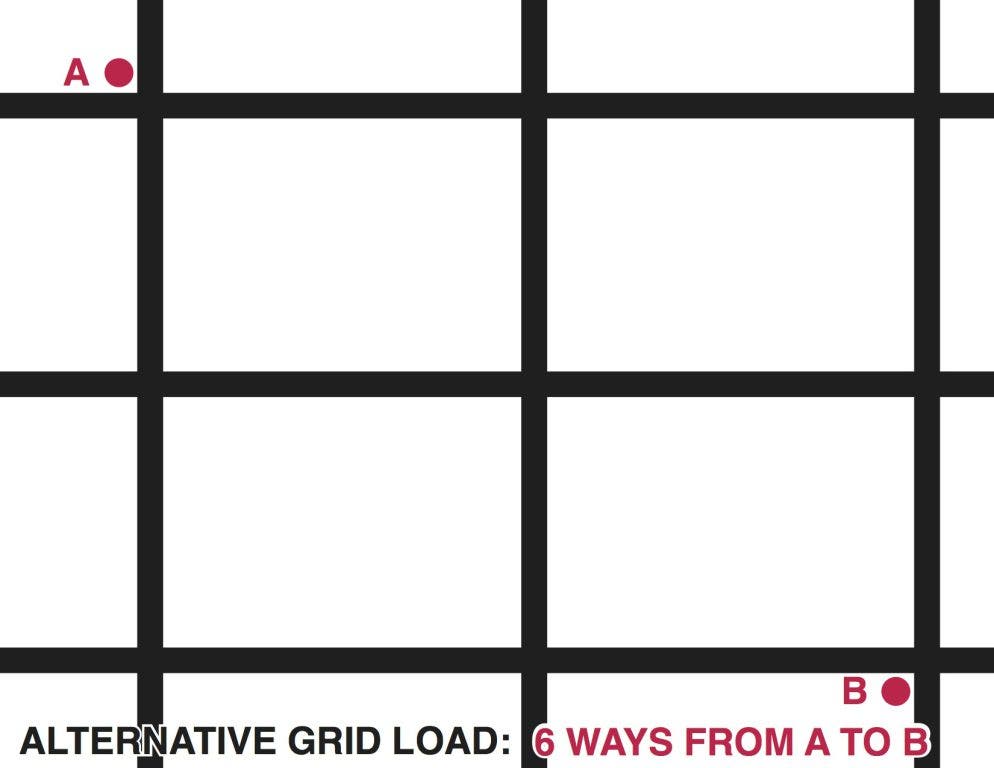
Consider the first diagram. Linear traffic loading is what we typically see in Lexington. All of the access points are located off the same road. This means there is only one way to get from point A to point B, which increases the traffic load in a direct relationship with an increase in access points. So, if you keep adding access points, there will be more traffic, and at a higher rate if those access points are made up of other dead-end access points(like a subdivision) and not through-traffic roads. In other words, its bad to have tree shaped streets on one "route."
Find out what's happening in Lexingtonfor free with the latest updates from Patch.
The second diagram illustrates a typical grid street plan. Here in “alternative traffic loading,” there are multiple ways to get from point A to point B. Generally, adding access points puts a minimal strain on the traffic loads, because there is no room for “tree shapes” and the traffic has options. This is one of the reasons why the grid has been the most common way to organize cities over the last few hundred years.
Because old Lexington formed off of the Augusta-Columbia highway, a linear situation, very few grid-like roads were laid out, and horses didn’t cause much traffic anyway. Most county seat small town grids were based on the courthouse square, but for some reason that didn’t happen in Lexington. However, most grids like this have blocks that are too small to facilitate any smooth, continuous traffic flow. If you make a “block” large enough for a community inside, with commerce along the edges, it can help create a happy medium between good traffic flow and safe pedestrian environments.
Find out what's happening in Lexingtonfor free with the latest updates from Patch.
Lexington, to my amazement, has a great example of this in the “Triangle.” If you imagine that Lexington was well-planned and traffic on 1, 378, and 6 was bearable because they weren’t linearly loaded, the Triangle is a pattern that should have been copied. The roads in the community are winding and have some 3-way stops, which force you to drive slow and cut down on car accident probability, which is great for pedestrians and residential areas. The “block” is small enough to where residents can walk or bike to any of the commercial areas around its edges, and the various exits and entrances keep any of the surrounding highways from becoming too heavily loaded with traffic. If we had built all of Lexington like this, I probably wouldn’t need to write this blog.
When it comes to Lexington traffic, the road-widening and one-way streets efforts are just band-aids, not solutions. We need to start a road remapping process to undo all of the damage done by the visionless development of the past.
Our only other option is to get cars off of the roads. Next time I’ll explain how that is possible.