
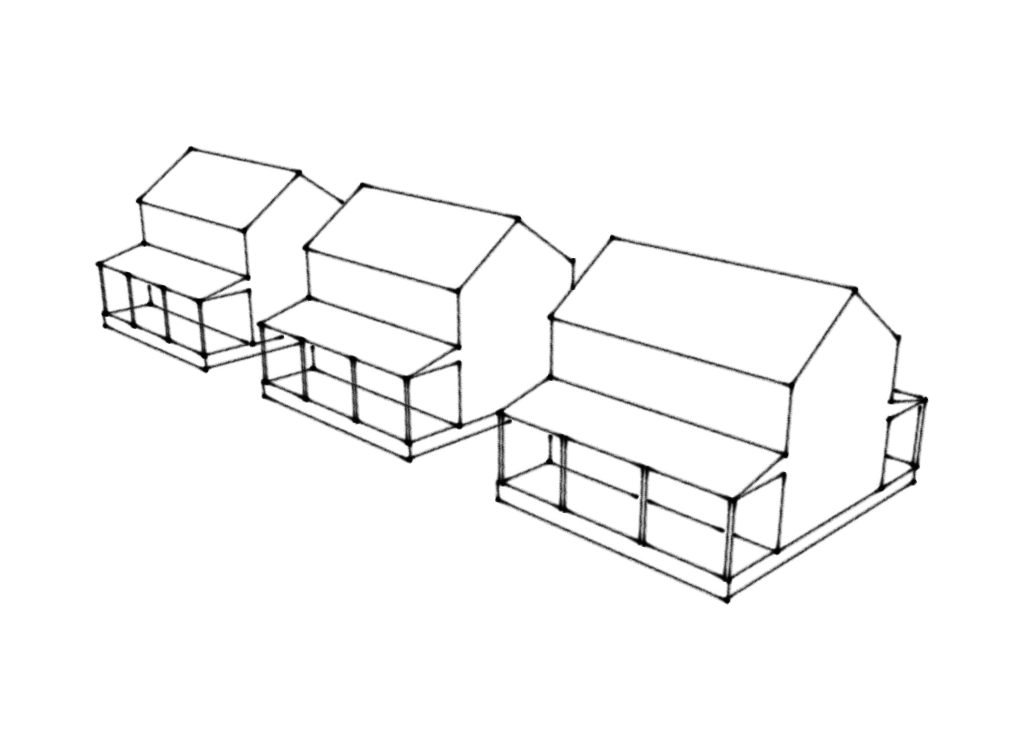


Moving into the future, Lexington as a town needs to become and look more cohesive in order to feel more like its own place. Most people think that this is an aesthetic argument; just pick a style you like, build everything like that, and then everything will look similar. This idea is incredibly dangerous, because architectural styles, if used purely for aesthetics, are vanity.
For example, hundreds of years ago, the colonists didn’t come over to America and say,”I want to build this house in the colonial style.” The people had certain spatial needs, building technologies, environmental factors, and cultural ideas during that period of time that led them to build a certain type of building. We only name styles in hindsight.
Today we live in our own period of time. In 2013 we have our own certain spatial needs, building technologies, environmental factors, and cultural ideas about art and architecture. We have to respect and learn from the past, but if we build only in vain styles that copy the past, we are failing to acknowledge that we live in 2013.
Find out what's happening in Lexingtonfor free with the latest updates from Patch.
Luckily, there are timeless patterns that transcend style that we can build with. A pattern, in architecture, is a space or structure with a specific function that is repeated. For example, over thousands of years people built homes with a specific place to build a fire. So, the fireplace, along with the chimney, became an architectural pattern.
If we look back at what has been built in Lexington(Pre-WWII), we can start to pick up on great patterns that we can use to enhance Lexington today, and build this sense of cohesiveness.
Find out what's happening in Lexingtonfor free with the latest updates from Patch.
One of the first patterns we see in Lexington is what I call the homestead. From the very first log cabins to the antebellum farmhouses, Lexington homes follow a similar profile. There is a central box with a gable roof, an upper floor or lofted attic, and wide porches that extend the whole length on the front and back that helped cool down the walls from the sun. In these early homesteads, we see an equal proportion between the front and back porches, representing an equal emphasis on the public self, and the private self.
Today, the front porch is a dying pattern. It was once the center of southern culture, where people lived publicly in their community. The suburban homes we build today are rarely built with a front porch that is big enough for us to use and interact with our neighbors. Instead, our back decks are the focus of our time and attention, physically representing our attitudes towards the community we live in.
I don’t believe we actually feel this way. We can once again start building front porches in Lexington, and reclaim a shift back to a balance between private and fulfilling public lives enjoyed on the front porch. Just as our Lexington ancestors enjoyed this, we too can build strong community through front porches.
Let’s build a better Lexington.