Community Corner
School Choice: A Tale of Two Sons, Two Schools
Karen Floyd explains how school choice has affected her family.

I am the product of public education: from Irmo Elementary School to a Juris Doctorate from the University of South Carolina School of Law. Likewise our identical twin sons have received excellent educations in public schools from Pine Street Elementary School to the Freshman Academy at Spartanburg High School. I can point to seminal teachers and coaches that have impacted their lives in positive ways, and we are forever grateful to each one. In the ninth grade, however, we made a change – a choice. While one son was flourishing, the other son was not reaching his potential. No fault lies with any person, process or institution. Though it has always been apparent that our twin sons, despite being identical, learned differently, responded differently and were challenged differently, it was not until mid-way through the ninth grade that our family chose an educational option other than public education, for one son.
Today, one son continues to thrive in the diverse and rich tapestry at Spartanburg High School while the other son has found his place at the Christian Academy of Oakbrook Preparatory School. As I write today, both sons are turkey hunting on Youth Day with my husband, their proud father. Despite tremendous similarities, a snapshot of this past Friday demonstrates the environmental distinctions from which our boys thrive. One son left our home early Friday with the face paint remnants from the previous night’s Lacrosse game still on his face, the other son left with “work clothes” complete with heavy duty yard gloves and sun screen (knowing full well the probability of sun screen actually being used was limited, at best). Though Spartanburg High School varsity lacrosse lost to Dorman the night before, our son was excited for practice later that day to hear what the Coaches “take” on the game might be, and what lessons were learned from the defeat. Our other son headed off to a service day at Hatcher Gardens where he and other students from Oakbrook Academy fulfilled their community service by working in the garden for the entire school day. Both children’s needs were met and they were growing in distinctively different ways despite genetic and environmental links.
“School Choice” has been a buzzword, and a political litmus test for almost a decade in South Carolina. State Representatives first voted on the issue in 2004, but individual lawmakers, such as State Senator Lewis Vaughn, began sowing the seeds years before. During that decade of deliberation other states passed and aggressively expanded school choice plans. Over 35,000 low-income students in Florida are now enrolled in the school of their parents’ choice through such a program this school year. State budget officials there calculate the tax credits save $1.49 for each dollar in revenues “lost” through credits. Test scores in both the public and private schools have shot up, chipping away at long-standing income gaps. In Pennsylvania, 40,000 students and in Arizona 30,000 have experienced school choice. Newer programs in neighboring Georgia and North Carolina already support thousands more.
Find out what's happening in Mauldinfor free with the latest updates from Patch.
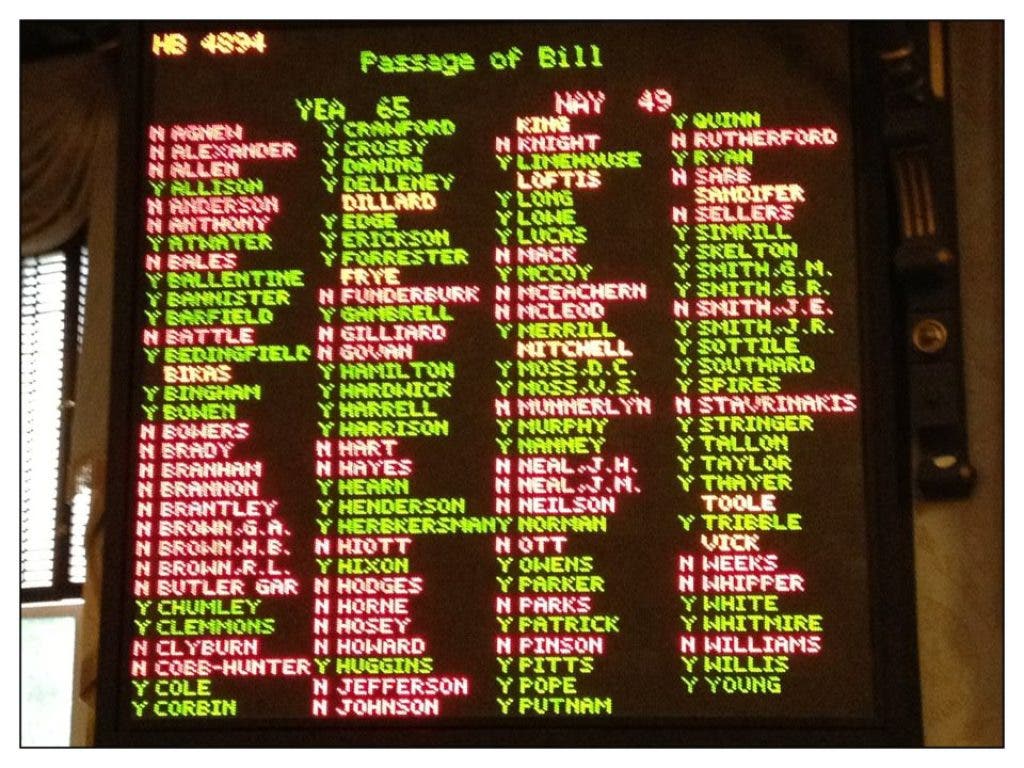
The biggest obstacle to the parental choice movement in South Carolina has been the lack of understanding of what School Choice is and the rhetorical terms of the debate. School Choice should be for every family. Independent education choices should also be available for every child, not the privilege of the economic elite. Representative Rita Allison’s passionate defense of the bill on Wednesday was particularly insightful. She explained how the school choice debate is not a zero-sum argument about choosing public “or” private schools; it’s really about “and.” To reduce inequality, to increase parental engagement and to raise student achievement, Allison insists every parent in the state deserves to have real choices for their own child’s education. That means public and charter and private and magnet and virtual and home school; whatever works for the specifics of that pupil’s learning needs.
Representative , another bill sponsor, reiterated Allison’s points at the podium. He stressed that school choice was an issue of how lawmakers set the field for parents to make choices, rather than a micromanagement of specific school policies and programs. “Parents have the most information and best motivation to make decisions for their own children,” he insisted, noting that even the best classroom in an absolute sense might not be the most appropriate for each specific student seated in it.
Find out what's happening in Mauldinfor free with the latest updates from Patch.
Just as the terms of debate evolved over time, so too have the specifics of the choice legislation considered. , targets support to low-income students and children with special educational needs through privately funded scholarships. Scholarship donors would be eligible for state income tax credits. Modest tax deductions for families who home school their children or pay out of pocket for independent schools are also part of the plan. While the details of this proposal are well proven through the experiences of other states, the size and scope is modest when compared to choice bills introduced just a few years ago.
School Choice is NOT a dichotomy of public “or” private education. It should be an option for all families in South Carolina who have decided –for one reason or another– that their local traditional public school is not the best fit for their child.
My family had a choice, and so too should every family in South Carolina.
Karen Floyd is the Publisher of Palladian View, a digital magazine for the conservative Republican woman.