Weather
Heavy Rain Events, Like Louisiana, Expected in a Warmer Planet
The historic flooding in Louisiana damaged thousands of homes, flooded major interstates and left at least 13 people dead.


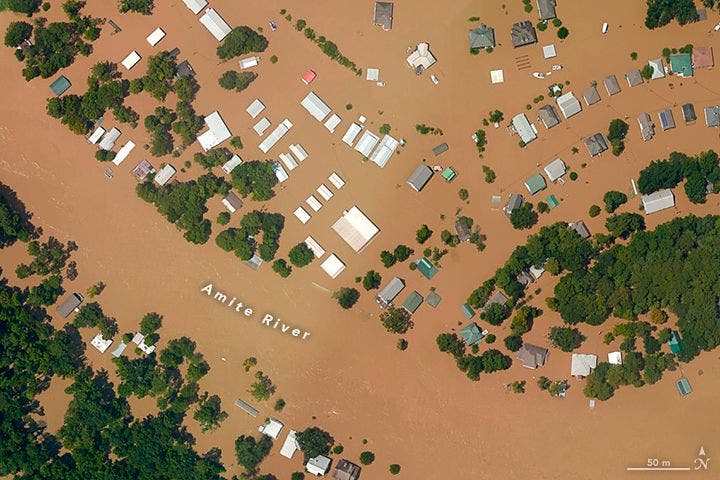
The heavy rain that left a large part of Louisiana underwater is consistent with the type of severe weather that experts say one would expect to see with a warming planet.
The link between climate change and the heavy rains in Louisiana is the increased amount of water vapor in the air, said Katharine Hayhoe, a climate scientist who is the director of the Climate Science Center at Texas Tech University.
Hayhoe explained that the connection is simple: When it's warmer, water evaporates faster, and consequently warmer air holds more moisture, making more water available for a self-sustaining storm system.
Find out what's happening in Across Americafor free with the latest updates from Patch.
"The storm system carried near-record amounts of atmospheric moisture drawn from the Gulf of Mexico and northwest Atlantic, where sea-surface temperatures are well above average," wrote Bob Henson and Jeff Masters of the Weather Underground blog. "Climate change has already been shown to increase the amounts of rain falling in the most intense events across many parts of the world, and extreme rainfall events like this week's Louisiana storm are expected to grow increasingly common in the coming years."
According to the Environmental Protection Agency, heavy precipitation refers to instances during which the amount of rain or snow experienced in a location substantially exceeds what is normal. What constitutes a period of heavy precipitation varies according to location and season.
Find out what's happening in Across Americafor free with the latest updates from Patch.
The rainfall in Louisiana was defined as a one-in-1,000-year event. However, Hayhoe said the definition of what we use to define such events is incorrect. According to Hayhoe, what might have been extremely rare in the past will become more common.
"We've already had six to seven one-in-1,000 and one-in-500-year events in the last calendar year alone," Hayhoe said in a phone interview with Patch.
Adam Sobel, a professor at Columbia University whose research specialties include atmospheric and climate dynamics, tropical meteorology and extreme weather, agrees that there have been more heavy rain events of late, saying that it's almost "spooky" how intense the last year or so has been. However, Sobel said that as these events have taken place in areas with independent weather systems, they are not as unlikely to occur as they would have if they were occurring in the same place.
Sobel said that qualitatively speaking, climate models predict heavier rain events in a warming climate. More specific and quantitative research can help scientists make more detailed statements when it comes to the connection between climate change and heavy rain events, some of which may not be consistent with what current knowledge tells us, Sobel told Patch.
"First of all, no study can tell us that climate change caused an event like this to happen, full stop. Every weather event has many causes. Climate change is just one of them, and usually not the most immediate. At most it can push things a bit in one direction, making the weather more severe if it was going in that direction anyway. Attribution studies can describe and quantify that push," Sobel wrote in a blog post.
Whether or not one believes in climate change, Hayhoe says we cannot deny that we are vulnerable to extreme weather, so it makes sense to prepare our resiliency, as many of these events are going to increase in frequency or intensity. Hayhoe cited the city of Duluth, Minnesota, as an example. Severe flooding in the city damaged structures and roads in 2012, leading officials to come up with a repair plan that would prevent future floods.
"Heavy rain does not necessarily translate into heavy flooding," Hayhoe said. It does translate into heavy flooding if we have the kind of topography and impermeable surfaces that we do in some of the places that have experienced heavy flooding in the past year or so. For example, in Ellicott City, Maryland, the flooding in early August was so widespread because the city is located in a fairly narrow valley with a river running through it, Hayhoe said.
According to Hayhoe, the direct link between a warming world and an increased risk of precipitation means we have to understand how that rain translates into impact and make choices that better prepare us for the future.
Image via NASA
Get more local news delivered straight to your inbox. Sign up for free Patch newsletters and alerts.