Crime & Safety
Do Not Arm Teachers, Say Military Vets Now Working As Cops
Veterans span both sides of this issue, but two veterans who are cops certainly don't want armed teachers in our schools.


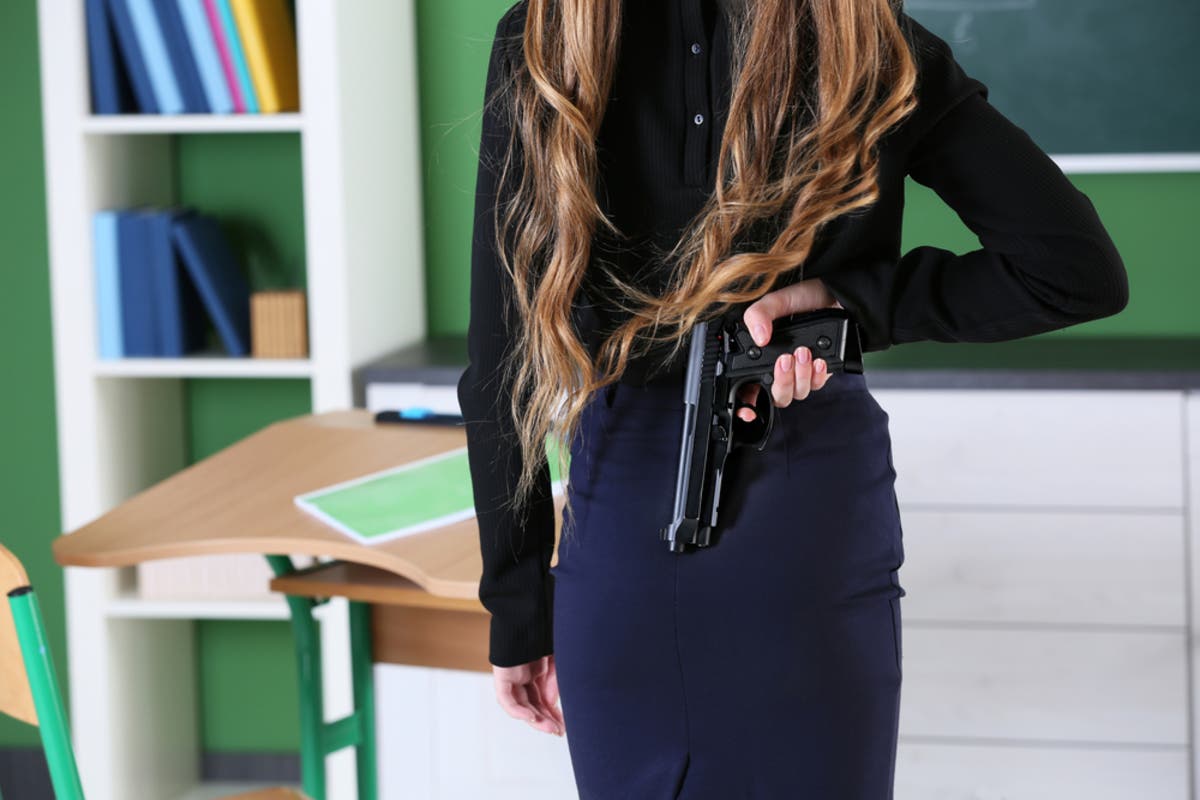
Should teachers be allowed to carry guns? The question has been rattling around in the heads of many Americans after President Trump said he was "very strongly" looking into the idea during a meeting last week with survivors of the Parkland high school massacre and others affected by school shootings.
The suggestion has been met with immense resistance and strong support. Patch looked around the country and reached out to several military veterans, cops and a former classroom teacher to get their input. There was no consensus among those interviewed by Patch, but some police officers — who are also veterans — and the educator strongly oppose the idea, while some veterans outside of law enforcement support it.
One Cape Cod, Massachusetts, police officer said he would be "terrified" if he responded to a school shooting where the teachers were armed. A U.S. Army veteran of Afghanistan, the officer asked that Patch not identify him because he was speaking as a private citizen and not for the police department that employs him.
Find out what's happening in Across Americafor free with the latest updates from Patch.
"The amount of training that is necessary to proficiently handle a weapon in a crisis is a problem even for police departments. Right now, I shoot twice a year with my department, and that's no where near enough," he said. "And you think you're gonna put a gun in the hand of an honors English teacher and think they're going to be effective when the shooting starts? No, absolutely not."
Some veterans Patch spoke with, however, liked the idea of allowing teachers who have already received training in pistol marksmanship to carry concealed handguns. One of them, Chris Van Bibber, a staff sergeant in the Marine Corps, said lots of military veterans have become teachers.
Find out what's happening in Across Americafor free with the latest updates from Patch.
"We have been trained with guns. We know how to deal with those situations," he said, noting that only highly trained teachers should carry concealed weapons and that no students or other teachers should know who is armed.
"I think teachers need to focus on teaching," Van Bibber said, and not "a gun and fear. They need to make a safe and fun environment for kids."
As he sees it, teachers who are well-trained in using handguns and dealing with crisis situations should be able to carry pistols if they want to do so.
Noah West, 33, a Marine Corps veteran who now works for Raytheon in Arizona, also said teachers should be able to carry concealed weapons in schools.
"We trust teachers to impart knowledge to the students," West said. "If you have a teacher you don't trust to protect those kids as well, they should not be teaching them."
Former classroom teacher Allison Strem said the idea of adding "guardian" to a teacher's job description is "abhorrent." Although teachers should be guardians when necessary, she says, Strem strongly believes they should never be put in a position where they have to defend children from bullets.
"We are already tasked with their educational, emotional and social well being and now we're the first to be thrown in to be their body guards," said Strem, 30, who previously taught history at a school for underserved districts in Chicopee, Massachusetts.
"I honestly told my parents that if a shooter were to come to my school, I wouldn't make it because I would have to save my kids ... That is a sentence that shouldn't even enter my mind, let alone leave my mouth to my family."
Amir Vaziri, 29, a Marine Corps veteran who formerly worked as a police officer in North Carolina, said arming teachers is a "stupid" idea.
"I could have beaten up half my teachers growing up," he said, noting that some troubled, violent students could arm themselves if they knew their teacher had a gun. Most concealed weapons aren't truly hidden because they create a bulge that students could easily see, he said.
Any funding put into arming teachers or ensuring they're well-trained, Vaziri said, would be better spent on bolstering the effectiveness of school resources officers.
"It's not the teacher's job to deal with that," he said. "It needs to be police."
The Cape Cod cop agrees. Police officers train in target identification, meaning they know not just how to shoot, but who to shoot. He said that if he were to enter a school in an active shooter case, armed teachers would just cause further confusion in an already chaotic situation.
"Add a bunch of teachers with guns that you don't know and who don't know how to respond or react and integrate with law enforcement in an active shooter situation, and you're fixing to have a cop shoot a teacher. Or a teacher shoot a cop," he said.
His comments reinforce the importance in intense and frequent training when it comes to dealing with active shooter situations.
Vaziri, who is politically conservative, said the same thing. If teachers aren't used to training with the police in such situations, "they're just a liability," he said. "Bad things happen quickly."
A 2016 article by the military and veteran news website Task & Purpose, "This Is Your Brain On War," digs into the effects of stressful situations, namely combat, on the human brain. It was written with the help of retired Lt. Col. Dave Grossman, who was once a psychology professor at West Point and wrote multiple books on how troops react to combat and killing.
Under stress, Grossman said in the Task and Purpose article, the body undergoes vasoconstriction in which blood moves to the core of the body. "That's why the face goes white," the article explains. “As the blood drains from the face, blood drains from the forebrain, and there’s no rational thought."
That's why troops are so well trained. In a stressful situation such as combat, when rational thought isn't in the mix, troops rely on that training. In a mental state when the "midbrain is in charge ... you’ll do what you’ve been trained to do — no more, no less," Grossman wrote. "You will do what you’ve been programmed to do — no more, no less."
A 2008 RAND Corporation study found that between 1998 and 2006, New York Police Department officers fired their weapons with only 18 percent accuracy while under fire, a number that jumped to only 30 percent when the suspects were not returning fire.
Ty Dockter, 31, a Marine veteran from Colorado, took a more practical view.
"Contracting a security guard from a company that handles required training would be a better option. They may be more apt to fight back and it would be considerably less expensive," Dockter said.
"You could spend the money you save on, oh, I don’t know, more teachers and making classroom sizes smaller," he said. "Then maybe train them on how to encourage students to work through problems."
While Americans hold vastly opposing views on whether guns belong in schools, there is widespread agreement on one thing: America's children need to be protected. The unanswered question is: How?
Article image via Shutterstock
Get more local news delivered straight to your inbox. Sign up for free Patch newsletters and alerts.