Community Corner
Two-Thirds Of Millennials Can't Say What Auschwitz Is: Study
The new survey says nearly half of Americans can't name a single concentration camp or ghetto in Europe during the Holocaust.


NEW YORK, NY — Two-thirds of Millennials cannot say what Auschwitz is and more than one in five of them either haven't heard of or weren't sure they'd heard of the Holocaust, according to a new study released on Holocaust Remembrance Day.
The survey, released on Thursday by the organization Conference on Jewish Material Claims Against Germany, also says more than four in 10 Millennials believe that no more than 2 million Jews were killed during the Holocaust. Around 6 million were killed.
Among the other key findings:
Find out what's happening in Across Americafor free with the latest updates from Patch.
- Nearly half of Americans, 45 percent, can't name a single concentration camp or ghetto in Europe during the Holocaust. This percentage was 49 percent amongst Millennials.
- Most Americans, 80 percent, have not visited a Holocaust museum.
- Most Americans, 58 percent, believe something like the Holocaust could happen again.
- Seven out of ten Americans say fewer people seem to care about the Holocaust than they used to.
Greg Schneider, executive vice president of the organization, said in a release that the study highlights how important it is to teach kids about the Holocaust in schools.
“There remain troubling gaps in Holocaust awareness while survivors are still with us; imagine when there are no longer survivors here to tell their stories," Schneider said. "We must be committed to ensuring the horrors of the Holocaust and the memory of those who suffered so greatly are remembered, told and taught by future generations.”
Find out what's happening in Across Americafor free with the latest updates from Patch.
Organization President Julius Berman says it's vital to start talking about the state of Holocaust awareness so that the atrocities aren't repeated. He called the lack of basic knowledge about the genocide alarming.
Data for the survey, titled the "Holocaust Knowledge and Awareness Study," is from a representative sample of 1,350 American adults via landline, cellphone and online interviews. Respondents were selected at random and constituted a demographically representative sample of America's adult population. It was conducted from Feb. 23-27.
Matthew Bronfman, a board member of the Conference on Jewish Material Claims Against Germany, which commissioned the study, told The New York Times that the long passage of time means the Holocaust simply isn't prominent in peoples' minds anymore.
“As we get farther away from the actual events, 70-plus years now, it becomes less forefront of what people are talking about or thinking about or discussing or learning,” Bronfman said. “If we wait another generation before you start trying to take remedial action, I think we’re really going to be behind the eight ball.”
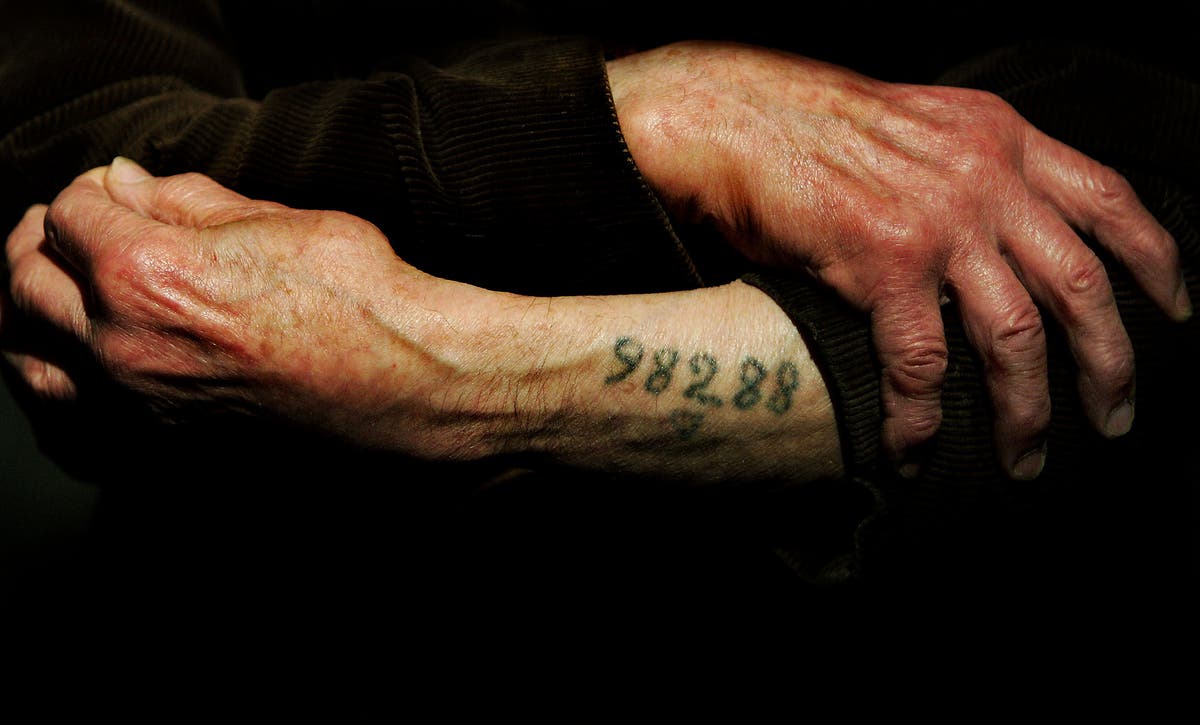
Photo credit: LONDON - DECEMBER 9: Auschwitz survivor Mr. Leon Greenman, prison number 98288, displays his number tattoo on December 9, 2004 at the Jewish Museum in London, England. Mr. Greenman O.B.E age 93 and a British citizen, spent three years of his life in six different concentration camps during World War II and since 1946 he has tirelessly recounted his life through his personal exhibition at the museum where he conducts educational events to all age groups. January 2005 will be the 60th anniversary of the liberation of the extermination and concentration camps, when survivors and victims who suffered as a result of the Holocaust will commemorated across the world. (Photo by Ian Waldie/Getty Images)
Get more local news delivered straight to your inbox. Sign up for free Patch newsletters and alerts.