Politics & Government
Who Is Amy Coney Barrett? A Look At Trump’s Supreme Court Pick
Following her selection by President Trump, Barrett, a Chicago-based court of appeals judge, now faces a bruising confirmation fight.


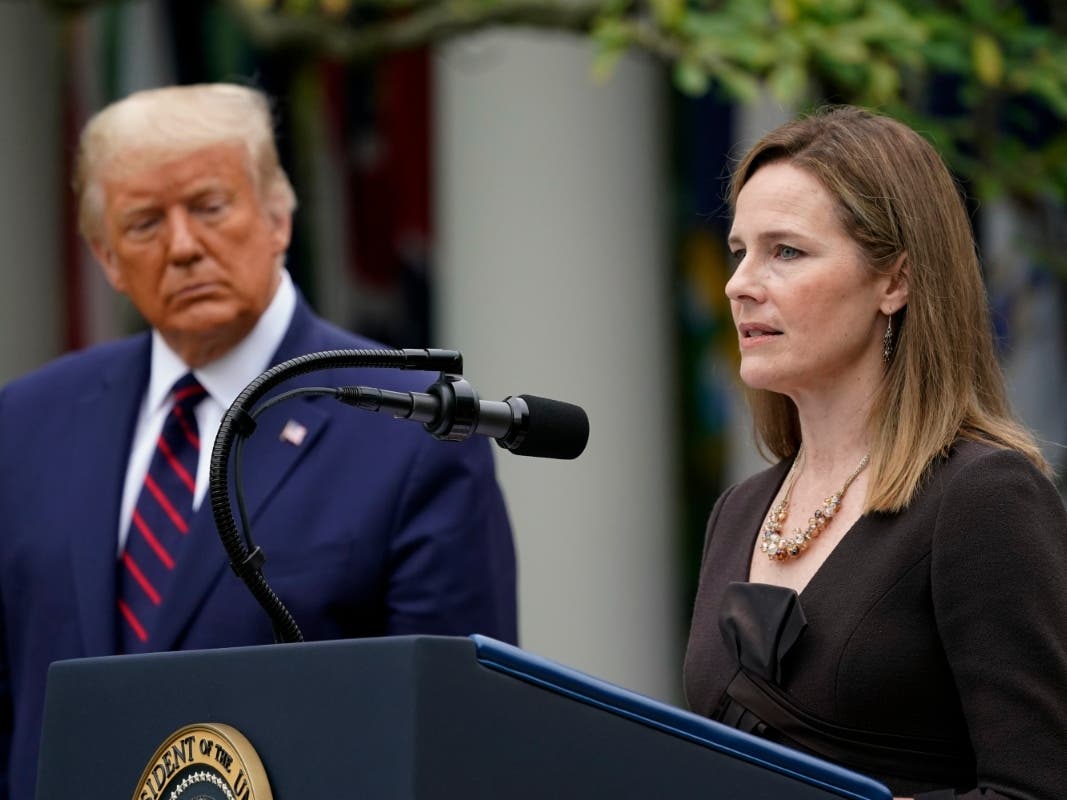

WASHINGTON, DC — Amy Coney Barrett, a federal appellate judge viewed as a reliable conservative on much-debated legal issues, is President Donald Trump’s pick to succeed Justice Ruth Bader Ginsburg on the U.S. Supreme Court.
Trump made the announcement during a Saturday news conference. In his remarks, Trump said Barrett will be "fantastic" and called her "imminently qualified for this job."
"She's not only a stellar scholar and judge, but a profoundly dedicated mother," Trump said. "Her qualifications are unsurpassed and her record beyond reproach."
Find out what's happening in White Housefor free with the latest updates from Patch.
Barrett’s nomination comes eight days after the death of Associate Justice Ruth Bader Ginsburg, who used her position on the Supreme Court to fight gender discrimination and unify the court's liberal wing. Ginsburg died Sept. 18 of complications of metastatic pancreas cancer.
Following Ginsburg’s death, Trump promised to put forth a female nominee to fill the vacancy. He also urged the Republican-controlled Senate to consider the pick without delay.
Find out what's happening in White Housefor free with the latest updates from Patch.
Barrett paid tribute to Ginsburg at the announcement ceremony.
"She not only broke glass ceilings, she smashed them," Barrett said. "For that, she has earned the admiration of women not only in this country, but across the world."
Barrett also acknowledged her "fellow Americans," saying the Supreme Court is "an institution that belongs to all of us."
"I assume this role to serve you," she said. "I never imagined that I would find myself in this position, but now that I am, I assure you I will meet the challenge with humility and courage."
Over the past week, Barrett emerged as front-runner on a list of potential female candidates. A devout Catholic, she is compared by religious conservatives and others on the right to conservative icon Antonin Scalia, the late Supreme Court justice for whom she clerked.
Liberals, however, say Barrett’s legal views are too heavily influenced by her religious beliefs.
Many fear a place on the nation’s highest court could lead to a scaling back of women’s rights.
According to The Associated Press, Barrett was asked in a 2017 White House questionnaire whether she always viewed abortion as immoral. Rather than answer the question directly, she said: “If I am confirmed (to the 7th Circuit), my views on this or any other question will have no bearing on the discharge of my duties as a judge.”
At just 48 years old, Barrett would be the youngest Supreme Court justice, meaning her tenure could last for decades.
Barrett’s Ascent Into Law
Raised in New Orleans, Barrett is the eldest child of a lawyer for Shell Oil Co., according to the AP. She earned her undergraduate degree in English literature in 1994 at Rhodes College in Memphis, Tennessee.
She and her husband, Jesse Barrett, a former federal prosecutor, both graduated from Notre Dame Law School. They have seven children, including two adopted from Haiti and one with special needs.
Barrett first made her mark in law primarily as an academic when she began teaching at Notre Dame at age 30.
Before joining the Notre Dame faculty, Barrett clerked for Scalia as well as Judge Laurence H. Silberman of the U.S. Court of Appeals for the D.C. Circuit. Barrett also worked as a trial lawyer and served as a visiting associate professor and John M. Olin Fellow in Law at the George Washington University Law School and the University of Virginia.
Barrett first became a judge in 2017 after Trump nominated her to the U.S. Court of Appeals for the 7th Circuit, a jurisdiction that covers Indiana, Illinois and Wisconsin.
Barrett marks Trump’s third selection to the high court. She was considered a finalist in 2018 for Trump’s second nomination, which eventually went to Brett Kavanaugh after Justice Anthony Kennedy retired.
Her Conservative Record
President Trump is no doubt hoping Barrett’s conservative record will energize his base just weeks before Election Day.
Barrett’s personal qualities are viewed favorably by conservatives across the country, and conservative groups lauded Trump’s choice days before it was officially made.
“She is the perfect combination of brilliant jurist and a woman who brings the argument to the court that is potentially the contrary to the views of the sitting women justices,” Marjorie Dannenfelser, president of anti-abortion political group Susan B. Anthony List, said of Barrett in an interview with the New York Times.
“Her religious convictions are pro-life, and she lives those convictions,” Judge Patrick J. Schiltz, a longtime mentor and a U.S. district judge in Minnesota, also told the Times. “The question of what we believe as a religious matter has nothing to do with what we believe a written document says.”
During Barrett’s 2017 confirmation, Sen. Dianne Feinstein accused her of allowing religion to guide her thinking on law. The California Democrat told Barrett, according to AP, “the conclusion one draws is that the dogma lives loudly within you.”
Barrett, however, disagreed. She told Feinstein that “her views had evolved” and judges shouldn’t “follow their personal convictions in the decision of a case,” AP added.
Jay Wexler, a Boston University law professor who clerked for Justice Ruth Bader Ginsburg alongside Barrett, told the Chicago Tribune in 2018 that Barrett was “very, very smart,” and “not at all ideological.”
“I take her at her word that she will try as hard as anyone can to bracket the views she has as she decides cases,” Wexler added.
Prior to the 2017 vote to confirm Barrett, The New York Times reported that she was a member of a group called People of Praise. Group members, the Times said, “swear a lifelong oath of loyalty to one another, and are assigned and accountable to a personal adviser.”
The group also “teaches that husbands are the heads of their wives and should take authority over the family,” the Times added, quoting legal experts who worried that such oaths “could raise legitimate questions about a judicial nominee’s independence and impartiality.”
The Senate eventually confirmed Barrett in a 55-43 vote, with three Democrats joining the majority.
During the three years she spent on the appellate bench, Barrett was involved in at least one abortion-related case, AP reported.
In that case, Barrett joined three conservative judges to ask that a 2018 ruling by the 7th Circuit Court of Appeals be tossed and for the full court to rehear the case. The ruling had declared unconstitutional an Indiana law requiring the burial of fetal remains after an abortion or miscarriage.
The law, signed by then-Gov. Mike Pence, also barred abortions on the basis on the race, sex, or disabilities of the fetus.
While they didn’t have the votes to force a rehearing, according to AP, Barrett and the other judges issued a joint dissent on the rehearing decision, suggesting they thought the Indiana law was constitutional.
When Barrett’s name first arose in 2018 as a possible Trump pick, even conservatives worried her sparse judicial record made it too hard to predict how she might rule, according to AP. Three years later, AP added, her judicial record includes the authorship of about 100 opinions and several dissents that display Barrett’s clear and consistent conservative bent.
Barrett has long displayed a fondness for "originalism," a mode of interpreting the Constitution in which justices try to decipher original meanings of texts when assessing if someone’s rights have been violated.
Many liberals oppose the approach, saying it is too rigid and doesn’t allow the Constitution to change with the times.
This came into play during a 2019 dissent in a gun rights case in which Barrett argued a person convicted of a nonviolent felony shouldn’t be automatically barred from owning a gun. All but a few pages of her 37-page dissent were devoted to the history of gun rules for convicted criminals in the 18th and 19th centuries, according to AP.
Barrett now faces an all-but-certain battle leading up to her possible confirmation.
Just hours following the announcement of Ginsburg’s death, Senate Majority Leader Mitch McConnell — who refused to allow a vote on President Barack Obama's nominee to replace Justice Antonin Scalia on the Supreme Court four years ago — announced that Trump's nominee “will receive a vote on the floor of the United States Senate.”
The statement caused immediate outrage among Democrats, who accused McConnell of hypocrisy and urged the Senate to wait until the outcome of November's presidential election before considering a replacement for Ginsburg.
If confirmed, Barrett wouldn’t be the only justice with little prior experience as a judge.
John Roberts and Clarence Thomas spent less time as appellate judges before their Supreme Court nominations, and Elena Kagan had never been a judge before President Barack Obama nominated her in 2009.
Typically, a Supreme Court justice confirmation drags on for months. In this case, however, Republicans will most likely try to turbocharge the pace to lock in Barrett before the Nov. 3 election.
Because Republicans control the Senate and its Judiciary Committee, which holds confirmation hearings on the president’s judicial nominees, Democrats are largely helpless in delaying the vote.
Get more local news delivered straight to your inbox. Sign up for free Patch newsletters and alerts.