Community Corner
9/11 Aftermath At Pentagon Recalled By Former Deputy Police Chief
A former Arlington deputy police chief who set up the incident command at the Pentagon after 9/11 spoke in Falls Church on Saturday.


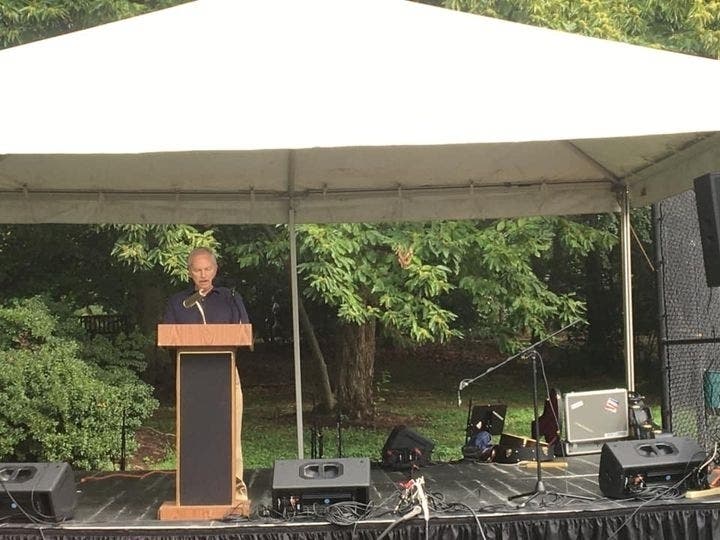
FALLS CHURCH, VA — While Saturday brought the community together for the 45th annual Falls Church Festival, it was a somber occasion as it coincided with the 20th anniversary of the 9/11 terrorist attacks.
Falls Church Mayor David Tarter recalls he first realized the magnitude of 9/11 when he heard about the first responder deaths: 343 firefighters and 71 police officers at the World Trade Center. In all, there were 2,977 victims of 9/11, including 2,753 at the World Trade Center in New York City, 184 at the Pentagon in Arlington, Virginia, and 40 aboard United Flight 93 that crashed near Shanksville, Pennsylvania.
To open the Falls Church Festival, Tarter asked for a moment of silence to honor the victims.
Find out what's happening in Arlingtonfor free with the latest updates from Patch.
"Although today is a fun day for our community, it also marks a solemn occasion: the 20th anniversary of the 9/11 attacks," said Tarter. "A day that will be etched in our minds for as long as we live. A day when 2,977 innocent lives were lost in an instant and families shattered forever."
Joining the festival as a guest speaker was Steve Holl, former deputy police chief for the Arlington County Police Department. He oversaw the Arlington Police response to the Pentagon after a hijacked passenger plane hit the Department of Defense headquarters on Sept. 11, 2001.
Find out what's happening in Arlingtonfor free with the latest updates from Patch.
Falls Church Police Chief Mary Gavin, who responded to the Pentagon as a captain at the Arlington County Police Department, said Holl set up the incident command structure for the 9/11 response.
"This is the man that led us through the Pentagon response. Not only the response but the crisis management and the recovery and the resilience after the fact," said Gavin.
Holl opened his remarks by paying tribute to all of the 9/11 victims: those at the World Trade Center, those aboard Flights 11 and 175, those at the Pentagon and aboard Flight 77, and those aboard Flight 93 who fought hijackers, causing the plane to crash near Shanksville, Pennsylvania rather than the intended target in DC. He also noted the 9/11 deaths continue to rise due to cancers and other diseases from exposure to dust and fumes from the attacks.
Holl gave credit to the civilians and military working for the Pentagon as the first ones responding to the attack.
"They immediately went into action to save those that were injured and those who were trapped by debris and confused by the smoke and the dust," said Holl.
Firefighters were faced with battling the fire after the hijacked plane crashed into the Pentagon. Holl noted that the fire in the Pentagon wasn't completely put out until over a day after the attack. Not only was the fire exacerbated by the plane fuel but also by the Pentagon's roof insulation made of horse hair.
"The firefighters did an absolutely heroic job in rescuing people and putting out the fire," said Holl.
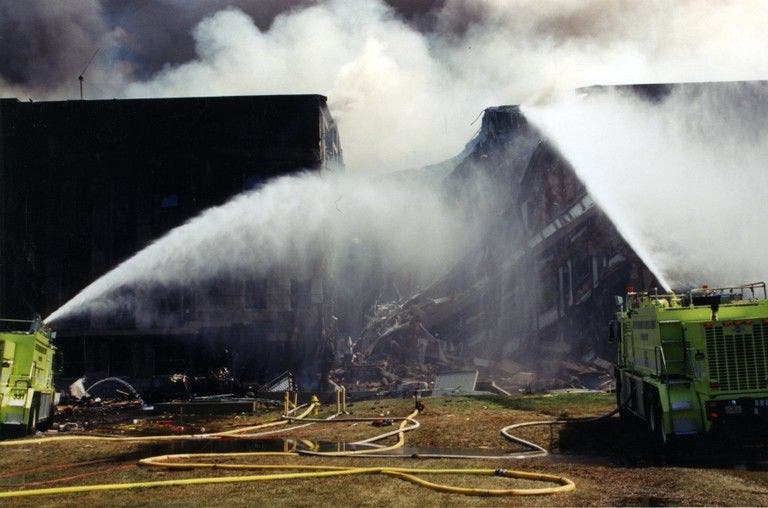
Arlington Police assisted with traffic control, evidence collection, security, escorts for critical supplies and victims' families, and debris searches coordinated with the U.S. Army.
"The first day or two, we did all of this with transmissions frequently over the radio repeating a warning 'unauthorized plane approaching the area: evacuate, evacuate, evacuate,'" said Holl. "And I remember looking up at the overpass that we were sheltered under and wondering would that protect us against an airliner? Fortunately, we never had to find that out."
Holl remembers a few other things police officers experienced the day of Sept. 11. When the Sept. 11 attacks happened, school resource officers had responded to schools in case some parents could not pick up their children.
He also remembers several officers stationed a mile from the Pentagon spotted Flight 77 before it crashed into the Pentagon. The officers realized the plane was at a low altitude and was on the wrong path if it was heading to Reagan National Airport.
"The plane was so low, that one officer could look up and see the reflection of the houses that the plane was flying over on the bottom of the fuselage," said Holl. "The other officer looked up and saw the faces of the passengers as they looked out the windows."
But one of the most striking memories was what happened to an American flag from the command post at the Pentagon. An officer suggested to Holl that an American flag be flown at the command post. Holl agreed and got an officer to bring a flag.
The flag was raised at the Arlington police command post, located at Washington Boulevard over Interstate 395. After it was flown for about two weeks, police initially planned to fold it up and display it at police headquarters. However, a police captain's neighbor who was a Navy commander suggested it be sent to Norfolk to be sent aboard a Navy aircraft carrier. That carrier headed to the Middle East, where airstrikes were starting against Al-Qaeda.
"The Navy flew that flag from the mast for several days while those strikes started," said Holl.
Holl also shared some of the ways others stepped up to help or showed support for first responders in the aftermath of the Pentagon attack. Search and rescue teams trained to respond to building collapses helped recover victims and search the debris. Military spouses at Fort Myer set up a line for families to call about their loved ones at the Pentagon. The U.S. Army Band staffed a credentialing tent that coordinated who got access to the Pentagon.
The aftermath of the attack also saw a McDonald's pop up in the Pentagon south parking lot, with the tall golden arch and all, to feed first responders. In typical corporate American fashion, a Burger King soon popped up. The North Carolina Men's Baptist Church also set up a tent to feed hundreds of people at a time.
John Deere responded by halting its normal production so it could make Gators to send to the Pentagon. Holl says those Gators were used to carry people and supplies around the Pentagon at least a month.
The community showed support in other ways. People brought homemade food and water, cards and posters that were displayed along Arlington National Cemetery.
One of those posters stood out the most to Holl. It read "They were heroes, but now they're angels."
Despite the attack's extensive damage to the west side of the Pentagon, the damaged portion was repaired and operational one year later: Sept. 11, 2002.
"But the memories of that day and the sadness they bring will never heal," said Holl.
SEE ALSO:
- Arlington Remembers: 'Plane Into Pentagon. All Help Respond Now.'
- Arlington Remembers Lives Lost 20 Years After Attack On Pentagon
- Fairfax County Marks 9/11 At Fire Station Among First To Respond
- D.C. Police Officer Recalls Recovering Bodies On 9/11 At Pentagon
- 9-11 Remembered: A Day That Changed DC, NoVA And The World
- 9/11 Memorial Stair Climb Completed By Firefighter Recruits
- 'Tower Of Light' Display At Pentagon To Honor 9/11 Victims
Get more local news delivered straight to your inbox. Sign up for free Patch newsletters and alerts.