Politics & Government
Arlington Board Backs SPARC Budget Request For Adults With Disabilities
The Arlington County Board agreed to support SPARC's state budget request with amendment to legislative priorities after a presentation.


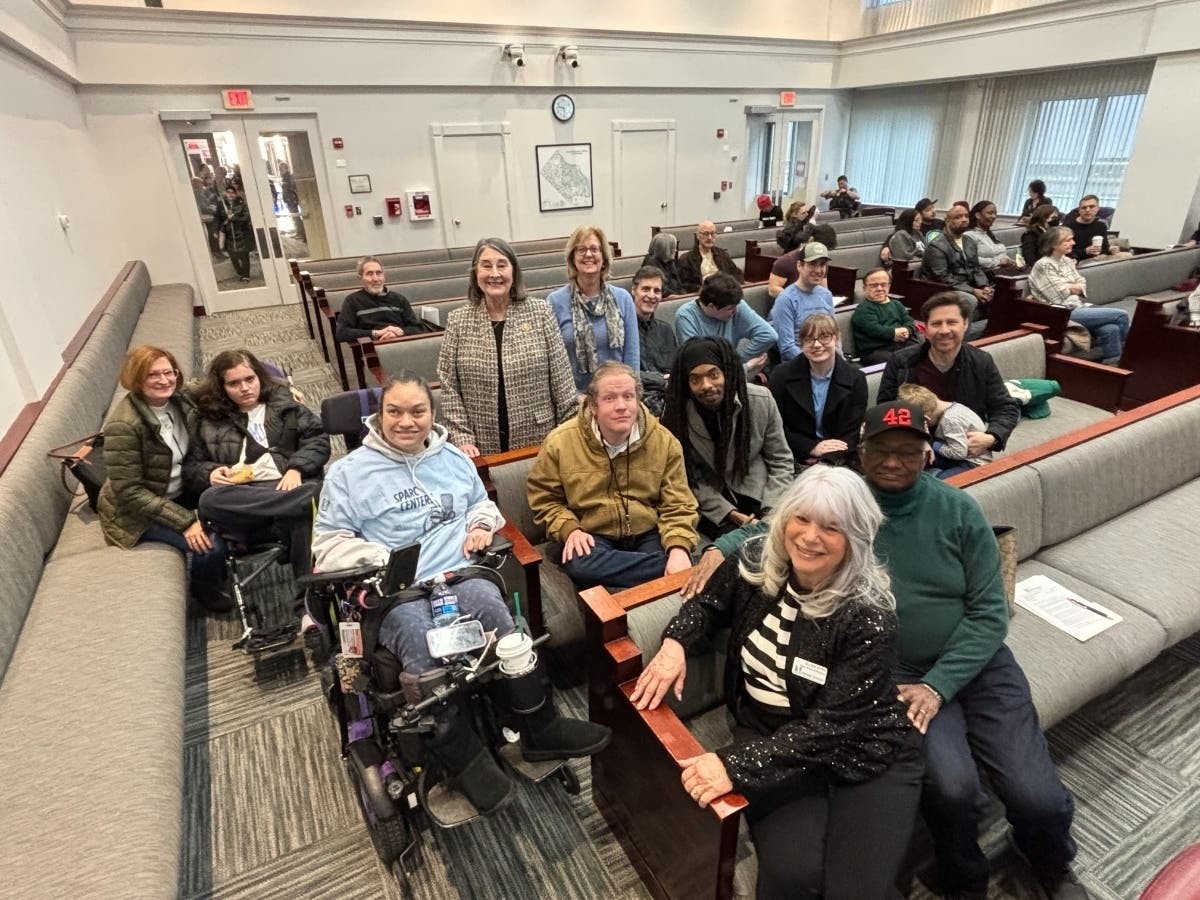
ARLINGTON, VA — The Arlington County Board agreed to send a letter of support to the state legislature for SPARC's budget request. The board will also add SPARC's budget amendment to its legislative priorities. This decision followed a presentation by SPARC leaders and participants on Saturday, Feb. 21, regarding the importance of supporting the non-profit's state funding request.
SPARC is a non-profit organization that provides day programs for adults with severe and multiple disabilities. These adults require one-to-one support for daily living activities and are unable to work. SPARC operates centers five days a week in various locations, including Arlington, Fairfax, and Loudoun counties.
SPARC CEO Debi Alexander thanked the board for its support. Alexander stated, “Because of Arlington County, SPARC operates every Tuesday and Thursday at the Arlington Mill Community Center — and that partnership is life-changing.” She added that without programs like SPARC, the adults served are at significant risk of isolation, regression, and institutionalization. Alexander noted that the partnership allows participants to experience learning, friendship, community engagement, and dignity.
Find out what's happening in Arlingtonfor free with the latest updates from Patch.
SPARC's budget amendment is currently before the Virginia General Assembly, carried by Del. David Reid (D-Loudoun) and Sen. Jennifer Boysko (D-Herndon). The organization provides services at approximately $15,900 per person per year, compared to roughly $58,000 per person per year for more restrictive alternatives.
"Arlington County’s commitment to equity — reflected in your adopted Equity Resolution and focus on ensuring all residents have access to opportunity — is evident in this partnership," Alexander said. “Your leadership demonstrates that inclusion is not aspirational; it is operational.”
Find out what's happening in Arlingtonfor free with the latest updates from Patch.
SPARC's work is intended to advance the Americans with Disabilities Act, which ensures individuals with disabilities have the right to live in the most integrated setting possible. Virginia remains under a federal injunction for not meeting these obligations, and community-based programs like SPARC are presented as part of the solution.
SPARC has asked Arlington County to provide aggregate data to identify residents who qualify for its specialized services. The organization also requested that the Arlington Community Services Board refer qualifying residents to SPARC. These steps aim to prevent adults with complex needs from being excluded from community-integrated programs that operate outside the Medicaid billing system. Joining Alexander at the presentation were SPARC Board Chair Ellen Dyke, SPARC Board Member Gaston Araoz, former Secretary of Education Jim Dyke, and SPARC staff, participants, and their parents who reside in Arlington.
Here is the text of the letter Board Chair Matt de Ferranti sent in support of SPARC's legislative efforts.
Dear Chair Lucas, Chair R. Creigh Deeds, and Members of the Committees:
The Arlington County Board writes in strong support of the proposed budget amendment to
increase funding for Specially Adapted Resource Clubs (SPARC) in Item 300, Paragraph S of the
2026–2028 Biennial Budget, carried by Senator Boysko.
Virginia remains under federal court supervision pursuant to the Permanent Injunction entered in
United States v. Virginia, which requires the Commonwealth to provide services to individuals
with developmental disabilities in the most integrated setting appropriate, consistent with the
Americans with Disabilities Act and Olmstead v. L.C.
Compliance is not theoretical. It is measured in whether real people are living connected and
dignified lives in their communities. At SPARC’s Arlington center, that compliance has a name
and a story:
- Like Jack, a non-speaking adult who communicates using an AAC device alongside his DSP of fifteen years. At SPARC, Jack chooses his activities each day — art, games, community walks — exercising independent decision-making in a structured, integrated setting. His participation reflects exactly what the ADA’s integration mandate envisions: meaningful access to community life, not passive supervision.
- Like Audrey, one of the youngest participants, who entered SPARC facing significant emotional and sensory challenges. Through structured art therapy and adaptive sensory programming, she is developing emotional regulation, confidence, and social connection in community-based settings. Without this type of individualized day support, many adults like Audrey face isolation or regression — outcomes the Permanent Injunction is designed to prevent.
- Like Tom, a 42-year-old man on the autism spectrum who works part-time but lacks the endurance and social stability to maintain full employment. In traditional settings, Tom’s anxiety is misunderstood. At SPARC, he finds structured peer engagement without stigma a place to build resilience, routine, and authentic community inclusion.
These are not anecdotal successes. They are measurable examples of integrated day service
delivery for individuals with complex needs — precisely the population the Court has identified
as underserved.
The proposed amendment does two critical things:
- It increases funding to reflect the true cost of sustaining SPARC’s integrated, participantdirected model.
- It directs DBHDS to include SPARC participant data in reporting under the Permanent Injunction, ensuring that the Commonwealth receives compliance credit for services it is already delivering.
SPARC delivers this model at approximately $15,900 per participant annually — substantially
lower than the estimated $58,000 per participant cost under provider-directed Medicaid day
services. The amendment therefore advances civil rights compliance while remaining fiscally
responsible.
The Permanent Injunction requires the Commonwealth to demonstrate measurable increases in
integrated day participation and to collect data on individuals with complex medical and adaptive
needs. Programs like SPARC are not supplemental — they are central to meeting those
obligations. Behind every compliance term is a person like Jack choosing his day, Audrey
finding her emotional footing, or Tom experiencing authentic social belonging.
For these reasons, we respectfully urge inclusion of this amendment in the final budget.
Sustaining SPARC is both a civil rights obligation and a sound public investment.
Thank you for your continued leadership in advancing dignity, inclusion, and community
integration for all Virginians.
Sincerely,
Matt de Ferranti
Chair, Arlington County Boar
Get more local news delivered straight to your inbox. Sign up for free Patch newsletters and alerts.