Health & Fitness
COVID 2-Year Anniversary: See How Virginians Coped With Pandemic
Virginians have a more positive view of how state and local governments handled COVID-19 in the two years since a pandemic was declared.


VIRGINIA — Monday marks the two-year anniversary of Virginia's first known case of the coronavirus. Over the past two years, nearly 19,000 Virginia residents have died from COVID-19 and more than 1.6 million have tested positive.
During the second year of the pandemic, vaccines were rolled out across the country. The only age group still not eligible to get vaccinated is children under 5.
The delta and omicron variants of the coronavirus sent cases, and hospitalizations, soaring again, starting last summer and continuing into early February.
Find out what's happening in Arlingtonfor free with the latest updates from Patch.
But as cases and hospitalizations have plummeted over the past month, Virginia, like other states, has removed most restrictions put in place to prevent the spread of the virus.
The first coronavirus case in Virginia was confirmed March 7, 2020. A U.S. Marine at Fort Belvoir, who had returned from overseas travel, tested positive for the coronavirus.
Find out what's happening in Arlingtonfor free with the latest updates from Patch.
While Monday is the two-year anniversary of the first coronavirus case in Virginia, next Friday, March 11, will mark the two-year anniversary of when the World Health Organization declared coronavirus a pandemic.
Patch created a survey to ask readers how they have coped since the start of the pandemic and what they have mourned and celebrated. The survey was not meant to be a scientific poll, with random sampling and margins of error, but is meant only to gauge the sentiments of our readers in an informal way.
In the survey, Patch asked readers in Virginia to reflect on the government response to the pandemic. Readers had a more positive view of how their local and state governments handled it compared with the federal level.
Everyone was scared at the start of the pandemic, not knowing the correct measures to take to protect themselves, a survey respondent said. The information provided by the government in the early days was "maybe a little over the top at first, but who knew then what we were up against. Some people needed to be told for the safety of all," the reader said.
"The government should have said, 'We are all in this together and we need to help each other stay healthy.' Instead, it was an anti-mask, anti-vax political mess," another reader said.
Virginia was far more relaxed with its mask mandates in settings such as gyms compared to the District of Columbia and Maryland, according to a survey respondent. The reader said mask mandates should have been more consistent across the D.C. metro area.
The survey found that 41 percent of readers characterized the local response to the pandemic as mostly positive, and 18 percent said it was very positive. A total of 25 percent of respondents said the local response was mostly negative or very negative.
In Virginia, 37 percent of respondents said the state response to the pandemic was mostly positive, followed by 18 percent who though the state's response was very negative. Fifteen percent said the state's response was very positive.
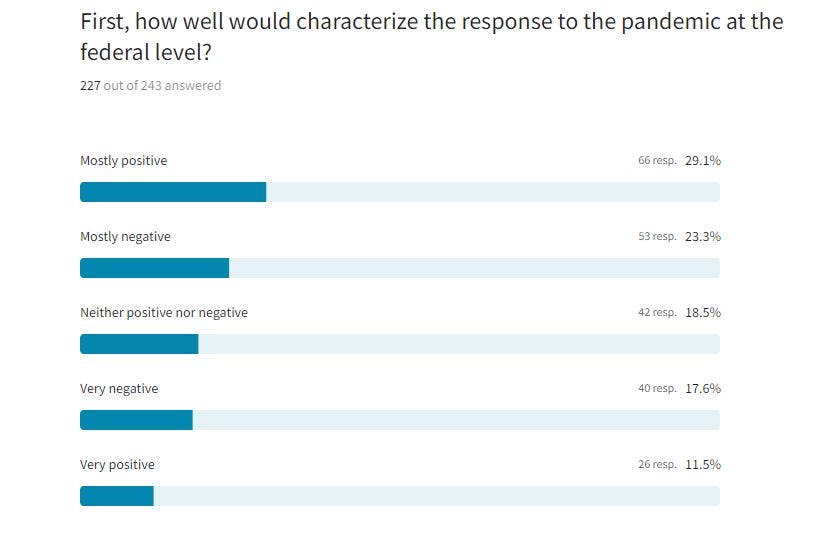
The federal government received the lowest ratings. Twenty-nine percent of survey respondents said the federal response to the pandemic was mostly positive, followed by 23 percent who said it was mostly negative, 18 percent who said it was very negative and 12 percent who said it was very positive.
'He Died Alone'
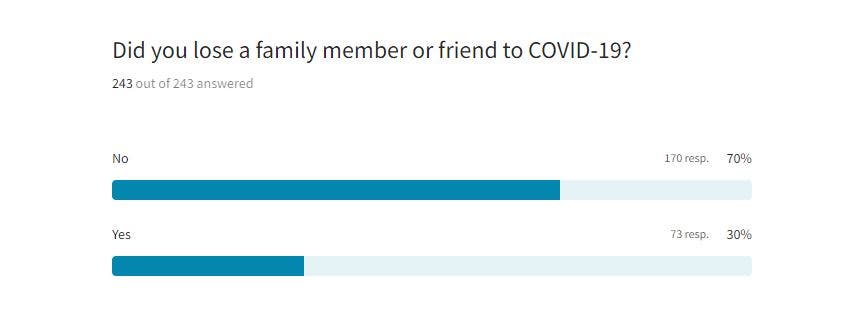
Thirty percent of the respondents said they had a family member who died of COVID-19.
Most of the respondents — 83 percent — said they did not get infected with COVID. Among the respondents who did get the virus, 50 percent had minor symptoms, 43 percent had moderate symptoms, and 7 percent had severe symptoms.
Only two respondents said they were hospitalized with COVID-19.
A reader said a coworker, who was unvaccinated, died from COVID-19. He was only 45 and had two daughters. “I was heartbroken going back into the office and seeing his seat,” the reader said.
Another reader said her husband died during the pandemic. Although her husband did not have COVID-19, she was unable to visit him in the hospital because of visitor restrictions due to the pandemic.
A reader recalls testing positive for COVID-19 on April 28, 2020. “I got COVID mild enough to survive, but bad enough to be briefly hospitalized when my breathing dipped below 90 percent at the same time that my pulse was near 200 beats a minute,” she said.
Since that stay in the hospital, she has struggled with COVID symptoms, ranging from extreme fatigue to blurred vision, brain fog, and numbness and tingling in her arms and legs.
“I actually finally started to get some relief late last fall only to be hit with the omicron variant on Christmas Day, setting all symptoms pretty much back to day 1,” she said. “I was vaccinated, but not yet boosted.”
As a “COVID long-hauler,” the reader said she has been unable to do the work she was doing before, and on too many days, unable to do much of anything at all.
The reader and her husband moved from Annapolis to Old Town Alexandria in January 2021, with hopes that she could continue the type of volunteer work that she did in Annapolis.
“As it turns out, I am not able to do much of anything,” she said.
Another reader said she came close to losing her mother to COVID-19 early in the pandemic. While her mother was able to leave the hospital, the long-term effects of the disease mean she now needs oxygen support around the clock.
A reader’s youngest brother died from COVID-19 in the early part of the pandemic. He lived in Brooklyn and had to be taken to the hospital by ambulance. The family was not allowed to visit him. “On the fourth day, he died alone,” the reader said.
“His daughter was traumatized and can't accept the death of her father,” she said.
A reader who caught the omicron variant was fully vaccinated. “So my experience was much like a bad flu and minor in comparison to so many others affected by earlier variants,” the reader said.
Mask Mandates And Vaccines
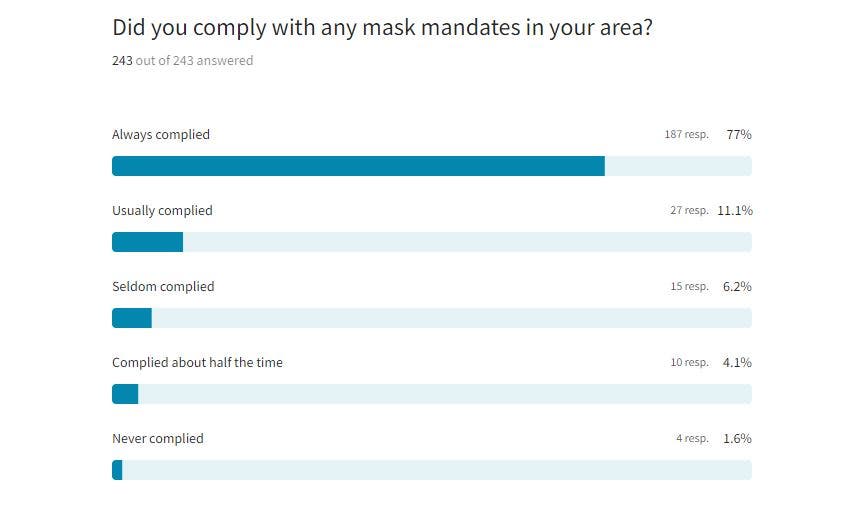
In the survey, 77 percent of readers said they always complied with mask mandates in their communities. Only 2 percent said they never complied. Sixty-five percent of the survey respondents said they still wear a mask in public settings.
Ninety-two percent said they have received at least one dose of the coronavirus vaccine.
Among the 8 percent of respondents who did not get a vaccine, one said they were afraid of the potential side effects. That person said they still feel fine today.
Another said they skipped the vaccine because they believe in natural immunity. One respondent said she avoided getting a vaccine because she believes they are still in the experimental stage, while another said their immune system and overall health made a vaccine unnecessary.
Among the respondents with children, 90 percent said they have gotten their children vaccinated or plan to get them vaccinated, for children under 5.
“Most members of my family only chose to get vaccinated in order to comply with the guidance at the time,” a reader said. “We were (and still are) not at serious risk from a severe COVID infection. We hoped it would help our community get back to normal, but we were so very wrong.”
Another reader said that once a vaccine is approved for children under 5, their children will be vaccinated.
Education In The Time Of COVID
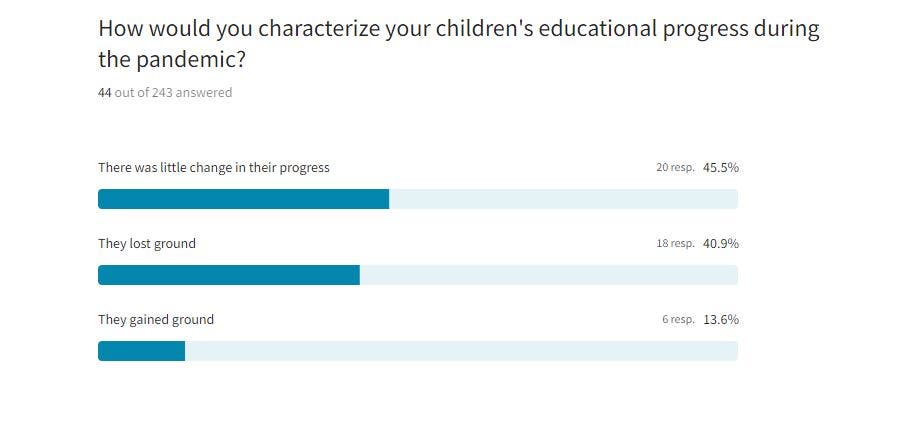
Among the parents who responded to the survey, 46 percent said their children’s educational progress changed little during the pandemic, while 41 percent said their children lost ground. Thirteen percent of parents said their children gained ground in their education during the pandemic.
"I know my second grader lost/didn't gain half a year of education and our middle schooler suffered mentally," a parent said in a response to the survey. "They have both recovered and gained what was lacking, even if the older child would like to stay home. It's better being in a group environment."
A reader said their fourth-grader's education plummeted during remote learning. "For example, her reading level went from several grade levels above to two grade levels below," the reader said.
Another reader found that their son learns well in an online environment. "It allows him to be more focused and manage his own time. He participates, is responsible and diligent in getting work finished. His teachers rave about him," the reader said.
In the survey, 51 percent said one parent typically did most of the supervision when their children were getting schooled remotely during the worst parts of the pandemic. Thirty-nine percent said both parents shared the supervision of their children's remote learning equally. Another adult in the home who was not a parent handled the education supervision for 7 percent of respondents.
“No adult supervised their work,” a parent said. All three of the reader's children are in middle school and high school. "As long as they get good grades, no adults supervise them," the reader said.
Another reader said their children did not get the supervision they needed during virtual learning because both parents were working full time.
Employment And Finances
Among the readers who responded to the Patch survey, 50 percent said they worked continuously through the pandemic and 50 percent did not.
For the people who did not work continuously, 44.2 percent said it was because they quit their job for reasons unrelated to the pandemic. Thirty-five percent were laid off as a result of the pandemic, and 12 percent quit their jobs over worries about the coronavirus.
Among the people who left their job during the pandemic, 76 percent said they retired, while 16 percent said they found another job and 4 percent started their own business.
Nearly all respondents — 96 percent — said their employer kept paying them throughout the pandemic.
A large majority of respondents — 70.1 percent — said they are not a front-line worker like a teacher, medical professional or service worker. About 9 percent said they are teachers and only 4 percent said they are service workers.
One of the teachers who responded to the survey said they quit their job to supervise their children when schools switched to remote learning. "I went back to teaching this year when schools opened back up," the reader said.
Another reader who quit their job as an executive in summer 2021 said it was somewhat related to the pandemic. "I was extremely burned out from making all of the decisions about our office without much direction — same as most responsible for any workplace," the reader said. "I moved to a role with less responsibility."
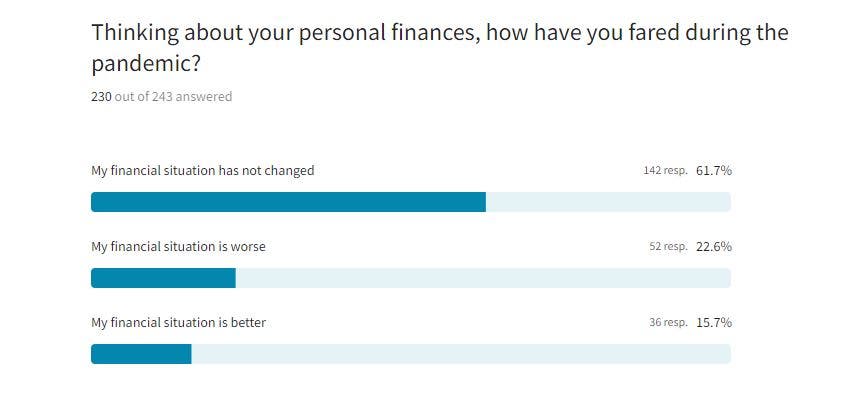
A majority of survey respondents — 62 percent — said their personal financial situation has not changed since the start of the pandemic two years ago. Nearly 23 percent said their financial situation has grown worse and 16 percent said their financial situation has improved.
A plurality of respondents — 35 percent — said they did not receive a stimulus check from the federal government. For those who did receive a stimulus check, 24 percent said they spent the entirety of the check, while 17 percent said they saved it all. Ten percent said they saved most of the money, but spent some of it.
In response to a question about how the recent bout of inflation has affected readers' financial situation, the average rating was 5.2 on a scale of zero being no impact and 10 being the worst impact. Seventeen percent of readers gave inflation a 5 rating on the 1 to 10 scale, followed by 15 percent who gave it an 8 rating and 12 percent who gave the impact of inflation a zero rating.
RELATED:
Get more local news delivered straight to your inbox. Sign up for free Patch newsletters and alerts.