Politics & Government
National Transportation Safety Board Issues Urgent Recommendations for Metro
NTSB calls for improving ventilation procedures during smoke and fire events in tunnels.

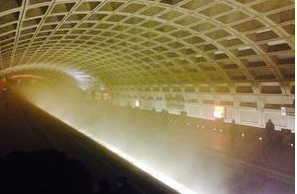
PHOTO of Metro by Lesley Lopez via Twitter
________________
The National Transportation Safety Board Wednesday issued urgent recommendations to the Federal Transit Administration, the Washington Metropolitan Area Transit Authority and the American Public Transportation Association calling for improved ventilation procedures during smoke and fire events in tunnels, according to a news release from the agency. The recommendations were made after the smoke incident at the L’Enfant Plaza Metro station incident that killed one and injured dozens more last month.
Find out what's happening in Arlingtonfor free with the latest updates from Patch.
Here’s more about those recommendations, from the release:
The NTSB is recommending a nationwide audit of transit agencies by the FTA to assess the state of tunnel ventilation systems, written emergency procedures for fire and smoke events, and training to ensure compliance with these procedures. Furthermore, the NTSB has recommended that the FTA verify that agencies are applying the best industry standards in maintenance and emergency procedures. Companion recommendations to APTA focus on similar issues.
Find out what's happening in Arlingtonfor free with the latest updates from Patch.
The NTSB also made three urgent recommendations directly to WMATA to address the safety issues that have come to light in the ongoing investigation into the Jan. 12, 2015 electrical arcing and smoke accident near the L’Enfant Plaza station in Washington, DC.
- Assess your subway tunnel ventilation system to verify the state of good repair and compliance with industry best practices and standards, such as those outlined in the National Fire Protection Association’s NFPA 130,® Standard for Fixed Guideway Transit and Passenger Rail Systems. ® (Urgent)
- Develop and implement detailed written tunnel ventilation procedures for operations control center staff that take into account the probable source location of smoke and fire, the location of the train, the best evacuation route, and unique infrastructure features; these procedures should be based on the most effective strategy for fan direction and activation to limit passengers’ exposure to smoke. (Urgent)
- As part of the implementation of the procedures developed in response to Safety Recommendation R-15-009, incorporate the use of the procedures into your ongoing training and exercise programs and ensure that operations control center staff and emergency responders have ample opportunities to learn and practice activating ventilation fans. (Urgent)
“Procedures for ventilation of smoke in emergencies can be critical, but they vary across systems, and in some systems are inadequate - as we have found in the present WMATA investigation,” said NTSB Acting Chairman Christopher A. Hart. “Although the investigation is ongoing, WMATA should immediately address these issues to prevent any chance of a recurrence, and other systems should be audited for similar problems.”
As part of the ongoing investigation, the NTSB found that the WMATA subway system has ventilation fans at strategic locations to remove smoke and heat from the tunnels. These fans can be operated in either a supply mode that pulls fresh air into the tunnels or stations or an exhaust mode that pulls air from the tunnels or stations to the outside. The fans can be operated either remotely from the WMATA Operation Control Center or locally from control panels located at the fans.
The investigation to date has revealed that WMATA does not currently have the means to determine the exact location of a source of smoke in its tunnel network. WMATA maintains no written ventilation procedures for smoke and fire events in the tunnel, and the ventilation strategy that WMATA implemented during the accident was not consistent with best practices.
The full safety recommendation letters are available at:
http://www.ntsb.gov/safety/safety-recs/recletters/R-15-007.pdf
http://www.ntsb.gov/safety/safety-recs/recletters/R-15-008-010.pdf
http://www.ntsb.gov/safety/safety-recs/recletters/R-15-011-012.pdf
Get more local news delivered straight to your inbox. Sign up for free Patch newsletters and alerts.