

CIVIL WAR TRAVELS WITH MS. REBELLE
Charleston – Part Two
Ms. Rebelle is continuing with our visit to Charleston, South Carolina earlier this year.Our first big outing was to Fort Sumter from the Point Pleasant side of Charleston. Since we were staying in Point Pleasant, it is a much shorter trip than the boat that leaves from the downtown Charleston area. The first view of the fort is of all the flags blowing in the wind. What a spectacular sight. The fort is sadly in ruins from all the shelling in the Civil War. Our trip was pretty close to the April 12, 1861 anniversary date of 152 years. On April 11, 1861 General P.G.T. Beauregard sent three aides, Colonel James Chestnut, Jr., Captain Stephen D. Lee, and Lieutenant A.R. Chisolm to demand the surrender of the fort. Negotiations failed and Union Major Robert Anderson held the fort for 34 hours before surrendering to the Confederates. Captain Abner Doubleday, who was second in command to Anderson, fired the first shot in defense of the fort. Edmund Ruffin took credit for the first Confederate shot but Lieutenant Henry S. Farley actually fired the first shot from Morris Island at 4:30 a.m. Since the Union was ill-equipped to return the fire, firing wasn’t begun for two hours. The fort was surrendered on April 13, 1861. General Anderson retained possession of the Union flag that flew over the fort when he left. It is now displayed in the museum on the premises. The Union soldiers evacuated on April 13th and boarded the Star of the West for New York City. It took the Union four years to take the fort back.
Find out what's happening in Centrevillefor free with the latest updates from Patch.
The fort was built following the War of 1812. Construction started in 1829 and was still unfinished in 1861 when the shelling began. New England exported 70,000 tons of granite to build up a sand bar at the entrance of Charleston Harbor. The brick structure is five-sided with walls five feet thick.
Unfortunately, the Park Service doesn’t allow a lot of time to look at everything in the fort. Only an hour was allotted to see the inside of the fort, the small museum, and walk the grounds. Park Rangers give talks on the aspects of the fort and answer questions. There is a gift shop on the premises.
Find out what's happening in Centrevillefor free with the latest updates from Patch.
Then and Now in Charleston
Touring around Charleston we came across several really old and beautiful buildings. The first one is the City Market. The market was first established in 1692 encompassing four city blocks from Meeting Street to Church Street. It was original called the Beef Market Building and was redesigned by Edward B. White in the early 1840s after burning down in 1796. If anyone has read Gone with the Wind, Scarlett O’Hara liked to go to the market to socialize and find out the gossip of the day. The building is all open sided with many stalls inside. The merchandise is taken in and out every day. There is just about anything you might want to buy sold in the building including food. The most famous item is the Gullah baskets woven by local African American Charleston women using a modified spoon to weave the designs. Bring your wallets though as they are quite expensive. The Confederate Museum is located on the Meeting Street side at 188 Meeting Street.
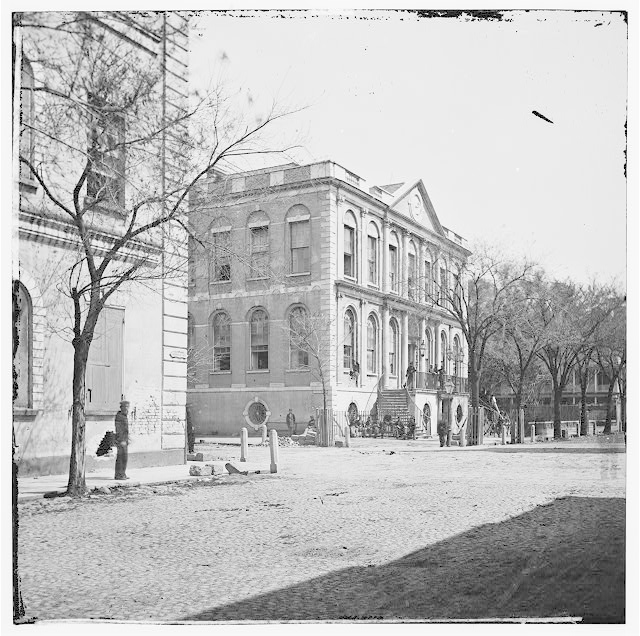
City Hall is another beautiful building located at the corner of Meeting and Broad Streets. This intersection is called the Four Corners of Law as the four buildings represent state, federal, municipal, and ecclesiastical law. Almost everything interesting is on Meeting Street in Charleston. The second floor of the building is still used for city government offices. Also on the second floor is a huge oil painting of General Pierre Gustave Toutant Beauregard. The general’s sword is on display as well as some other items belonging to him. The building was designed between 1800-04 by Gabriel Manigault in the Adamesque style. The round basement windows are unique to his style of design.
The Calhoun Mansion is also located on “guess where?” You’ve got it – 16 Meeting Street. The 35-room mansion was owned by Vice President John C. Calhoun who is buried at St. Phillips Episcopal Church Cemetery at 142 Church Street in Charleston. Calhoun is one of six or more famous people buried there including: Charles Gadsen, James Gadsen, Daniel Huger, Charles Pinckney (signer of the Declaration of Independence), Thomas Pinckney, and Edward Rutledge (signer of the Declaration of Independence). Even though John C. Calhoun accomplished quite a bit in his life, he was not eligible to be buried in the church side of the cemetery. Only people born in Charleston were eligible to be buried on the church side. Calhoun was born in Clemson so he is across the street from the church. The Calhoun Mansion was used in the TV mini-series North and South as the home of George Hazard, portrayed by James Read. The movie The Notebook was also filmed there.
St. Michael’s Episcopal Church is located at 17 Broad Street the intersection of Meeting Street. The steeple of the church is 186 feet above the street and visible in many of the old photos of Charleston during the Civil War. The weather vane atop the steeple is 7 ½ feet tall. The clock in the tower has kept the time in Charleston since 1764. George Washington worshipped there in May, 1791 in pew No. 43 (the Governor’s Pew), a large double pew in the center of the church. General Robert E. Lee worshipped there in the same pew in the 1860s. The eight famous bells made in 1794 in England for the church were sent to Columbia during the Civil War but were cracked in a fire there in 1865. Remnants of the bells were salvaged from the fire and sent to England to be recast. The bells still ring in Charleston. The pulpit is original and there are several beautiful stained glass windows in the sanctuary. The chancel stained glass window was crafted by Louis Comfort Tiffany in 1905 in the design of a blue sky with gold stars and a starburst.
Boone Hall Plantation is located in Mount Pleasant, SC at 1235 Long Point Road, a short distance from Charleston. The original house was from a land grant to Major John Boone in 1681. The current house was built in 1936 and was patterned after the original house which burned down many years ago. One of the most interesting things about Boone Hall is the long driveway with live oak trees bending towards each other and the hanging Spanish moss on them. Those of you who love North and South can just visualize the late actor, Patrick Swayze, riding down the lane at a full gallop as Orry Main. We spent most of the day there just enjoying this most beautiful place.
The Battery on East Bay Street is one of the most beautiful parts of the city. The mansions overlook Charleston harbor and have a view of Fort Sumter as well. Following the Civil War, Union General John Porter Hatch assumed military command of the city of Charleston and had his headquarters on South Battery Street from February-August, 1865. I am proud to say that he is “one” of my 385 graves and is buried in Arlington Cemetery.
One of our last visits in Charleston was to The Citadel incorporated in 1842. The campus is located at 171 Moultrie Street along the Ashley River. It reminded us a lot of the Virginia Military Institute in Lexington, VA. The building that resembles VMI the most has a red and white checkerboard on the courtyard of the building. I asked permission to walk inside but in true Southern tradition, a cadet must escort females into the diamond as they call it. So a nice young cadet took my arm and escorted me inside on the diamond. Pretty impressive I must say. The photograph shows the checkerboard pattern underneath the class ring for 2013. Four Confederate Civil War generals graduated from the Citadel – Ellison Capers, Micah Jenkins, Evander Law, and John Bordenave Villepigue. The Federal army took possession of the Citadel in 1865 and held possession until 1879. The Citadel reopened in January, 1882. 189 Cadets reported to the newly reopened Citadel on October 2, 1882.
The places listed above are just a few of the many things to see and do in Charleston. We did pretty well seeing all we could in two days with two travel days down there and back. If you go, you have to have some of the wonderful low country food – shrimp & grits come fast to my mind. We ate at the Hominy Grill which was wonderful. We had the best motel in Point Pleasant – the Quality Inn. The chef made such a spread every morning for breakfast including a large pan of grits and fresh biscuits or scones with everything else in between. It was wonderful. Ms. Rebelle had grits every day in Charleston. The motel prices are a little more reasonable across the Ravenel Bridge and no parking fees with quick access back into the city. It is definitely worth the trip.
NOTE: Ms. Rebelle’s hobby is travelling the country finding and honoring the graves of our 1,008 Civil War generals. So far I have located and photographed 385….169 Confederate and 216 Union.
Ms. Rebelle is a member of the Bull Run Civil War Round Table which meets every second Thursday of every month at 7 p.m. at the Centreville Regional Library. The public is invited to attend at no cost and visit the website www.bullruncwrt.org for additional activities (tours, etc.)