Health & Fitness
How Fairfax City Can Help Mason Improve It's Image
City policies are hampering George Mason University's efforts to overcome the commuter school reputation.

When talking about George Mason University, we often hear city officials cite the “Town-Gown Connection”. This is essentially a forum for the two entities to communicate any issues of policies that bridge between them. As an example, GMU held several meetings regarding the West Campus Connector project, and ended up changing the plans several times based on concerns from the city, the county, and the general public. It seems to me that The University is making on honest effort to maintain a positive relationship with the neighboring jurisdictions. But from a planning perspective, they are getting little in return.
Shedding the Commuter School Image
In 2010, Mason celebrating earning the designation of a “residential campus” by The Carnegie Foundation for the Advancement of Teaching because 1/3 of undergraduate students officially lived on campus. Despite this, it continues to hold the reputation of a commuter school because of the lack of student culture both on and off campus. There is also very little housing that is affordable or practical for students within walking or biking distance of campus, and the only adjacent commercial development is University Mall.
Find out what's happening in Fairfax Cityfor free with the latest updates from Patch.
These things are important because they contribute to quality of life for college environments. Recent University rankings have shown George Mason moving up the charts from and academic standpoint, but the social image is still very poor. From a residential standpoint, students who don’t live on campus are spread out around the region. From a commercial standpoint, there is no off-campus area for students to feel at home, while not in the confines of the campus environment. In essence, there is no “college town”.
Lost Opportunities
Find out what's happening in Fairfax Cityfor free with the latest updates from Patch.
In the 1997 Fairfax City comprehensive plan, the area along Chain Bridge Road at the south end of the city was proposed as mixed-use development with potential for joint development opportunities, such as a conference center, involving the University. This would have established a link between the University and downtown Fairfax, allowing for that college town environment, but not focusing it entirely on our historic downtown.
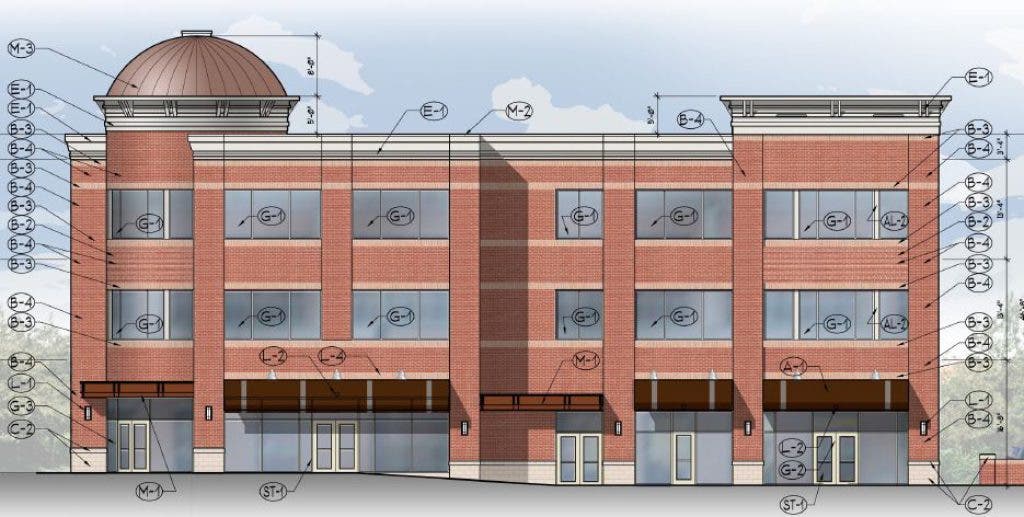
But that vision never came to fruition. Instead, that land was developed with high end townhomes and single family homes, creating a permanent gap between the University and downtown. The only remaining evidence of this plan is the Canfield Village project that just broke ground across from the INOVA building on Route 123. This three story office building will have just 6,000 square feet of retail on the bottom floor (about half the size of a CVS), a few hundred feet north of campus. Not much of an off-campus destination for students.
Until recently, the Eleven Oaks property, which straddles George Mason Drive just north of campus, also had the potential to be developed into a college friendly mixed-use development. The property is primarily located in Fairfax County and the University had expressed interest in finding a partner to develop the parcel. But the Fairfax City purchased the property for construction of George Mason Boulevard, and just sold it for a development of more high end single family homes and townhomes – something out of reach for students or faculty.
Beyond the Eleven Oaks property, some city officials seem to want to keep students out of the city completely. I recall the review of the failed apartment project on the Ted Britt property in Kamp Washington in 2010. Some council members drilled the developer to make sure students couldn’t live there. The developer responded that it wouldn’t be a problem because the apartment rates wouldn’t be affordable to students. This isn’t a sign of a healthy “Town-Gown Connection”.
Looking Forward
The city should realize that attracting students and faculty from George Mason would help support local businesses and strengthen community character. The University is an asset to our community that not many other communities in Northern Virginia have. Students have an ever-increasing discretionary spending power and are less likely to drive, especially when they can live close to campus. Plus, giving them an emotional connection to their community will make them more likely to want to stay here after they graduate.
Although there is understandably a concern of a community being dominated by students (ie: College Park, MD) we have the opportunity to carefully craft our masterplan to accept a reasonable amount of student housing and associated businesses without being overrun. Allocating a set amount of these uses in each of the nodes in the Fairfax Boulevard Masterplan, for example, will allow these areas to reap the benefits of college culture without any one of them being overburdened by it. This is an attribute that can make Fairfax City unique from any college town.