Politics & Government
Confederate Street Renaming Receives Input From Fairfax City Residents
Forty-seven people signed up to speak at Tuesday night's public hearing over a Fairfax City Council proposal to rename 14 streets.


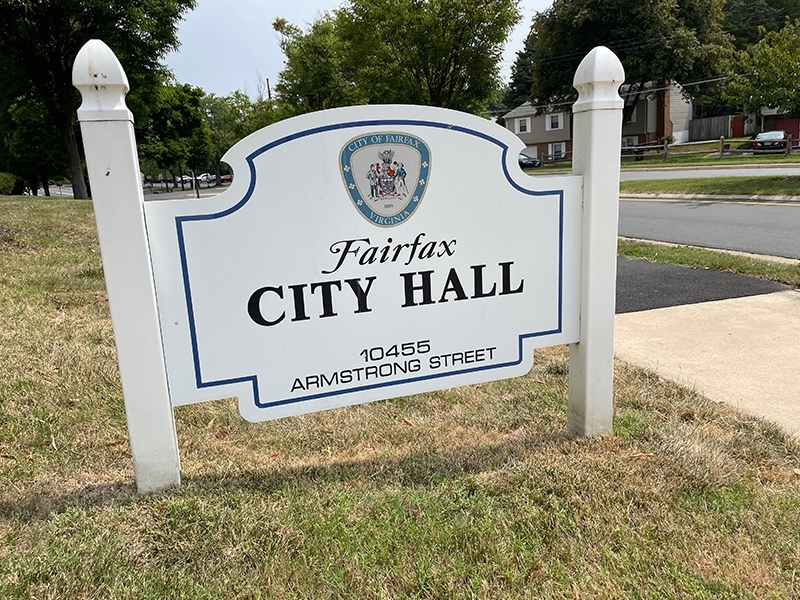
FAIRFAX CITY, VA — Forty-seven people signed up beforehand to speak at Tuesday night's public hearing at Fairfax City Hall to discuss a proposal to change 14 streets names due to their association with slavery, the Confederacy, and the "Lost Cause."
The proposal stems from the recommendations made in September by the 16-member Stakeholder Advisory Group based on the findings of the "Connecting Fairfax City For All" initiative, which the city council started in January 2021.
The city council had kicked off the process in 2020, when many jurisdictions began to examine racial equity in the aftermath of George Floyd's murder at the hands of Minneapolis police officers. The city council's aim was to revaluate the way the Civil War was represented in the city.
Find out what's happening in Fairfax Cityfor free with the latest updates from Patch.
In its final report and recommendations, the Stakeholder Advisory Group recommended the city change the names of 14 streets due to their association with the Confederacy: Lee Highway, Old Lee Highway, Mosby Road, Plantation Parkway, Confederate Lane, Raider Lane, Ranger Road, Reb Street, Scarlet Circle, Singleton Circle, Traveler Street, Mosby Woods Drive, Stonewall Avenue and Lee Street.
At Tuesday night's meeting, members of the community had an opportunity to voice their support of and opposition to the street naming proposal. The city council did not take action on Tuesday night, but will vote on the proposal at its June 28 meeting.
Find out what's happening in Fairfax Cityfor free with the latest updates from Patch.
Here are excerpts of some of the remarks made by members of the public at Tuesday night's public hearing:
"The city and stakeholder advisory group through this process imply that residents who bought property in Mosby Woods and don't want their street name changed, are somehow racist, backwards, or sympathizers to the Confederacy. On page 12 in the SAG report, right here, it says it considered street names and place names associated with the Confederacy as candidates for change. The name Fairfax is definitely associated with the Confederacy as they were clearly here. But somehow it's the word Ranger that is insensitive and hurtful their words not mine. They did however conveniently ignore the name of our city, named for slave owner. Finally, I ask you not to get into those who use diversity to cause divisiveness. I asked you to vote no on changing Ranger Road, saving residents the hassle of dealing with the consequences of your decision." — Dorothy Storm, 10224 Ranger Road in Mosby Woods
"I oppose these named change proposals. ... They do nothing whatsoever to help anyone in our society who needs us. They do not educate a child. They do not put a roof over anyone's head. They do not address actual injustices that cry out for our attention. Instead, they have the illusion of helping people without us having to do anything constructive at all. But what they do do is needlessly cost citizens time and money and of course, pit neighbor against neighbor. There's not one person who lives on any of these streets that did not know the name of their street or their neighborhood for that matter when they moved there. But if that somehow escaped their notice for several years, it seems to me rather arrogant to think that their neighbors should pay the price for their inattention." — Francis Dietz, 10220 Ranger Road in Mosby Woods
"I believe that words are powerful. What we name things represents our values. The neighborhood name and street names no longer represent our values. It's time to make a change. I believe that systemic racism still exists in our country. While I know that changing street names is not going to eliminate systemic racism, it's one small thing that we can do now to show that racism is not OK. I do not believe that we would be erasing history. To those who believe that, I would say that we are having a long overdue reckoning with that part of our history." — Patricia McMurray 324 Peaceful Harbor Lane, Hague, Virginia (Mosby Woods homeowner)
"A street name is more but legal formality and not representative of what truly makes up a neighborhood. We are a community of friends and neighbors that care and respect each other and help during times of need. That sense of community is what is most important. We should not be focused on trying to divide citizens of our city in an effort to rewrite the history and make changes the majority of the residents never asked for it. Requiring affected city residents on a small side street to take time to update their address places an unnecessary burden on them." — Jennifer Gear, 10013 Mosby Road
Related: Mosby Woods Resident Opposes 'Cockamamie' Street Name Changes: Opinion
"What was most compelling, however, were the comments that people made as my husband went door to door, which is something missing from the other surveys, the electronic one and the paper one. The majority of people expressed the idea in one way or another that they thought that the name Ranger [Road] was innocuous. Another theme was that people didn't want their tax money used to change the name for Ranger and that the community would be better served by using the tax money where it's needed most in the schools, for roads parks, public safety, etcetera. For those reasons, we hope that the mayor and the council will vote to retain the names for Ranger Road and will use our tax money in areas that will more strongly impact the community and and benefit us." — Barbara Hunt, 10309 Ranger Road in Mosby Woods
"The point that I wanted to make is that we use these historical references to our street names, monuments and markers around town so that we can call out the parts of history that we want future citizens in this town to associate with or to know that we associated ourselves with. When these names and symbols were chosen for our community, in the '60s, the Confederacy was the type of thing that people were OK with being tied to. How do I know that is what these references are to and that Ranger is not a reference to the U.S. Army Rangers, with the Texas Rangers or the Rescue Rangers is because it is in a neighborhood theme for a person whose country was not the south actually whose country was the United States of America, who chose to fight against that flag that we all pledged allegiance to a couple of hours ago. And the knowledge of that is why members of John Mosby his family wrote a letter suggesting that Mosby Woods Elementary School change its name. And in that same spirit, I would ask the city council to follow that same guiding principle." — Ben Partington, 10104 Ranger Road in Mosby Woods
"Some residents have voiced concern that the real task of our committee was to erase history and actually the opposite is what we set out to do. Street names and subdivisions are not the repository of history. But, 'My street has a historical name and yours does not' affects nothing about the understanding of history. However, if connections to the Confederacy in the names of its leaders and officers appear to be given places of honor or recognition that does do a deep injustice to history. The purpose of the Lost Cause movement after the Civil War was to pretend a false understanding about the war, why it was fought and what it really meant. If anything, our group's efforts to reverse this helps to set the record straight." — Jay Lamb, 9916 Broadview Drive in Country Club Hills [Editor's note: Lamb was a member of the Stakeholder Advisory Group.]
At the beginning of the public hearing, City Clerk Melanie Crowder provided an overview of the name change proposal process and answered some questions that had been raised in earlier feedback from the community.
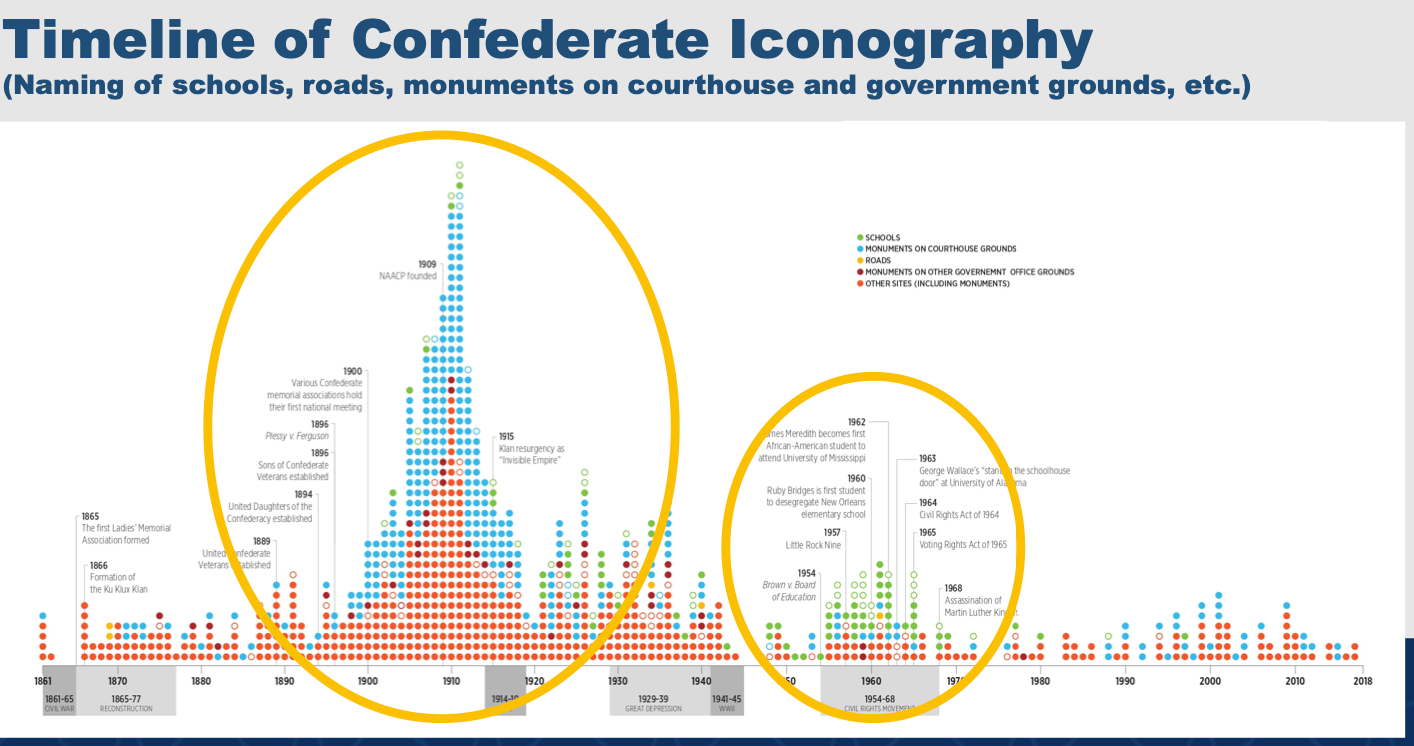
In her presentation, Crowder shared the above timeline showing the adoption of Confederate iconography on public land from 1861 to 2018.
"The circle to the left is during the early 1900s, which is known as the Lost Cause era, where efforts were made to preserve the memories of dying Confederate veterans," Crowder said. "The second circle on the right highlights the civil rights movement from 1954 to 1968."
Related: Confederate Street Renaming Process Up For Council Consideration
In 1959, schools started to be desegregated in Virginia. The 100th anniversary Civil War occurred two years later in 1961, which happened to be the same year that the Town of Fairfax was incorporated as a city and the first houses started being built in the Mosby Woods neighborhood.
Developer George Yeonas chose to give the neighborhood a Civil War theme after his son noticed the historic marker in the city commemorating Mosby's Midnight Raid, according to Crowder. Yeonas shared the story at the neighborhood's 50th anniversary celebration in 2012.
"As Mr. Yeonas shared, we know that the streets in Mosby Woods were themed to the Civil War," Crowder said. She added that even though names like Ranger, Scarlet and Traveler have other meanings, taken in context with the rest of the neighborhood, their names relate to the Civil War theme.
The city council originally budgeted $100,000 to facilitate the process of changing the city seal and removing or updating the language of historic monuments or markers, as well as addressing the changing of street signs, Crowder told Patch in April. She added that the city spent $45,000 to hire a consultant to help facilitate its public engagement efforts regarding diversity, equality and inclusion.
Related: Antisemitic Meme Surfaces As Fairfax City Mulls Changing Street Names
Get more local news delivered straight to your inbox. Sign up for free Patch newsletters and alerts.