Community Corner
Remembering Herndon’s History: Virginia Greear’s Memories
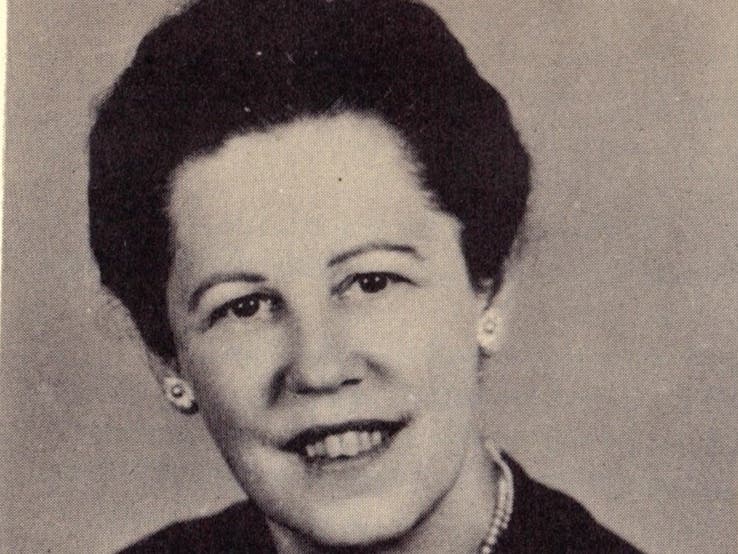
Virginia Greear spent much of her life researching and sharing the history of Herndon.


By Barbara Glakas
HERNDON, VA — Virginia Pauline McFarland Greear (1893-1991) was once widely known as the Town of Herndon’s unofficial historian, called a “walking encyclopedia” by some. She was born in Arcola (formerly Gum Springs) in Loudoun County. Her mother was in fragile health and died young. Virginia came to Floris in 1896 to live with an aunt and uncle – James and Emma Cockerille — who raised her. She graduated from Floris High School in 1911.
After getting married in 1945, she moved to the family farm of her husband – Arnold Greear.
Find out what's happening in Herndonfor free with the latest updates from Patch.
Arnold came to Herndon in 1912 and by the early 1920s was a mailman, using a buggy pulled by a two-horse team to make deliveries along Herndon’s rural mail route. Shortly before he retired in 1952, he broke his arm and had a hard time putting mail in the mailboxes. Virginia Greear started riding along with him to put mail into patron’s boxes. Around Christmastime, she would go to the post office and help him sort the mounds of mail that accumulated during the holiday season.
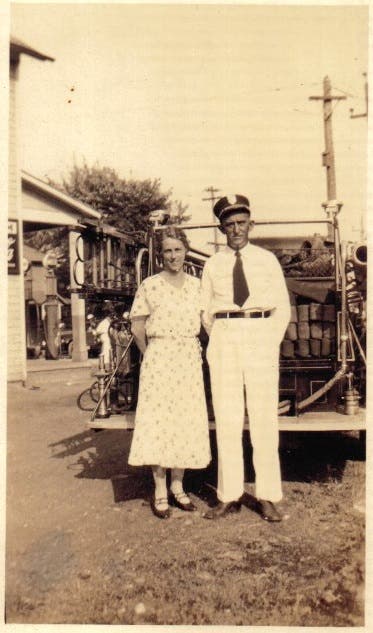
In 1949, she was the director of the Herndon American Legion’s publication staff who wrote the book, “Service Record, World War I and II, Herndon, Virginia.” This book compiled short biographies of all the Herndon residents who had served in World Wars I and II. It also included a short history of the town and histories of various organizations in town, such as the scouts, the Volunteer Fire Department, the P.T.A., the Chamber of Commerce, town churches, etc.
Find out what's happening in Herndonfor free with the latest updates from Patch.
In 1967 Arnold and Virginia Greear moved into a new house on Oak Street. Arnold died two years later.
Virginia Greear took care of her aunt and uncle for as long as they lived. She did not go to college and did not take a job until she worked for the Rationing Board during WWII. She never owned a car nor cared to, and was a familiar figure walking around town. She was an active member of the Herndon United Methodist Church. In her later years, she was known to fold church bulletins, stuff envelopes, and do odds and ends around the church.
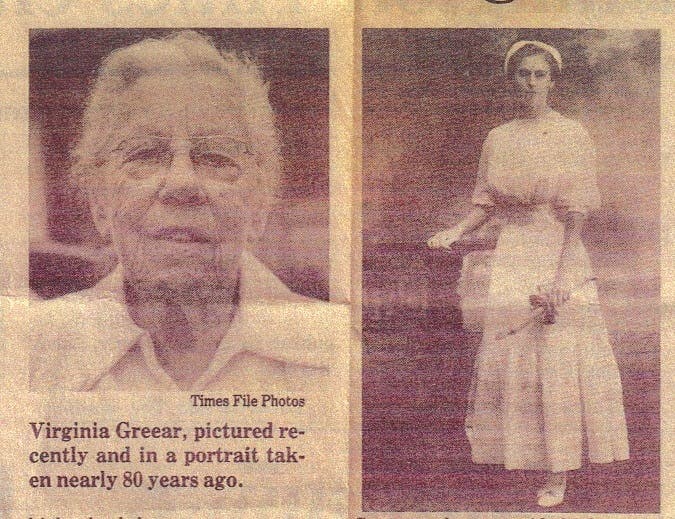
Virginia Greear was also a founding member of the Herndon Historical Society, leading an innumerable number of tours in the Depot Museum, sharing her love of history, re-creating the flavor of small town life from years ago. The Herndon Times newspaper named Virginia Greear its 1984 Citizen of the Year for her contributions as an informal historian.
In the 1970s and 1980s, Virginia Greear was interviewed by various local newspapers, such as the Journal, the Herndon Times and the Herndon Observer, in which she recounted some memories of life in Herndon.
As a teenager, she remembered meeting many of Mosby’s Rangers at a reunion in Darlington’s Grove. J.J. Darlington was a Washington attorney who bought a large summer home and many acres of land in Herndon in the vicinity of the Darlington Oak subdivision. The Mosby reunion occurred in 1910 on the Darlington property.
In another article she recounted the time in the summer of 1918 how area farmers sent a carload of flour to France to help with the war effort. “The Herndon Milling Company ground the wheat into the flour and another local business provided storage bags. The wheat was loaded onto a special train car down by the depot.”
When describing some aspects of life in early Herndon, she said:
“In the old days, people couldn’t shop like they do now. Everyone, even those in town, kept some livestock around, a cow, a hog, a few chickens, and everyone had a vegetable garden. Some had small orchards or at least an apple tree. A smart housewife could take a few eggs or some butter to town and trade them for sugar, coffee or salt. My aunt was one of the first people around to can her own green beans. She would cook them in a big iron pot and put tomatoes in and the acid from the tomatoes would keep the beans from becoming contaminated.”
Virginia Greear also recalled how, “the milk cans stacked up at the depot, brought to town by the farmers from the dairy farms that covered much of the countryside.”
About local stores she said,
“Herndon was a ‘town.’ To get there you hitched a team to the wagon and bounced in on dirt roads. When we needed new shoes, groceries or dry goods we rode a horse and buggy into town and went to Wilkins’s store at Elden and Spring, or to Cohen’s store where Nachman’s is now.”
Wilkins’s store was a general store in the 1899 building that is now home to Jimmy’s Old Town Tavern. Cohen’s store was a clothing store on Lynn Street that was later bought by the Nachman family in 1919; this 1874 building that is now home to Green Lizard Cycling.
Virginia Greear continued, “All the Herndon streets were dirt roads and the first sidewalks were timbers with boards laid across them.” These elevated walkways were reminiscent of the types of sidewalks we normally associated with old western towns in cowboy movies.
Virginia Greear also remembered two early doctors, Dr. Ed Detwiler (a medical doctor), and Dr. Ben Detwiler (a dentist). She recalled how they owned the first two cars in town.
“Imagine the general shock one year when not one, but two cars appeared on the rutted roads hereabouts. The cars made a chug-chug noise. You could hear them coming down the road and everyone would run up to see them. People had to hold onto their horses to keep them from running away.”
In one feature article about Virginia Greear, the newspaper said,
“She remembers the telephones run by an operator who would tell you without ringing whether someone was home. She remembers the first radio, owned by a farmer who invited the neighbors in to listen to it, one at a time, though the headphones.
“For Mrs. Greear the [Herndon] depot is more than a restored building. She remembers and describes it as a business place; the dairy farmers brought their milk here, and commuters to Washington took the train to Rosslyn every morning. It was easier to get to Washington then, she said, and the fare was $10 a month.”
Virginia Greear enjoyed her later years, spending Sunday afternoons in depot showing visitors the artifacts in the museum. She studied the past for its own sake, sharing the information with people, admitting that the past helps keep her going. She did not live in the past but valued the past. “I’m not going to let the old rocking chair get to me.”
Also see ...
Frederick Washington's Life In Segregated Herndon
Remembering Herndon's History: Historic Street Names
Remembering Herndon's History: Fire Department's Ladies Auxiliary
About this column: “Remembering Herndon’s History” is a regular Herndon Patch feature offering stories and anecdotes about Herndon’s past. The articles are written by members of the Herndon Historical Society. Barbara Glakas is a member. A complete list of “Remembering Herndon’s History” columns is available on the Historical Society website at www.herndonhistoricalsociety.org.
The Herndon Historical Society operates a small museum that focuses on local history. It is housed in the Herndon Depot in downtown Herndon on Lynn Street and is open every Sunday from noon until 3:00. Visit the Society’s website at www.herndonhistoricalsociety.org, and the Historical Society’s Facebook page at https://www.facebook.com/HerndonHistory for more information.
Note: The Historical Society is seeking volunteers to help keep the museum open each Sunday. If you have an interest in local history and would like to help, contact HerndonHistoricalSociety@gmail.com.
Get more local news delivered straight to your inbox. Sign up for free Patch newsletters and alerts.