Community Corner
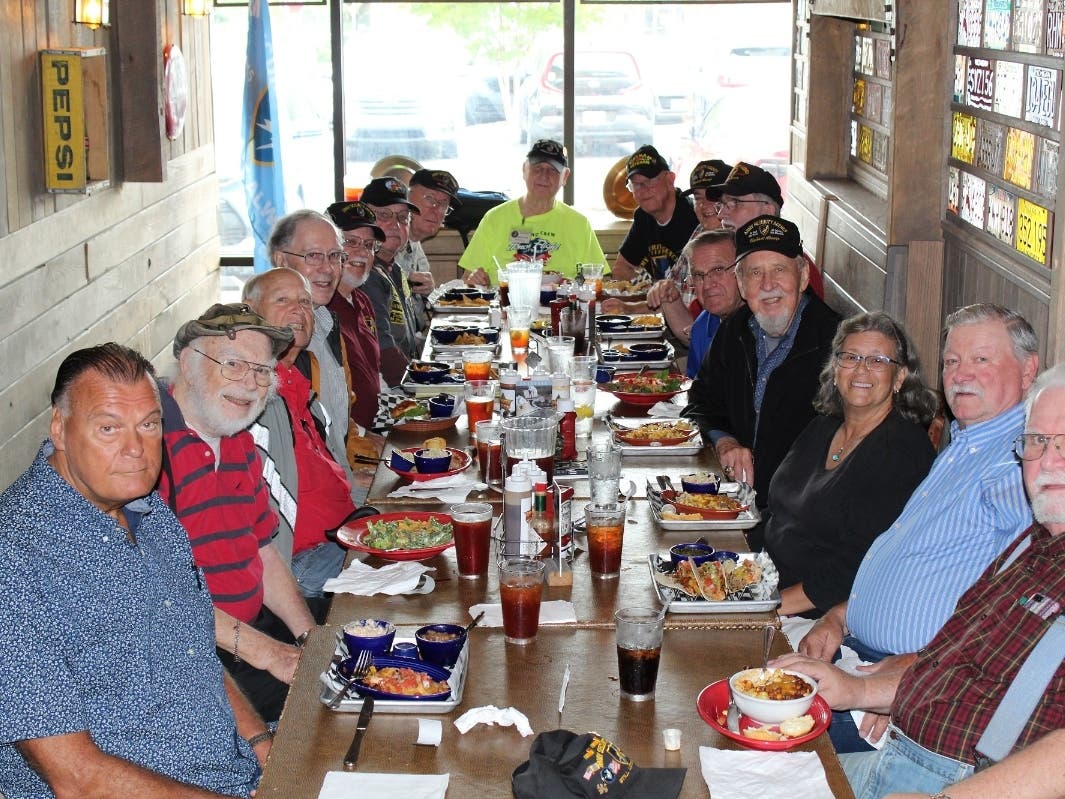
ASA Veterans meet for Lunch at Smokin Willy BBQ in Purcellville
In monthly gatherings, one may not find someone that he/she served with, but mutually know someone both served with in the ASA.



The history of Military Intelligence in this country originates during the American Revolutionary War with spies, scouts, informants, and such. Since then, technology has dictated just how intelligence on the enemy is collected, where today, spy satellites are used extensively – in addition to the continued use of “spies, scouts, and informants.”
Over the years, the U.S. Army Security Agency (ASA) was a very significant player for the nation in collecting intelligence on actual and potential adversaries by intercepting radio signals. The ASA existed between 1945 and 1977 and was the successor to the Army Signals Intelligence Service/Agency, with operations that date to World War I. Initially, this involved the interception of radio transmissions used by enemy forces communicating, sometimes by happenstance, but this capability evolved to very sophisticated collection means as technology improved, to include virtually all types of electronic signals.
Tens of thousands of ASA soldiers have been employed over the years to conduct these operations, playing a significant role in WW I, WW II, the Korean Conflict, and Vietnam, and during peace time, significantly contributing to the winning of the Cold War. Following WW II (and compelling contributions to the breaking of German and Japanese communications codes), the Army established a direct link between the Army Security Agency (ASA) with the newly created National Security Agency (NSA) when it was created in 1952. Note also, that the Navy and Air Force later developed their own “signal interception” capabilities and organizations.
Find out what's happening in Leesburgfor free with the latest updates from Patch.
The comradery of this group of men and women is strong. Much of what they did over the years serving our country was highly classified but is now declassified, at least in part, and they are now able to discuss some of what they did and are reconnecting with fellow service members. This is therapeutic in many ways, especially for those of the Vietnam era, never welcomed home and never able to discuss the very highly classified work they performed for our nation. Now all should be recognized for what they accomplished, and not just in Vietnam.
Note that during Vietnam, the ASA units had the “cover name” of Radio Research units, and all major tactical units were assigned such support – technically, ASA was “Never officially in Vietnam.” However, ASA was the first unit deployed in Vietnam. ASA arrived in Vietnam on May 13th of 1961. One of the first fatalities in the War in Vietnam was a member of ASA on December 22, 1961. ASA was among the last American units to leave Vietnam after the fall of Saigon in April of 1975. During ASA’s 12-year tour of service there, ASA units were awarded more than 120 U.S. decorations and 60 foreign citations.
Find out what's happening in Leesburgfor free with the latest updates from Patch.
The United States military is truly a brotherhood and sisterhood. Because military men and women are required to make sacrifices well beyond anything expected of their civilian counterparts, it is understood that the friendships established may also be much stronger. The reality is that the needs of the armed services come first, and personnel change duty locations at the direction of the military. During an individual’s time in the service, there are always fellow military members to rely on for support. Military families have a unique understanding of the challenges and can relate in ways that civilian support systems cannot.
Those who serve together form a common sense of purpose and devotion to duty. These military friendships last forever. But when people leave the military, they often lose touch with those dear old friends.
Across the country, groups of these Veterans are gathering, to the benefit of the individuals wanting to reconnect with fellow members of the ASA of years past. These groups include those that made a career in the military, those that served their four years and returned to civilian life, and both enlisted and officer ranks.
One such group is the Winchester/Northern Virginia ASA Luncheon Group that meets for lunch once per month, alternating between Winchester and Purcellville. Today, there are 38 members that periodically join for lunch, sometimes five, sometimes as many as 18, depending on individual schedules. In gatherings such as these, invariably, if one does not find someone that he/she served with, they mutually know someone both served with in the ASA.
In addition to these monthly luncheons, there is an ongoing effort to place a U.S. Army Security Agency (ASA) Memorial at Arlington National Cemetery (ANC). The memorial would recognize and honor the ASA and its veterans, for contributions made from its beginnings in 1945 to when the ASA ceased to exist, by order, on December 31, 1976 and was integrated into the U.S. Army Intelligence and Security Command (INSCOM) organization on January 1, 1977.
Harry Newman, Bill Jacobson and other U.S. Army Veterans and members of the National ASA Association Board of Directors are involved in working to establish an ASA Memorial at the ANC. The plan will be to place an appropriate memorial within ANC as agreed upon by the Secretary of the Army and ANC. At present, there are several dozen monuments and memorials, of various types and designs, that commemorate individuals, groups, military units, and battles.
According to Jacobson, the memorial proposal has been previously denied, due to lack of space, and the proposal would presently take an act of Congress in the form of a bill. “Three bills have been written but were not able to get out of committee for a vote. It should be noted that since the proposal was denied, ANC has expanded. The National Park Service (NPS) has also donated space to ANC that is not suitable for interment, but is especially suitable for a memorial. An example of the NPS donation lies just outside the main gate to ANC where several memorials already exist. The space required for the ASA memorial would be smaller than the space required for an interment.
“If approved by the Secretary of the Army and Arlington National Cemetery, the final cost would be determined by the memorial's design. The design included in the original proposal was priced at approximately $20,000 for design, fabrication, and placement. The National Army Security Agency Association has raised well over $20,000 for that purpose,” Jacobson said.
For more information regarding the monthly luncheons, and the ASA Memorial, contact Harry Newman at harry.newman@comcast.net or Bill Jacobson at wmjake01@gmail.com.