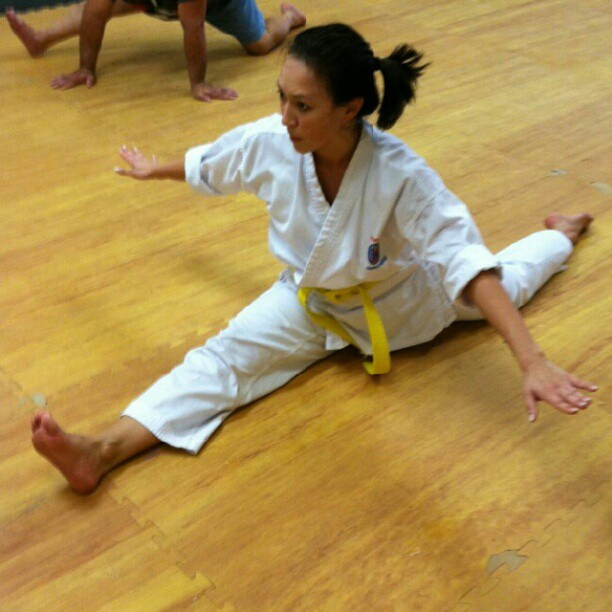
There are several ways to safely and effectively address and improve your range of motion, but first you must understand where and why you want to increase range. If you are training for a particular sport the basic rule of thumb is to have a little more functional range than is required for that sport. Now that you know “what” you’re stretching for let’s discuss the basics of “how”.
- Joint mobility-
Joint mobility training, or joint rolling, is a type of range of motion training I would recommend to nearly everyone. When I studied martial arts my instructor insisted that your warm-up was not complete without joint rolling. Joint mobility training is basically taking your joints through their full range of motion, which smoothes out the joint surfaces and improves the circulation of blood flow. This contributes greatly to the health of the joints. This type of training can prevent or reduce arthritis and is good for nearly every individual. Every Dfit warm-up incorporates this type of flexibility training.
Find out what's happening in Oaktonfor free with the latest updates from Patch.
- Dynamic stretching or plyometric stretching-
Dynamic stretching is how you prepare for your given sport or activity and reduce injury. This type of training goes beyond flexibility. Moving about increases the heart rate and activates the adrenal response. The neural feedback your muscles receive goes up and the stretch reflex is sharpened. This not only helps protect against muscle injuries, but your stretch reflex is what puts the spring in your step and generates more force than a static muscle. These ballistic movements are meant to be performed with speed eventually approaching the speed of your sport.
- Full range of motion weight training-
For a long time I considered full range of motion weight training to be dangerous, after all I’m a product of the 80’s and 90’s. The truth is that your sport or activity requires a particular range and that is the range you should train for. If you’re a basketball player you probably don’t need to go into a full squat when you train your legs, but if you are a lineman in football, you may find yourself in this position. So if your sport or goal requires you to have a lot of range or flexibility, then you should be practicing this in the gym. Full range of motion weight training works because you are creating strength through the range of motion you want to be able to perform in, thus creating flexibility through that range of motion. Once again what are you trying to do?
Find out what's happening in Oaktonfor free with the latest updates from Patch.
- Isometric strength and flexibility training-
Isometric strength training was very popular once upon a time, but went the way of the medicine ball when aerobics and machines became popular. The idea here is you push against an immoveable object like a wall and you become stronger at the angle you train in. This has an interesting effect if performed at your stretch limit. If the body doesn’t like an extreme range because you lack strength in that range, working your strength at your range of motion limit is the way to go. A more recent application of this kind of training is a technique called PNF or (proprioceptive neuromuscular facilitation). PNF works by tricking your stretch reflex or convincing your stretch reflex you are strong. At your full range, or what your body thinks is its limit, your muscle doesn’t want to get any more tense, yet you make it contract harder by flexing that muscle. Once you relax you can eke out a little more stretch.
- Correct breathing-
Most likely you never considered the importance of your breath, but if you ask a Tai Chi or Yoga instructor how important this actually is they could probably talk about it for days. Oriental Masters of these disciplines place a huge emphasis on breath control and here is one relevant reason why. Our nervous system is subdivided into voluntary and involuntary actions. We have complete control over things like moving our limbs and talking while other functions are controlled automatically like our heartbeat or digestion. Breathing is the only function you can control consciously and unconsciously because it’s regulated by both sides of the nervous system. Gaining control over your breathing will create a pathway to gaining control over functions you were never meant to control like your heart rate. Have you ever been stressed out and remembered that someone said “just take a deep breath” and presto you start to calm down? This topic deserves its own blog, but let’s just say the right type of breathing can make you stronger and more flexible. When performing your isometrics you should breathe shallow and when relaxing into your stretch you should breathe deeply.
The main takeaway here is when doing your flexibility training, take the time to fully understand your goal and or sport. Mindful athletic preparation is the best way to avoid injury and increase performance. I don’t want to imply there is never a good reason to do a static or passive stretch, there are circumstances where this is appropriate like a muscle cramp, minor strain or an extreme imbalance. Static stretches should be performed with complete care, purpose and in conjunction with a diverse flexibility routine.
(Read part 1 here)