Politics & Government
Budget Shortfalls, Aging Facilities Discussed By Fairfax Co. Officials At Town Hall
Fairfax officials and residents discuss a $44M school funding gap and the challenges of aging infrastructure under a proposed flat tax rate.


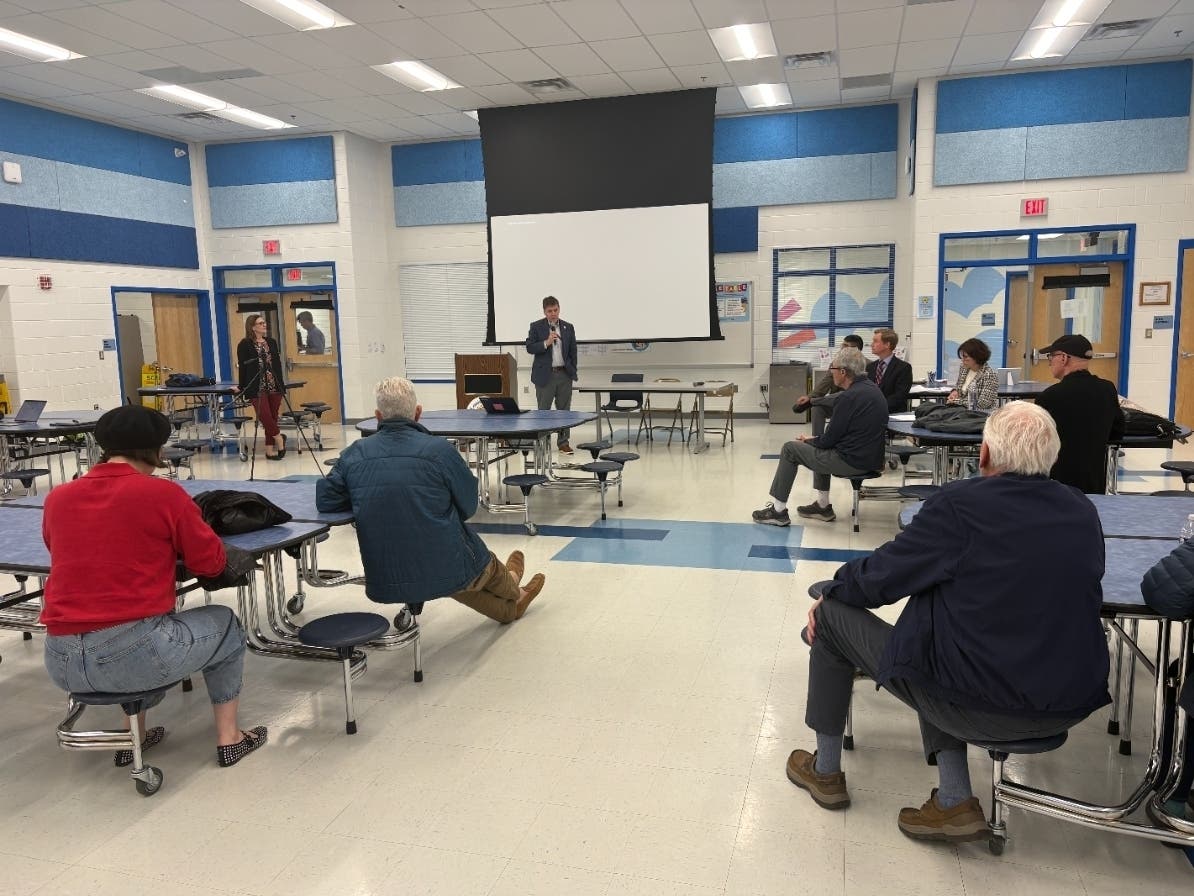
VIENNA, VA — Fairfax County officials met with residents Monday evening to outline a proposed fiscal year 2027 budget marked by significant capital needs, multi-million dollar shortfalls for public schools, and a concerted effort to maintain aging infrastructure.
Supervisor Walter Alcorn (D-Hunter Mill) and School Board the meeting at Louise Archer Elementary School in Vienna, detailing a budget proposal based on a real estate tax rate of $1.1125 per $100 of assessed value. While the rate remains unchanged from the previous year, officials noted that residential property values continue to drive the majority of the county’s tax growth
Katie Horstman, deputy director with the Fairfax County Department of Management and Budget, highlighted that the $5.98 billion proposal includes $118.1 million in increased transfers for school operations. However, this only partially funds the school board’s original request, leaving a current shortfall of approximately $44 million.
Find out what's happening in Viennafor free with the latest updates from Patch.
Horstman also emphasized the county's struggle with its own physical assets. "We really have a concerted effort this year to put our resources to an aging county facility," she said, noting that 75 percent of county buildings are at least 20 years old.
School Board Member Melanie Meren (Hunter Mill) echoed these concerns, pointing out that the average age of a school building in the county has reached 45 years. Meren argued that the state of Virginia chronically underfunds Fairfax County Public Schools, forcing the local government to bear a disproportionate burden.
Find out what's happening in Viennafor free with the latest updates from Patch.
RELATED: Real Estate Tax Bills To Increase In Fairfax Co. Under FY2027 Budget Proposal
“It’s a different Fairfax than it was years ago,” Meren said, noting that one-third of students now live at the poverty level. “We want to make sure all of our teachers can teach to the many different needs. ... It takes twice as much to educate a kid. We know more now what it takes to educate kids, and sometimes it takes more money”.
The presentation also addressed recent county actions to generate capital, including the controversial $166 million sale of 41 acres near Dulles Airport to a data center developer
“I kind of held my nose and did it, but it directly relates to this issue of capital funding,” Alcorn said, regarding the his vote for the sale. He explained that the funds would be used for upgrades to police training facilities that otherwise would have required a bond referendum.
During the public comment portion, some residents expressed skepticism over the budget's growth. One attendee used AI to analyze a 10-year progression, claiming the county budget had increased by 49 percent since 2017.
In response to questions about the $44 million gap in school funding, Alcorn remained "cautiously optimistic" that additional funds might come from the state legislature in Richmond.
The Fairfax County Fiscal Year 2027 Advertised Budget Plan, as proposed by County Executive Bryan Hill, focuses on balancing fiscal stability with significant infrastructure needs and employee compensation while maintaining a flat real estate tax rate.
Below is an overview of the key components of the proposal:
Tax Rates and Impact on Homeowners
- Flat Real Estate Tax Rate: The proposal maintains the current tax rate of $1.1225 per $100 of assessed value.
- Increased Tax Bills: Despite the steady rate, the average homeowner’s tax bill is projected to increase by approximately $356–$375 (about 4 percent) because of rising residential property assessments.
- New Revenue Sources: The budget reflects the first full year of the 4 percent Food and Beverage Tax (Meals Tax), which was implemented on Jan. 1, 2026, and is expected to generate approximately $135.8 million annually.
Funding Priorities
- Public Schools (FCPS): Education remains the top priority, with a proposed $118.1 million increase in total transfers. This includes $99.2 million for operations, $11.4 million for debt service, and $7.5 million for the School Construction Fund. However, this does not fully fund the School Board's request, leaving an approximately $44 million gap.
- Employee Compensation: Over three-quarters of the increase in county disbursements is dedicated to staff. The plan includes a 2 percent cost-of-living adjustment, funding for collective bargaining agreements, and merit/longevity increases.
- Infrastructure and Aging Facilities: The budget prioritizes "reinvestment in aging facilities." With 75 percent of county buildings now at least 20 years old, the plan restores baseline funding for capital renewal.
Reductions and Adjustments
To balance the $5.98 billion budget without a tax rate increase, the county implemented $32.9 million in reductions, including:
- Position Cuts: The elimination of 107 merit positions across various county departments.
- Service Reductions: Reductions in transit routes (removing approximately 48,500 hours) and some youth programming.
- Fee Increases: A 5 percent increase for most zoning, Fire Marshal, and Land Development fees. The annual trash collection fee is also proposed to increase from $610 to $630.
Next Steps
- Public Hearings: April 14–16
- Budget Markup: April 28
- Final Adoption: May 5
- Fiscal Year Begins: July 1
Members of the public who wish to participate in the upcoming budget public hearings on April 14–16 can provide testimony in several ways: in person, by phone, or via video. To speak during these sessions, individuals must sign up in advance using the Public Hearing Speakers List form available on the Fairfax County website or by contacting the Clerk to the Board’s office at 703-324-3151.
For those opting to submit video testimony, the request and video must be fully completed and submitted by 9 a.m. the day prior to the hearing. Alternatively, residents can provide feedback without testifying by emailing their comments to FY27Budget@publicinput.com or by calling 703-890-5898 (code 6733) to leave a recorded message.
Get more local news delivered straight to your inbox. Sign up for free Patch newsletters and alerts.