Politics & Government
Lake Forest Animal Network. Part 8 - Some Obvious Facts
Looking at some obvious facts about animal care

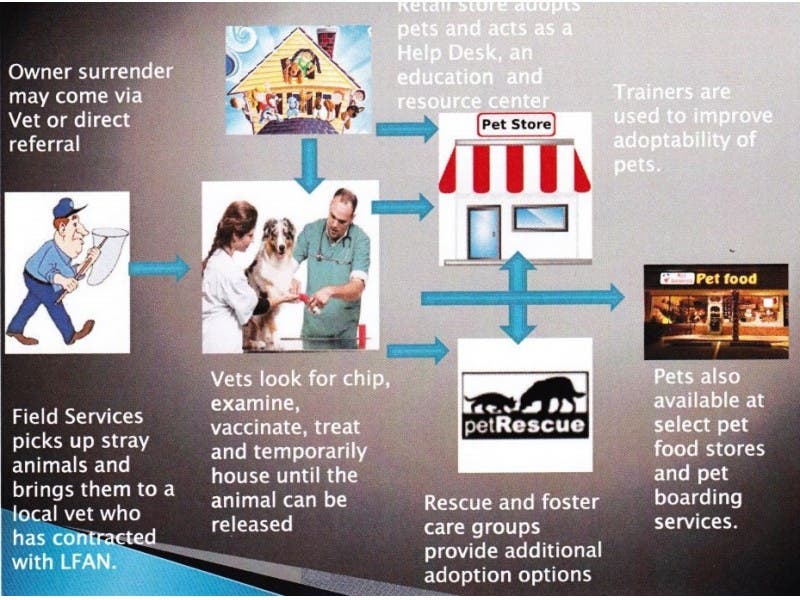
I’ve spent some time analyzing the staff report on the animal care proposal. Saturday I went through the main conclusions of the report, 5 of which were incorrect, 4 of which were partially correct, and only 2 of which were sound. Sunday I showed where the discrepancies in data came from, and identified several major errors which staff made in capacity analysis, which in turn, impacted their budgetary and functional analyses. Today I want to talk about some areas of common ground.
“The question is not can they reason nor can they talk, but can they suffer?” - Jeremy Bentham
THE COUNTY PROVIDES MISERABLE SERVICE
Find out what's happening in Lake Forestfor free with the latest updates from Patch.
No one disputes the fact that Orange County’s animal care service is a disgrace. How many Grand Jury investigations and scathing reports does it take? Their litany of sins is so long I’ve devoted entire articles to listing them. For brevity’s sake, let’s simply say that they provide
- · Poor service
- · Inhumane care
- · Unacceptably high kill rates
- · Unreliable and faulty information
The causes of this sad state of affairs are
Find out what's happening in Lake Forestfor free with the latest updates from Patch.
- · Poor leadership
- · Poor management
- · Poor training
- · Under staffing
- · Lack of oversight
For this, the City pays about $600,000 a year, about $200,000 of which comes from the General fund.
A NEW SHELTER WILL CHANGE VERY LITTLE
Almost all of the problems identified by the Grand Jury and by others will not be addressed by building a new shelter. There will be some improvement in the inhumane care to the extent that animals will no longer be forced to live on concrete slaps, have their cells housed down while they are still inside, and have urine and feces flowing freely in front of their cages. But a new building will not improve the inadequate training. It won’t insure that illegal euthanasia deaths take place. It won’t increase the pathetically low staff to animal ratios, or provide better managers. Very little will be solved by building a new shelter.
WITH IMPROVEMENTS WILL COME INCREASED FEES
For decades OCAC has been promising a new shelter, increased staffing, improved training, better supplies, etc. If these things do come, they will come at an expense which the cities will pay. OCAC has estimates on how much they expect cities to pay for their share of building a new shelter (a practice unheard of in the animal care industry), but they haven’t uttered a peep about the increases in costs. To bring OCAC up to acceptable standards, the costs will be enormous, possibly even double what we now pay. OCAC wants the City to commit to hundreds of thousands of dollars to build the new shelter without knowing what we will pay to operate the new shelter. What kind of a deal is that?
BIGGER IS NOT BETTER
There is a wealth of data in the animal care industry that shows conclusively that as shelters increase in size, admissions increase and euthanasia rate increases. For example, here in California, euthanasia rate and annual admissions are linked as follows:
- · Under 1,000 = 7%
- · 1,000 to 2,000 = 10%
- · 2,000 to 5,000 = 17%
- · 5,000 to 10,000 = 30%
- · Over 10,000 = 37%
OCAC is 38.3% euthanasia rate with 26,050 admissions in 2014.
Most people think “bigger is better”. Sometimes it is, but consider your child’s education. Is it better for him/her to have more kids in the classroom?
The true solution to the problems of poor service, inhuman care, and high kill rates is to have a network of satellite shelters in north, central, and south county, but OCAC sticks to their ancient model of a single shelter for a single county. No other county of this size has a single shelter, and many smaller sized counties have multiple shelters. Building another monolith is the wrong move.
INTAKE IS ON THE DECLINE
For the past 10 years, all over the nation, intake to animal shelters is on the decline. Even in such a miserable place as OCAC this is also the case. From 2010 to 2014 (the latest figures available), admission of dogs is down an average of 7% per year and for cats the figure is nearly 11%. Barring a major down turn in the macro economy, or some other unforeseen circumstance, there is no reason the decrease should not continue.
NO ONE CAN PREDICT THE FUTURE
Going forward, whether we stay with OCAC or partner with another shelter, or adopt the model my group proposed, no one knows whether or not our revenues will go up or down, whether or not our expenses will go up or down, and whether or not admissions will continue to go down.
CHANGES WILL IMPACT EVERYONE
Projections about future revenue, future expenses, and future trends in admissions are only projections. If the 60% of the dog owners who don’t pay their license fees suddenly decide to pay up, whoever is running the animal care system will gain revenues. If the economy turns south, people stop paying, and people give up their animals because they are too costly to keep at home, whoever is managing the animal care system will suffer a drop in revenue and an increase in expenses.
The staff report constantly makes reference to the fact that the projections in our proposal rely on future trends that cannot be predicted. But this can just as easily be said for staying with OCAC. The difference, of course, is that by being small and nimble, the model being proposed can meet these challenges more easily. I’m reminded of the fate of the dinosaurs and the survival of the small mammals.
LAKE FOREST IS OF LITTLE INTEREST TO OCAC
Lake Forest represents about 2% of the County’s animal care service. We’re not the smallest, but we are one of the smallest. In terms of service, OCAC assigns one Animal Control Officer to patrol not only our City but many of the cities in South County. If we report a dead animal it can take up to 2 weeks for someone to come pick it up. If one of our pets gets picked up, they will spend 8 hours in a truck before being brought back to the shelter in Orange. Is it any wonder hundreds of Lake Forest animals have died between the time they are picked up and they arrive at the shelter?
LAKE FOREST HAS A SMALL NUMBER OF ANIMALS IN NEED
The City and I agree that less than 500 live animals were in need of service in 2014 (the latest information available), and of these only about 300 were dogs or cats. That’s slightly more than 1 animal per day, and more than a third of these animals died shortly after coming to the shelter or were euthanized at the owner’s request. Another 20% were lost and returned to their owner, usually within 24 hours.
Most of the birds and “other” animals died shortly after admission, and the remaining were transferred to rescue groups. Among the dogs and cats, on average, there were less than 6 in the system at any one time, and on some days there were none in residence.
Looked at from the point of view of the number of animals in need of adoption (i.e., removing the ones who remain with a Veterinarian for quarantine, observation, treatment, or euthanasia, and the ones that are returned to their), a facility with the capacity for 6 animals would meet the needs more than 73% of the time. Increase the capacity to 8 and the needs are met 84% of the time. Bear in mind these figures are based on 2014 data, and if the trend continues, 2017 data should be considerably less.
Using American Humane Association guidelines, a facility to cater to the needs of 6 dogs and 2 cats at any one time would require 700 square feet of animal spacing. Imagine now that OCAC is going to ask the City of Lake Forest for somewhere between $500,000 and $900,000 to build a shelter to house less than a dozen animals. That’s an expense of $750 per square foot!
“Whether you believe you can do something or believe you can’t, you’re probably right.”
Henry Ford
DETAILS ABOUT LFAN ARE NOT FULLY FLUSHED OUT
The original proposal and the subsequent versions were designed as conceptual models supported by extensive data analysis along with preliminary budget estimates based on the data analysis. This proposal was never offered as a finished product, so the criticisms that various details have been omitted seem specious at best. More details need to be added. The proposal must be flushed out so that all the details are in front of us, just as they are with every other kind of City project. But if the concept works, and the budgetary projections are in order based on the data analysis, we can approve the concept and have the staff flush out the details.
DETAILS ABOUT OPERATING EXPENSES AND REVENUES ARE UNKNOWN
It’s true that we have no idea what the expenses and the revenues will be in the later part of 2017. WE can provide estimates, but there is no way of telling whether or not these are correct. But that’s no reason not to commit to OCAC!
Hah!
Caught you!
The claims being made about the LFAN model are equally true for the OCAC model. We can make projections based on the trends (e.g., admissions for dogs has been decreasing on average 7% per year and for cats about 11% per year), but we have no way of knowing in each case (i.e., OCAC vs. LFAN).
If OCAC actually does what they promised the Grand Jury and the citizens they will do, we can expect an enormous increase in the costs of services. But OCAC is giving us no projections. If other cities leave OCAC, and there is some evidence that all 3 remaining South County cities will leave), costs will go up enormously. Right now the costs of the Animal Control Officers in South County are shared among the 4 cities and the unincorporated areas. If 3 of the 4 cities leave, the burden will shift to the remaining city. The $600,000 cost to Lake Forest will go up enormously in either of these conditions, both of which are likely.
The LFAN model, on the other hand, is not subject to either of these anticipated cost increases.
DETAILS ABOUT START-UP COSTS ARE UNKNOWN
We are in better shape with regard to start-up costs. The City and I agree that the start-up costs as well as the transition costs are going to be less than $500,000. For this $500,000 we get $155,000 worth of vehicles along with $200,000 worth of staff time that will go into lowering our animal admissions which in the long run will lower our costs. Similar programs have demonstrated time and time again that aggressive intervention programs can reduce admissions by 10% to 25%. Assuming the $600,000 OCAC costs, a reduction of 10% to 25% means that our investment will reduce our costs between $60,000 and $150,000 per year going forward. That‘s a pretty good ROI.
Contrast what we will spend on establishing the LFAN model with what we get to establish the OCAC model. The original estimate was between $500,000 and $900,000, but if cities leave OCAC the final figure may be more. But using their $500,000 to $900,000 figure, what we get is nothing. That’s right - Nothing. We get no equity in the new shelter. All we get is the agreement that OCAC will continue to provide us with service, and we know what kind of quality that has been.
SUMMARY
This is a lot of material for anyone to absorb, and if you are still reading at this point, thank you for your commitment to our residents and our pets and animals who share this precious piece of Earth with us.
Tomorrow I’ll summarize. Tuesday night I will present my summary to the Council and with God’s help we will end the needless killing and move forward to a brighter future for all.
Never, never be afraid to do what’s right, especially if the well-being of a person or animal is at stake” Martin Luther King
ABOUT THE AUTHOR
Dr. Jim Gardner is on the City Council for Lake Forest. You can check him out on LinkedIn and/or Facebook and you can share your thoughts about the City at Lake Forest Town Square on Facebook. His comments are not meant to reflect official City Policy.
Dr. Gardner has office hours every Tuesday from 4 pm to 6 pm at the City Hall. In addition, he holds a Town Hall meeting every quarter. The next meeting will be on March 26 at 2 pm at the Foothill Ranch Public Library.
YQctXIPh^v