Health & Fitness
New data address price concerns about local food.
Data collection by the nonprofit Pacific Coast Farmers' Market Association shows that local food is often cheaper than chain grocery stores.
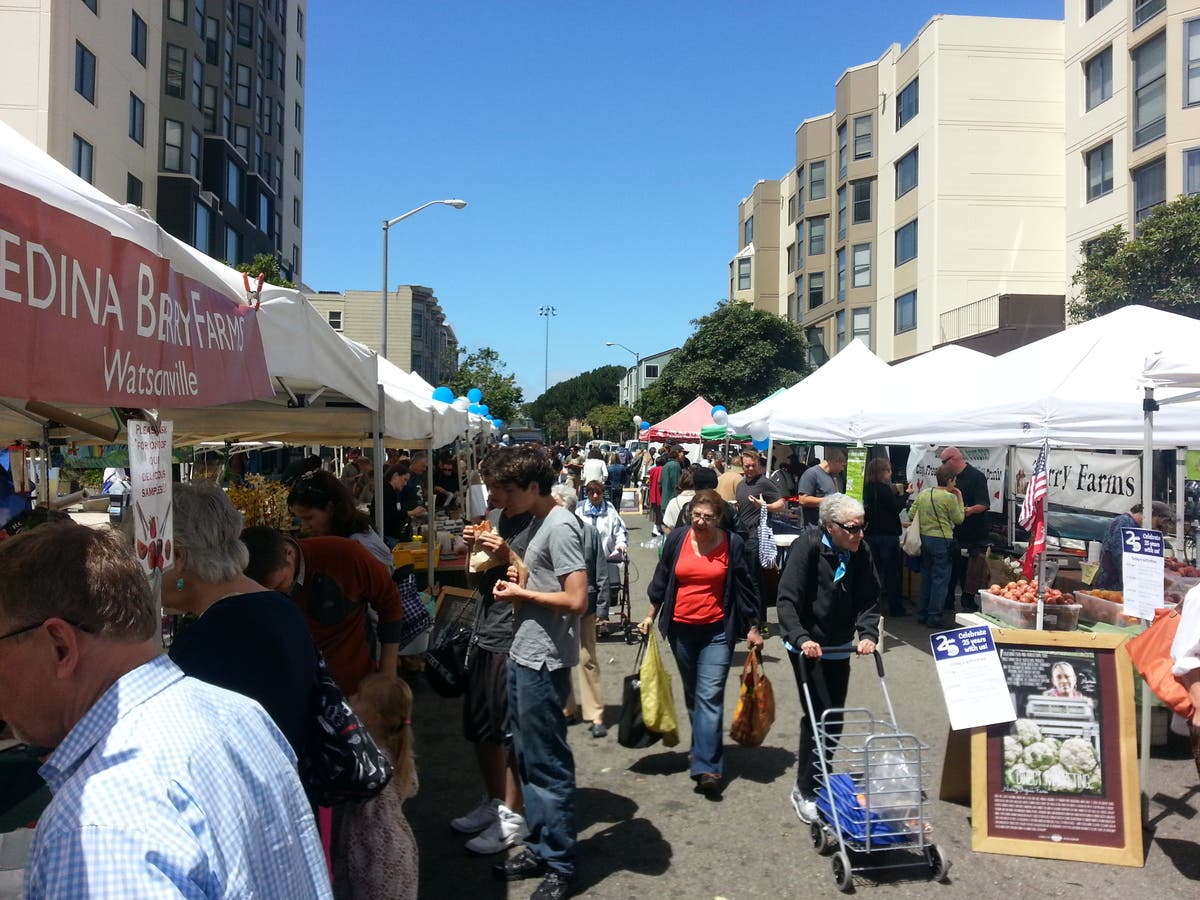
The San Francisco Bay Area consistently ranks as one of the most expensive urban regions in the United States. With the average price of a San Francisco one-bedroom apartment running well over $3,000 per month, many of us Bay Area residents are concerned about money, cost of living, and getting the best deals for our dollar. On top of that, we want to be ethical consumers of local and healthy foods, leading us to grapple with balancing our convictions with our budgets. Grapple no more. Recent data collected by the Pacific Coast Farmers’ Market Association (PCFMA) indicates that food from local farmers’ markets are competitively priced when compared to national retail grocery store chains. So you can live your farm to table ideology and afford it, too.
PCFMA collected data from the Castro and Fillmore farmers’ markets, as well as national chain grocery stores in the Castro and Western Addition neighborhoods. The results indicate that the prices at the farmers’ market are comparable to the grocery stores. Some items were significantly cheaper at the farmers’ market, while other items were cheaper at the grocery store. For example, organic heirloom tomatoes sold for $3.00 per pound at the Castro farmers’ market, while nearby chain grocery stores offered them at an average price of $4.49 per pound. Conversely, conventional broccoli sold at an average of $2.14 per pound at the surrounding grocery stores, while it sold for $2.50 per pound at the Castro farmers’ market. PCFMA selected fruits and vegetables that are commonly found in produce bags in the summer months: tomatoes, peaches, strawberries, broccoli, and potatoes, to name a few. Both organic and conventional produce prices were compared, and special discounts and deals were omitted from the data.
The findings coincide with previous, comprehensive price comparison studies from the Santa Monica Farmers’ Markets, Leopold Center for Sustainable Agriculture, and the Northeast Organic Farming Association of Vermont (NOFA VT), among others. In these past studies, the researchers consistently found that the price differences between supermarkets and farmers’ markets were not statistically significant. As written by the 2011 report published by NOFA VT, “the price comparison study has shown that price differences between farmers’ markets and grocery stores have been to a large extent exaggerated, and that farmers’ markets are an especially affordable alternative for consumers who either currently purchase organic food or who have expressed an interest in buying organic food but are restricted due to high organic prices at grocery stores.”
Find out what's happening in San Franciscofor free with the latest updates from Patch.
Beyond the price comparisons between national chain retailers and farmers’ markets, shoppers make the argument that farmers’ markets offer added value. For many, it is the perceived qualitative aspects of the farmers’ market – such as the congenial atmosphere and freshness of produce – that draws them to shop locally. Produce bought at the farmers’ market is often picked from the vine or pulled out of the ground the day before it is sold to shoppers. This freshness makes for full, robust taste, a taste which shoppers will gladly pay for.
For full results of the PCFMA price comparison project, you can visit the Castro and Fillmore farmers’ market to pick up informational flyers!