Neighbor News
LTE: Can a Developer Buy a Zone to Wreak Havoc In? Seems Like It.
Fairfield's zoning commission is voting on the first of three approvals a developer needs to build at 111 Mill Hill Road. Part 3.

To the Editor:
On February 27, the president of the Ludlowe Park Association, Elise McKay, sent a one-page letter to Fairfield's Plan and Zoning Commission. She asked two questions.
First: A developer wants up to nine housing units at 111 Mill Hill Road. The property sits in a residential zone where that isn't allowed. Doesn't the developer first need to change the zone?
Find out what's happening in Fairfieldfor free with the latest updates from Patch.
Second: The new rule the Commission is considering requires a one-acre lot. 111 Mill Hill is forty thousand square feet — about eight percent short of an acre. Doesn't the developer also need a waiver?
Four months later, the Commission has not answered. The rule is still on the docket.
Find out what's happening in Fairfieldfor free with the latest updates from Patch.
The vote you can see, the steps you can't
The proposed rule, called Section 10.3.D, would allow up to nine housing units on a single one-acre lot. To put that in perspective: an acre divided nine ways is about 0.11 acres per unit — roughly the size of a typical suburban back yard. The surrounding properties on Mill Hill Road are single-family homes on lots two to three times that size. The new rule, in effect, would allow nearly three times the residential density of the surrounding neighborhood — on the same parcel that doesn't currently meet the rule's own minimum acreage.
The rule's criteria — at least one acre, in a specific corridor, with road access — sound general. In practice they describe one specific property: 111 Mill Hill Road. The developer is True You Design and Development LLC. The attorney is Christopher Russo.
The developer's application — submitted February 6 — never named 111 Mill Hill. Neither did the Town's February 24 agenda. McKay was the first person to put the address on the public record.
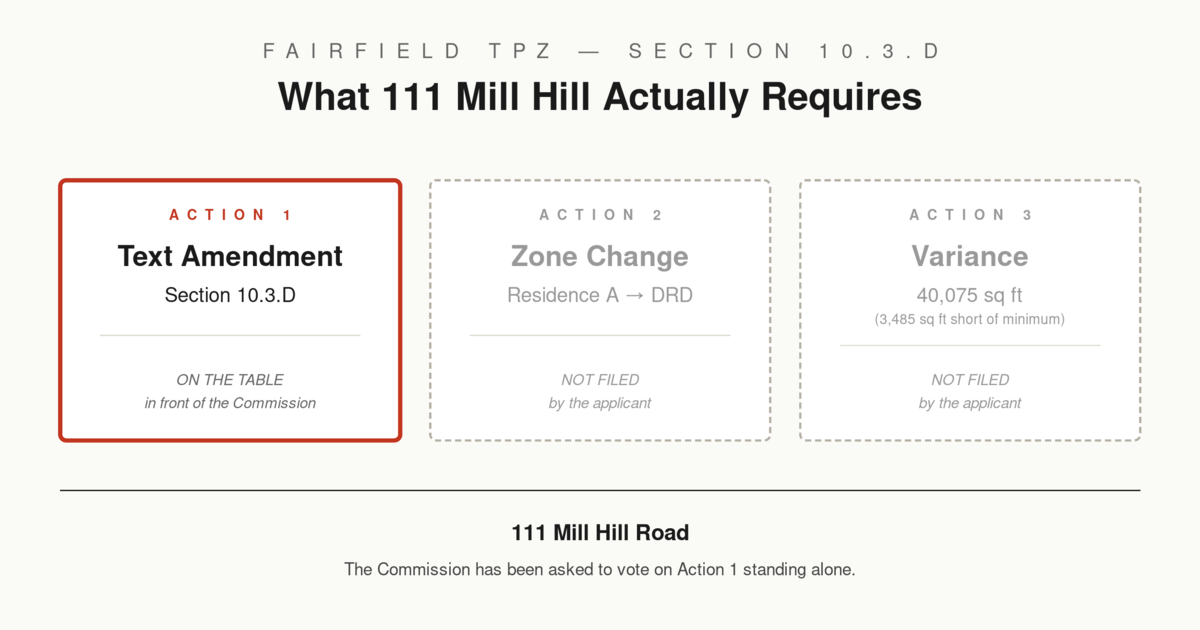
Even if the Commission passes the rule, the developer cannot actually build at 111 Mill Hill on that vote alone. Two more things have to happen first:
- A zone change. The property is in Residence A. The new rule applies only to what Fairfield calls a Designed Residence District — one of several "Designed" zones in town where the rules are flexible enough to be tailored for individual developers. Moving 111 Mill Hill from one zone to the other requires a separate hearing and a separate Commission vote.
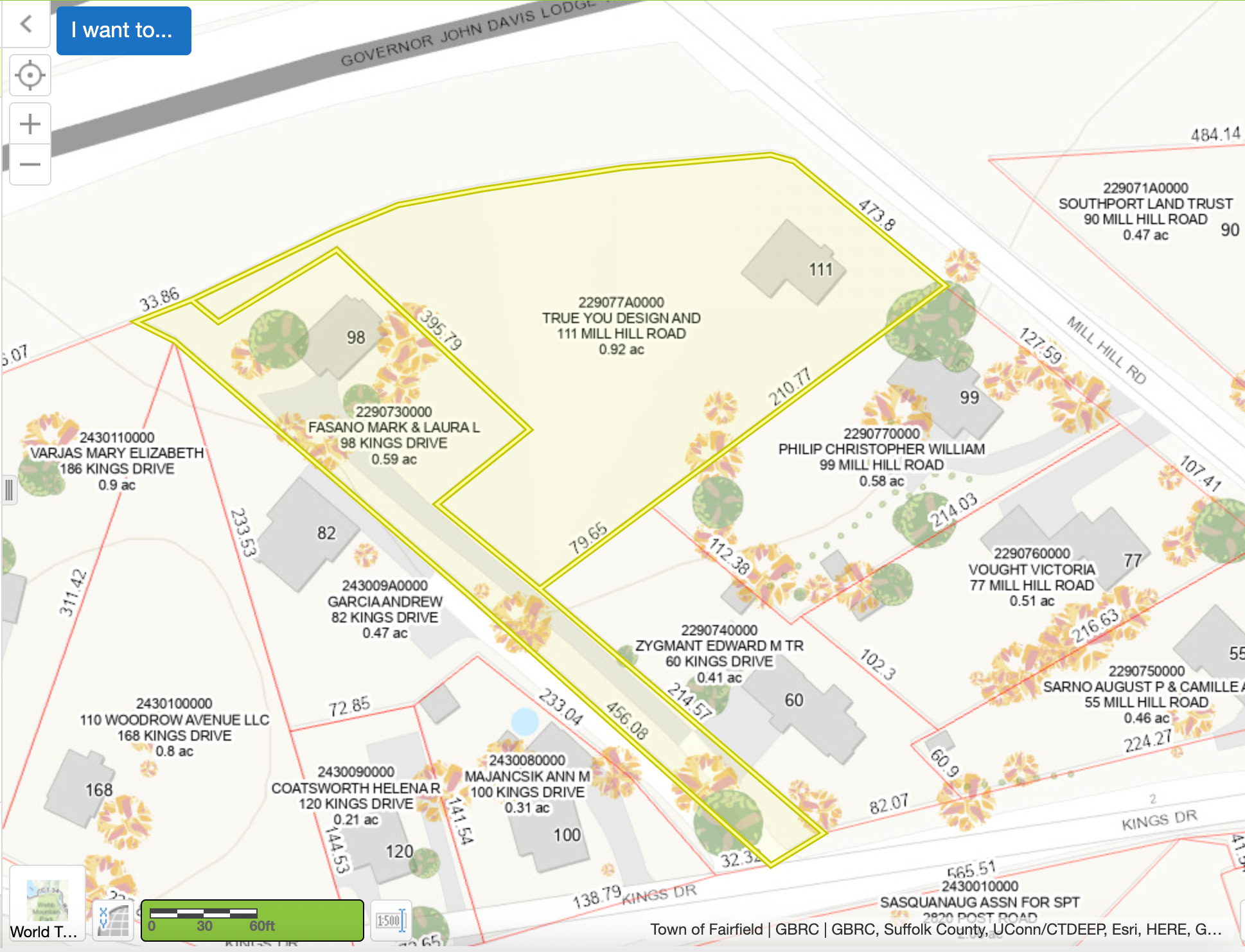
- A waiver or land assembly. The property is 40,075 square feet — 3,485 square feet short of the new rule's one-acre minimum. The developer would need a variance — or would need to combine 111 Mill Hill with the adjacent parcel at 98 Kings Drive, the flagpole lot visible on the Town's public assessor map. Either route requires a separate approval the developer has not filed.
The Commission is being asked to vote on Step 1. The developer has not filed Step 2 or Step 3.
The Town's Planning Director confirmed all three steps in writing to McKay within hours of McKay's letter. That confirmation has been on the public record since February 27.
"Summary review" and "as of right" are different
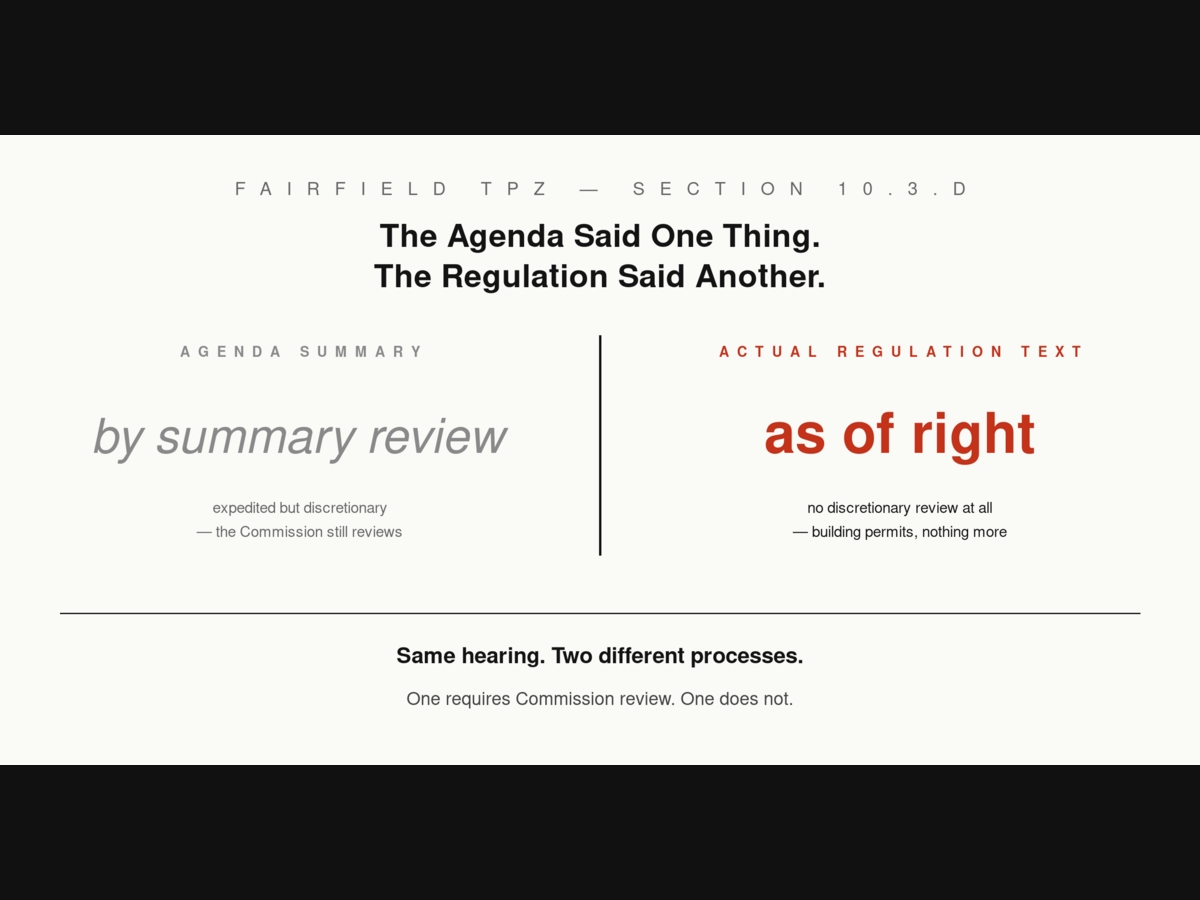
The Town's agenda summary describes the new rule as proceeding "by summary review." The actual text of the rule says "as of right."
The phrases mean different things. Under summary review, the developer files an application and the Commission has to act on it within sixty-five days. The grounds on which it can deny are limited — but an application exists, and a Commission vote exists.
As of right eliminates the application. Any qualifying lot owner could build a nine-unit development without ever appearing before the Commission, without staff approval, and without notifying neighbors.
The agenda summary used the gentler phrase. The rule itself uses the more aggressive one.
The Commission has rejected this playbook before
The same attorney filed a separate application the same week for a different client — Section 10.19, an age-restricted housing development at 1477 Congress Street. Same structure: a custom-fit rule presented as a general one.
The Commission voted on 10.19 on May 26. Seven to zero against. Every member opposed.
Chair Tom Corsillo, in chambers: "This applicant started with a development and tried to ret-con a zoning framework."
Commissioner Steve Levy: "a text amendment in wolf's clothing."
The Commission had the tools to recognize a custom-fit rule. They used them. The question is why they have not yet used them on this one.
The Town didn't do its homework
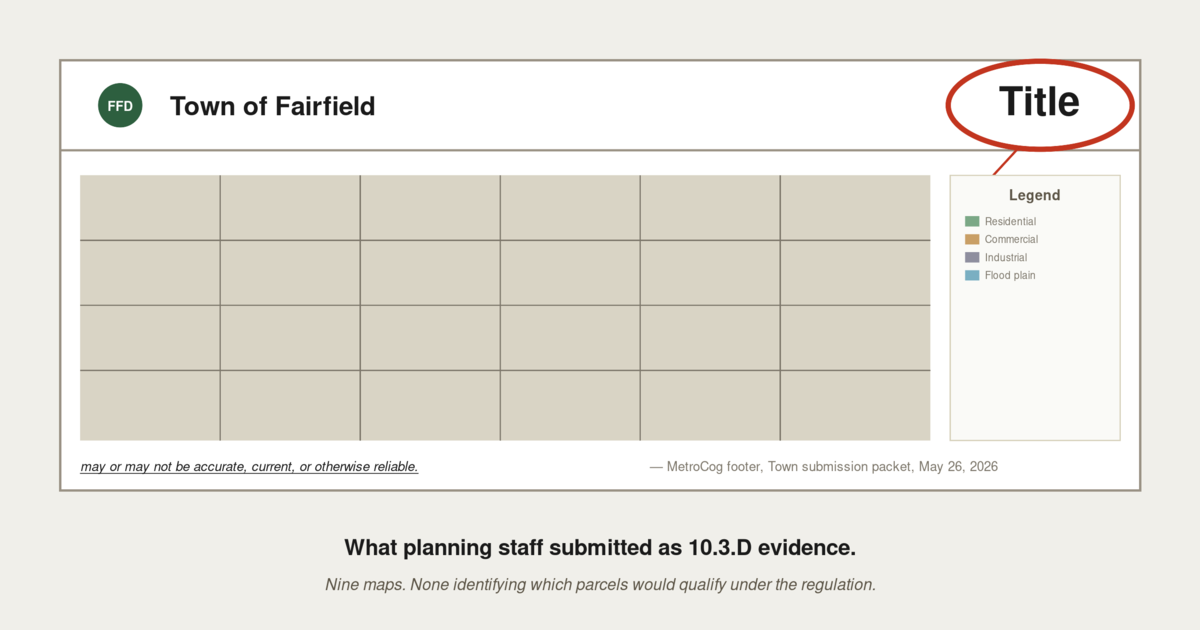
If 10.3.D is really a general rule, the Town should be able to map which properties it would apply to. Planning staff did not produce that map.
On the morning of the May 26 hearing, the Planning Department uploaded nine zoom-in aerial maps to the Town's public site. None of them highlights which properties would qualify under the new rule. None identifies 111 Mill Hill. Each was produced by an outside regional agency. Each carries a footer that says the data "may or may not be accurate."
And each one — in the spot where a descriptive title would normally go — still reads the word "Title." The placeholder from the template was never replaced.
McKay's twenty-home neighborhood association did the work the staff did not. Within seventy-two hours of the Commission's February 24 referral, her one-page letter named the property, the zoning problem, and the size problem. The Town has had four months. No comparable analysis exists in the public record.
The chairman's own words
In a Patch op-ed published June 11, Tom Corsillo wrote that "developer-initiated changes" to Fairfield's zoning should be met with public skepticism. His own Commission has two such changes in front of it this year — Section 10.3.D and the now-denied Section 10.19 — both filed by the same law firm.
He has not, as of this writing, applied that test to the case in front of him.
In his day job, Corsillo is a developers' advocate. That is not interpretation. City & State New York — an industry publication covering New York political consulting — identifies Tom Corsillo in its 2026 industry feature as a twenty-year veteran of the public-affairs firm Marino, where he has "carved out a lane as a housing expert" and where his paid clients include institutional lenders whose business depends on housing development.
A reader can decide what to make of that.
Why this matters
Reasonable people will disagree about whether 111 Mill Hill should be developable as a nine-unit residential cluster. Some will support the project on the merits. Others will have concerns about traffic, parking, character, or the integrity of the existing zoning. That is the normal back-and-forth of land-use politics, and the Commission exists to mediate it.
The question this column raises is structurally prior to any judgment about the project. It is whether the zoning framework should be modified — by general regulation — to accommodate a specific property that does not currently qualify, in a current zoning district that does not currently apply, at a parcel size that does not currently meet the proposed regulation's own threshold. If the answer is yes for 111 Mill Hill, then by the same reasoning the answer is yes for any parcel a property owner with adequate legal representation wishes to qualify. Zoning stops functioning as a stable framework. It begins functioning as a discretionary licensing system in which favored parties get their regulations written for them.
The Ludlowe Park Association recognized this on February 27, three days after the Commission referred the amendment to public hearing. A 20-home homeowner association asked the structural questions in writing. Four months on, the Commission has not answered them in public.
10.3.D is still pending. The Commission has not voted. They demonstrated in May that they can recognize a custom-fit rule when they choose to look. They have not yet chosen to look at this one.
There is still time.
Emily Hau is a Fairfield resident and she is paying very close attention.
Read the series:
Part 1: How Fairfield's TPZ chairman spends his day job advising New York housing-finance lenders — and why his public posts about that work matter for the residents whose zoning he votes on. patch.com/connecticut/fairfield/fairfields-tpz-chair-voted-against-parking-protection-nodx
Part 2: How Fairfield's TPZ chairman voted three times against engaging outside legal counsel on Connecticut's new housing law — and why his New York day job involves advising on exactly that kind of legislation. patch.com/connecticut/fairfield/why-fairfields-tpz-voted-5-2-three-times-keep-public-hearing-cts-new-housing-nodx
You're reading Part 3: The developer-initiated zoning regulation amendments now in front of the Commission, and the specific 0.92-acre Mill Hill Road parcel one of them appears to have been drafted for. patch.com/connecticut/fairfield/can-developer-buy-zone-wreak-havoc-seems-it-nodx
Part 4: How Fairfield's TPZ chairman used a bylaws subcommittee to constrain a sitting commissioner — and why the video of her resignation isn't on the Town's official YouTube. patch.com/connecticut/fairfield/six-minutes-secretary-resigned-video-gone-nodx
Part 5: How Fairfield's planning director misstated a regulation her own office had just drafted — and why her misstatement defined a 4-3 vote that left downtown unprotected. https://patch.com/connecticut/fairfield/she-said-protecting-downtown-would-destroy-it-regulation-said-otherwise-nodx
Part 6: How Fairfield's TPZ Vice Chairman responded to the series — and why the response, which does not dispute a single fact, is the record's strongest possible endorsement. patch.com/connecticut/fairfield/tpz-vice-chairman-randolph-asked-solutions-let-me-repeat-them-nodx