Neighbor News
LTE: Why Fairfield's TPZ Voted 5-2 — Three Times — to Keep the Public From Hearing About CT's New Housing Law
To make residents feel like the unreliable narrators of their own town's planning process. Part 2.

To the Editor:
If you've ever sat through a Fairfield Town Plan & Zoning Commission meeting and walked out feeling like something was off — like there was something you weren't being told, and you were being reassured a little too smoothly that nothing was amiss — you weren't imagining it.
I've spent the last several months following this Commission closely. To see the pattern, you have to read hundreds of pages — agendas, application narratives, zoning regulation texts — and notice that the language describing this week's item is not the same as the language describing the same item last week. Most residents, reasonably, don't have the time. That's where the pattern hides.
Find out what's happening in Fairfieldfor free with the latest updates from Patch.
The pattern is consistent. Agenda items are routinely described in language friendlier than the regulations they enact. A developer-initiated text amendment that the regulation itself describes as as-of-right — meaning anyone can build, no public hearing — has appeared on the agenda for five consecutive meetings labeled “by summary review.” A March amendment the agenda described modestly as a “Parking Needs Assessment” for buildings over seventeen units turned out, in operation, to eliminate parking requirements for residential developments of sixteen units or fewer. When residents — or even fellow commissioners — push back, the response from the leadership is a calm undercut: what do you mean, we've already dealt with that, it's a non-issue.
This piece is about one specific instance of that pattern: a lawyer's briefing on Connecticut's new housing law that the four-vote majority of the Commission voted, three times by 5 to 2, to keep out of the public's earshot.
Find out what's happening in Fairfieldfor free with the latest updates from Patch.
Public Act 25-1 is the biggest housing-zoning law Connecticut has passed in a generation. Three times this year, Fairfield's Town Plan & Zoning Commission voted not to let the public hear the Town Attorney explain what it means for Fairfield. The attorney is Phil Pires of Cohen & Wolf, whose firm is paid roughly $1 million per year by the Town, per documents released under a Freedom of Information request.
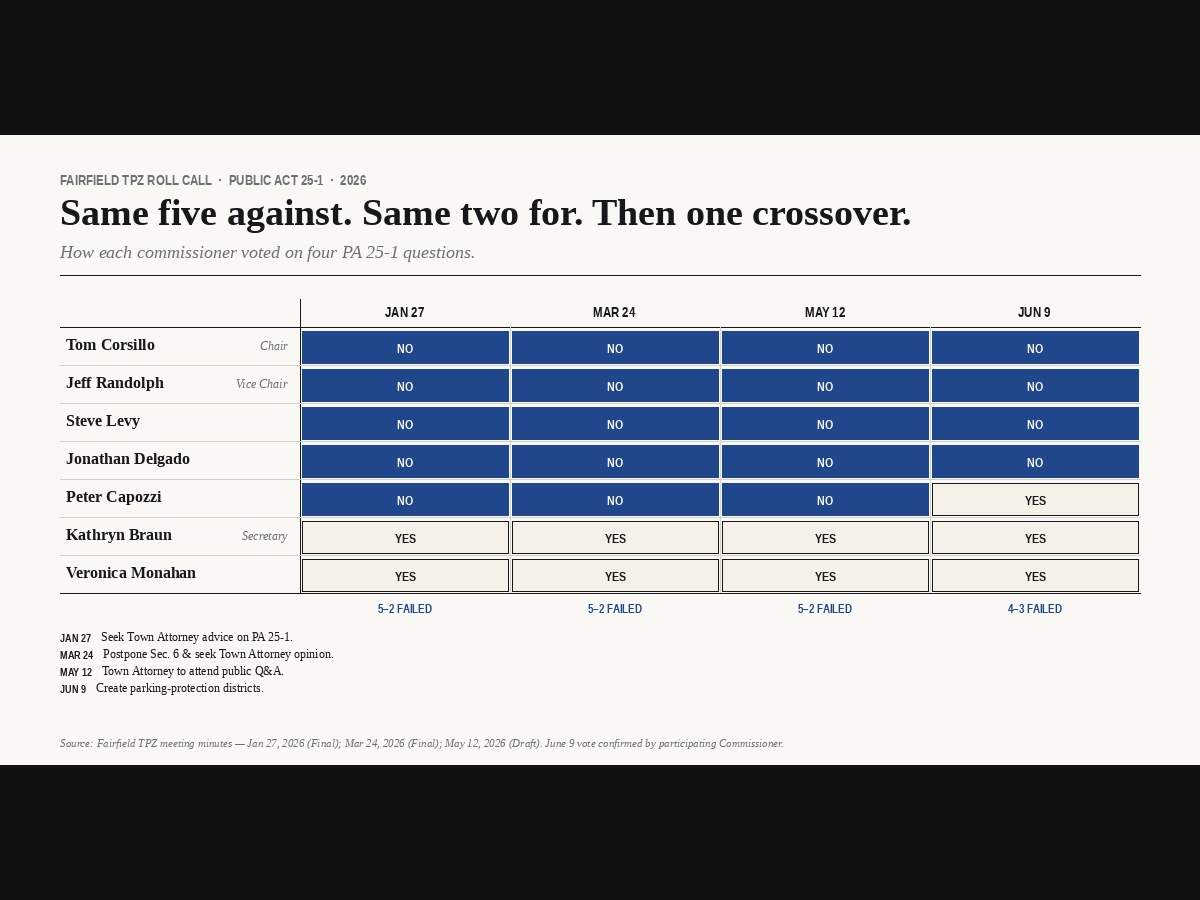
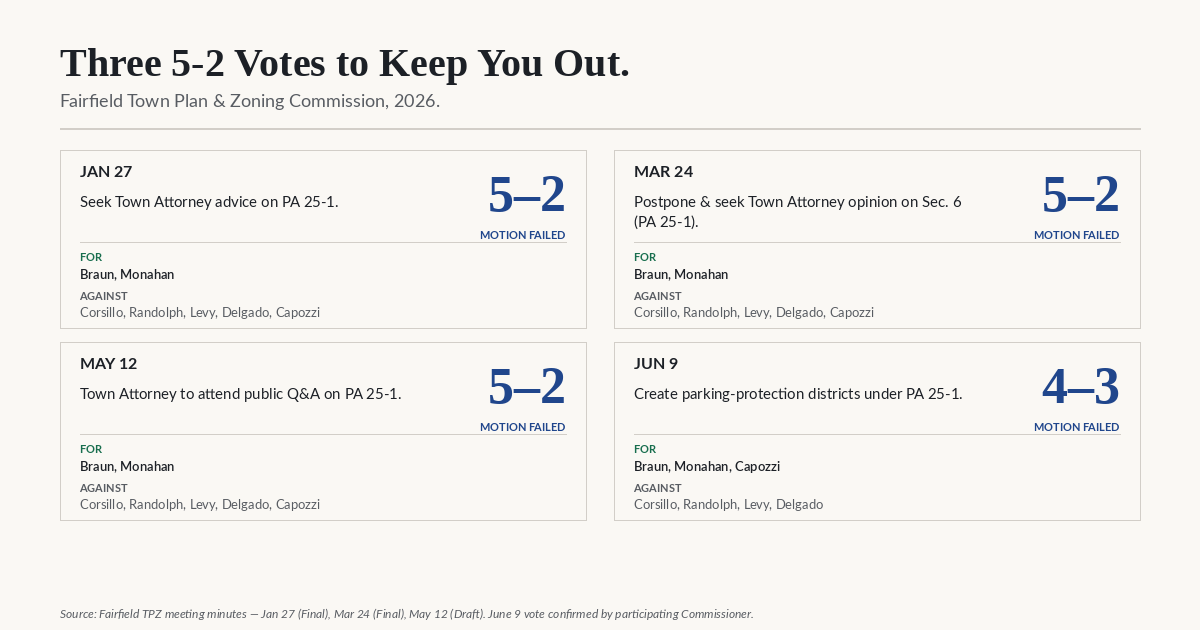
The motions varied in form. The substance was the same. On January 27, Commissioners Kathryn Braun and Veronica Monahan moved to seek the Town Attorney's advice on the interpretation of H.B. 8002 — the bill that would become PA 25-1. Failed 2-5. On March 24, the day the Commission adopted amendments to Section 6 of the Zoning Regulations under PA 25-1 — the amendments that rewrote how downtown Fairfield is developed — Braun moved to postpone the vote and request the Town Attorney's opinion. Failed 2-5 by the same five. On May 12, Braun and Monahan moved that the Town Attorney attend a Q&A. Failed by the same five.
The two yes votes, each time, were Braun and Monahan. The five no votes, each time, were Chair Tom Corsillo, Vice Chair Jeff Randolph, Steve Levy, Jonathan Delgado, and Peter Capozzi.
The story isn't whether Fairfield got legal advice on PA 25-1. The story is that the public was never allowed to hear it.
The lawyer existed. At the Commission's June 2, 2026 meeting (Fairfield TV YouTube recording, around 46:26), it was confirmed on the record that the Town Attorney had reviewed the language of Fairfield's PA 25-1 compliance regulations before the Commission adopted them in March. The legal analysis was there. It never made it into open session.
The Chair understood the statute. On January 23, 2026 — four days before the first 5-2 vote — Tom Corsillo appeared on a public housing seminar panel hosted by State Representatives Cristin McCarthy Vahey, Sarah Keitt, and Jen Leeper. The panel is on YouTube. Over one hour and forty-three minutes, he discussed PA 25-1 in detail. He explained the bonus HUE-point pathway for middle housing in residential zones. He explained the §8-30g moratorium math. He explained that PA 25-1 allows towns to designate up to two parking-protection districts, each up to 4% of town area:
“To the extent we think there are places where it's important to preserve those parking requirements, there is the ability to do that.”
The Commission had already acted. Six weeks after the panel, on March 3, the Commission adopted amendments to Section 25 of Fairfield's Zoning Regulations. The agenda described the item modestly. The substantive effect, restated on the June 2 record: residential developments of sixteen units or fewer can now operate without specific parking standards. That's operative law in Fairfield today. On March 24, the Commission adopted Section 6 Designed Business District amendments under PA 25-1 — the amendments rewriting how downtown Fairfield is developed — and rejected, 5-2, Braun's motion to postpone for Town Attorney review. Per the June 2 discussion, the scope of what the March amendments would allow was not fully understood by many of the commissioners present beyond the Planning Director.
Then May 12. On the day of the third 5-2 vote, the Chair told his Commission he did not know what was happening on July 1. July 1, 2026 is the effective date of §16 of Public Act 25-1 — the same provision the Chair had described, by mechanism, on the January 23 panel. The January testimony was specific, accurate, and forty-three minutes long. By May 12, the Commission had already adopted both the March 3 Section 25 parking amendments and the March 24 Section 6 Designed Business District amendments under PA 25-1. Three times — January 27, March 24, May 12 — by 5-2 vote, the four-vote majority declined to bring into the public's earshot the same legal analysis the Commission's leadership had already used to act.
The June 9 vote. Four weeks later, the Commission voted 4-3 against creating any of the parking-protection districts the Chair had specifically described on the January panel as available to the Town. The three votes in favor were Commissioners Braun, Monahan, and Capozzi. The publicly-submitted comment record was unanimous in favor of designation. The motion failed in the absence of any public, shared understanding of what the statute actually permits.
The op-ed. Two days later, Tom Corsillo published an op-ed in this space titled “Planning Proactively for Fairfield's Future.” It does not mention Public Act 25-1 by name. It does not mention the three 5-2 votes. It does not mention the June 9 vote. It does not mention 10.3.D, the developer-initiated zoning regulation amendment that first appeared on his Commission's agenda ten days after the Chair posted on Bluesky calling residents who object to parking-minimum elimination “dishonest status quo advocates.”
The op-ed also implies that Fairfield has never planned proactively for its future before. That is false. Fairfield has had affordable-housing plans since the 1980s. The 2016 POCD existed. The 2025 POCD was the product of seven years of public input under the prior Commission. Proactive planning has been Fairfield's posture for decades. What the op-ed calls “planning proactively” is something else.
What it calls planning is, in practice, the opposite. It is agenda items written modestly so the substance gets through quietly. It is Town Attorney advice reviewed in private. It is months of internal preparation that converges, at a single meeting, into a moment when the room realizes the thing has already been done. June 2 was such a moment.
If you've felt, sitting through these meetings, that the description of what was happening did not match what was happening, that is not your imagination. That is the work product.
TPZ Chair Tom Corsillo calls it planning for Fairfield's future. The record shows him arranging the work so that by the time the public realized what was happening, it was a fait accompli.
Emily Hau is a Fairfield resident.
Read the series:
Part 1: How Fairfield's TPZ chairman spends his day job advising New York housing-finance lenders — and why his public posts about that work matter for the residents whose zoning he votes on. patch.com/connecticut/fairfield/fairfields-tpz-chair-voted-against-parking-protection-nodx
You're reading Part 2: How Fairfield's TPZ chairman voted three times against engaging outside legal counsel on Connecticut's new housing law — and why his New York day job involves advising on exactly that kind of legislation. patch.com/connecticut/fairfield/why-fairfields-tpz-voted-5-2-three-times-keep-public-hearing-cts-new-housing-nodx
Part 3: The developer-initiated zoning regulation amendments now in front of the Commission, and the specific 0.92-acre Mill Hill Road parcel one of them appears to have been drafted for. patch.com/connecticut/fairfield/can-developer-buy-zone-wreak-havoc-seems-it-nodx
Part 4: How Fairfield's TPZ chairman used a bylaws subcommittee to constrain a sitting commissioner — and why the video of her resignation isn't on the Town's official YouTube. patch.com/connecticut/fairfield/six-minutes-secretary-resigned-video-gone-nodx
Part 5: How Fairfield's planning director misstated a regulation her own office had just drafted — and why her misstatement defined a 4-3 vote that left downtown unprotected. https://patch.com/connecticut/fairfield/she-said-protecting-downtown-would-destroy-it-regulation-said-otherwise-nodx
Part 6: How Fairfield's TPZ Vice Chairman responded to the series — and why the response, which does not dispute a single fact, is the record's strongest possible endorsement. patch.com/connecticut/fairfield/tpz-vice-chairman-randolph-asked-solutions-let-me-repeat-them-nodx