Sports
Rocky Hill Native Pitches for Bowie Baysox
Pitcher discusses playing for the Baltimore Orioles double a team.
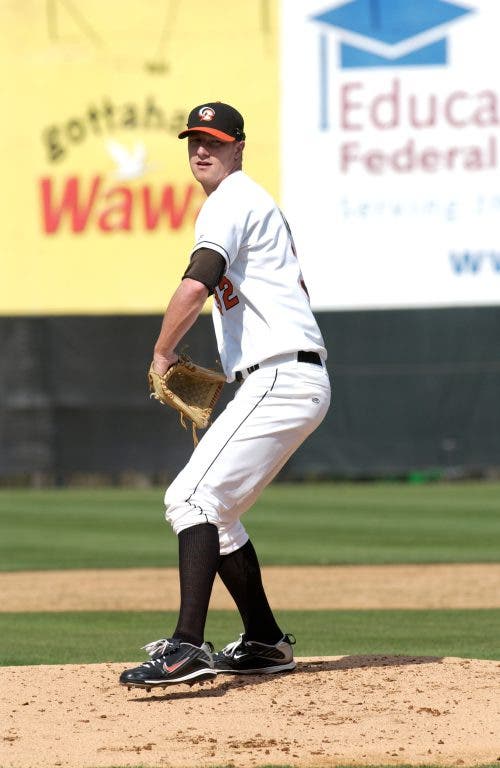

Rocky Hill’s Pat Egan has spent five years as a pitcher in the Baltimore Orioles organization after being drafted in the 35th round in 2007. Before being drafted, Egan was a baseball and basketball star at and led the Terriers to a state basketball title.
After high school, he established himself as one of the best pitchers in the history of ’s baseball program.
Despite substantial injury issues in college, Egan has rewarded the Orioles' faith in him with a 3.41 career ERA, establishing himself as a reliable reliever with an excellent sinkerball.
Find out what's happening in Rocky Hillfor free with the latest updates from Patch.
Though Egan, 26, has struggled during his time in Triple A, he is again thriving with the Double A Bowie Baysox and hopes to again be promoted later in the season.
He talked to Patch reporter Daniel Atkinson earlier this week about life in the minor leagues.
Find out what's happening in Rocky Hillfor free with the latest updates from Patch.
Daniel Atkinson: You are from an area where very few professional baseball players and athletes come from. What about your game and personality allowed you to succeed where players you competed against in the area did not accomplish that?
Pat Egan: I don’t think my skills were that much better than anyone else when I was younger. I just worked hard and was very determined to succeed. I had a few lucky breaks and was in the right place at the right time, where people were able to see my skills. From there my career fell into place.
DA: You were putting together an impressive career at Quinnipiac before a blood clot in your shoulder and then Tommy John surgery derailed your career and forced you to lose significant time. How were you able to maintain being a successful pitcher and able to sustain the Baltimore Orioles interest when you returned to the mound? How did your injury problems change you as a pitcher?
PE: It was definitely tough. I was lucky that a lot of people, like my teammates and coaches and my family, gave me a strong support group and kept me focused on my ultimate goal of getting drafted and making the big leagues. But it was really frustrating not being able to be on the mound helping out your team. I had to take a step back and learn how to pitch again. The break I had from the game allowed me to study it and learn how to be more of a pitcher. I learned that I couldn’t try and strike everybody out, and that I would have to mix things up more if I wanted to be successful.
DA: You were converted into being a full-time relief pitcher in 2009 as you reached high A ball. What do you think the organization saw in you that made them want to have you in a relief role, and how hard of an adjustment was it for you to go from a starting role to a relief one?
PE: Well, almost all pitchers are drafted as starters. Hardly anyone comes out immediately as a reliever, so it’s a transition players are used to. With my sinker and ability to get ground balls, I think the organization just thought I’d be strong at getting teams out of jams. I’ve had to prepare myself differently and have a new mindset when I’ve known I’d only throw 1-3 innings, but by now I’m completely used to relieving.
DA: What has been the biggest difference between pitching in the lower leagues and pitching in Double A and Triple A the past two years?
PE: The quality of the hitters in the higher leagues is much better. The hitters up here have much better patience and a better command of the strike zone. If you leave a pitch down the middle or up in the zone, you’re in trouble. In the past, I could just try and strike out hitters. Now, I have to attack the strike zone if I want to be effective.
DA: You are known as having a strong sinkerball and great control and as pitcher who can get important ground-ball outs or strikeouts when a team is in desperate need of them. Do you think that description is accurate, and is that the role you see for yourself now and in the future?
PE: Yeah, I definitely think it’s accurate. I created a role for myself as I moved up. I’ve always had a good sinker, and I’ve worked really hard to establish it as a pitch that hitters have trouble with. I know I can’t overpower guys at this level and in the majors, so I need to throw strikes and get ground-balls if I want outs.
DA: Except for a brief stint with Milwaukee this winter, you have been with the Orioles organization your entire career. Is it frustrating at all to be with an organization that has struggled for so long at the big-league level and that has so many barriers to success?
PE: Obviously Baltimore hasn’t been good in a long time, but I and my teammates don’t really think about what’s going in with the Orioles. We just all want to make it up there and hope to get a change to turn the team’s fortunes around. It’s tough when the Orioles are in the AL East and trying to rebuild through the minor leagues, but I think they’ll be good sooner or later.
DA: In your second stint with Triple A Norfolk during the first three months of the season you had your most significant struggles of your career, posting a 5.12 ERA, before demoted to Bowie, where you have gotten back on track. How frustrating were your struggles at Norfolk, and why were able to regain success once being demoted back to Double A?
PE: Being demoted to Double A was the most disappointing moment of my career. I was disappointed in myself and the fact that I didn’t attack batters in Triple A like I should have. I’m trying to look at the moment as a turning point for me. I’ve used the last month to work on my pitching and getting back to basics, and so far I’ve had my old success here. Hopefully I’ll be called up again soon.
DA: You are 26 and have been in the minor leagues since 2007. Realistically, how long are you going to keep going?
PE: I know I’ve been in the minors for a while. But I will stay with baseball as long as teams will have me and my body lets me. A lot of people say they want to play in the major leagues when they are kids, but it has truly been a dream of mine to make it there my entire life. I have given all I can to be a major league pitcher, and will keep giving all I can. I know I have the skills to do it. All it takes is one right opportunity or situation. You see guys making it the big leagues when they’re 29 or 30, so you know it can happen. I’m not close to giving up yet.