Community Corner
Remembering Herndon's History: The Village Blacksmith
Barbara Glakas recalls the history of Henry Simms, one of Herndon's first Black business owners.


By Barbara Glakas
HERNDON, VA — Henry Simms was the only blacksmith listed in the Town of Herndon’s first official census in 1880. He also happened to be one of the only African Americans in the Town of Herndon to own a business.
The Town of Herndon was incorporated in 1879. It’s first enumerated census of the people who lived within the incorporated town limits was taken in 1880. That year, there were 422 people living in the town. Of those 422 people, 88 of them were listed as “heads of households.”
Find out what's happening in Washington DCfor free with the latest updates from Patch.
Simms was listed as a blacksmith. It is known that he owned his own blacksmith business. Two other African American men – Frank Weaver and Robert Clemons – were listed as farmers while others were listed as laborers or servants.
Simms was born in South Carolina, but his birthdate is not clear, with various documents showing he was born anywhere between 1832 and 1841. It is also not clear exactly when Simms came to Virginia, since records on African Americans prior to the 1863 Emancipation Proclamation are sparse. However, according to a website “Northern Virginia History Notes,” the first year that former slaves were included on the Fairfax County Personal Property Tax ledger was 1866. Those records show that Simms was mentioned in Fairfax County tax records in 1868 and 1869.
Find out what's happening in Washington DCfor free with the latest updates from Patch.
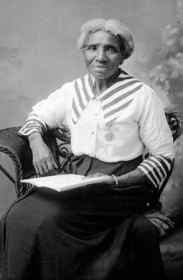
Census records show that Simms married Ann “Annie” Moten (sometimes written as Morton) in Herndon in 1867. Annie Simms was born in around circa 1847/1848 in Virginia, specifically in Herndon, according to at least one record. She would ultimately bear 15 children although by 1900 only nine had survived.
It is not exactly known where the Simms family lived in the 1860s and early 1870s. However, the 1870 Fairfax County census showed that Henry Simms lived in the “Herndon, VA Post Office” area. Other people who were listed on the same census page as Henry Simms were known to live in the area that would later become known as the Town of Herndon — people such a William Roby, Lawrence Hindle, and Lyman Ballou.
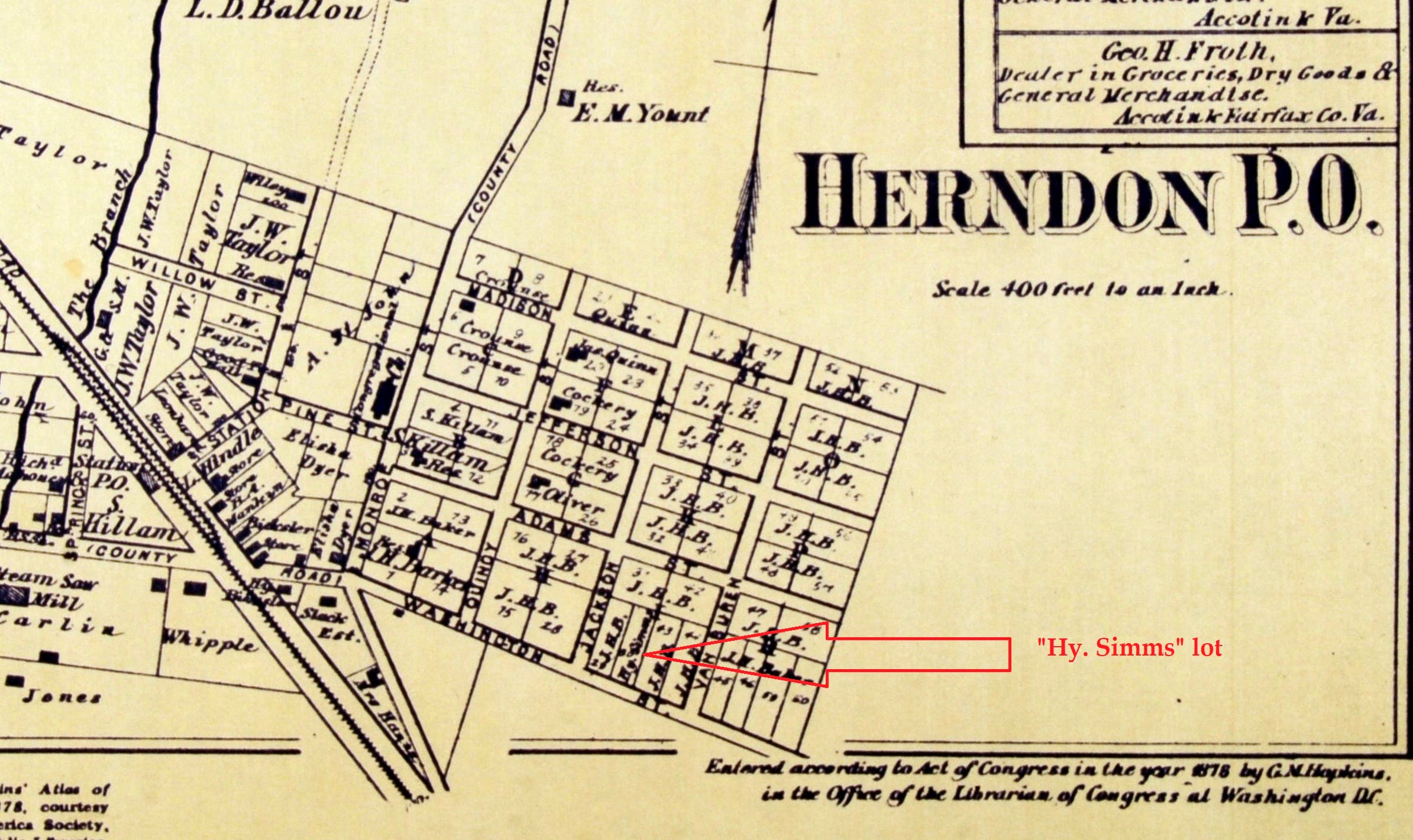
In 1878, Henry Simms bought a parcel of land in Herndon, about 1 acre in size, for $75. The lot of land was located in the vicinity of the northeast corner of Elden and Jackson streets, now the present-day location of Jiffy Lube. This parcel can be seen on the 1878 map of Herndon. The lot is marked on the map, “Hy. Simms.” The lot marked “Hy.Simms” is the former “Lot #30” of John Barker’s subdivision. But the deed indicated that Henry Simms may have owned both Lot 30 as well as the lot next door, Lot 29. That would have been equivalent to about 1 acre.
In 1891, Henry Simms recorded a declaration which said,
“By and between Henry Sims of County of Fairfax, in the State of Virginia, who doth hereby declare his intention as a householder and head of a family, to claim the full benefit of a “Homestead” under Article XI, of the Constitution of Virginia, and of the act of the General Assembly of Virginia, passed June 27th, 1890, relating thereto; the same to be exempt from Levy, Seizure, Gameskeeping, or Sale, in the following property, viz.”
The property he listed was: a house and one acre of land in the Village of Herndon ($500); a set of blacksmith tools ($20); one horse ($25); household furniture ($25); and two hogs ($20).
This confirms that Henry Simms lived on the same lot where he had his blacksmith shop, a common practice of that time.
Henry Simms and his family can be found on Herndon census documents up through the year 1900. In that year, he was listed as being 60 and his occupation was still blacksmith. Along with his wife, he had a daughter (Mary) and two sons (Joseph and James) living in the house with him that year. The census indicated that Henry Simms could neither read nor write, but his children could. Both of the boys were teenagers that year, but they were also both listed as blacksmiths as well. At least three of Henry Simms' sons practiced blacksmithing. Their oldest son, George (b. 1868), would become a blacksmith as well.
Deed records show that in 1903 Henry/Anna Simms of Herndon sold 5,115 square feet of his land to three trustees of the Herndon Baptist Church — Thomas J. Moffett, Wesley Kephart and Curtis E. Greslam. That amount of land equaled about one-tenth of an acre. The Herndon Baptist Church had been built at the corner of Elden and Monroe streets just a couple of years prior. Part of the land at the north end of Henry Simms' property would later be used to build a parsonage for the Baptist church, a building which still stands today at 730 Jackson St.
It is not known what happened to Henry and Annie Simms after 1903. However, we see in a 1910 census that one of their sons – James Henry Simms – was a 24-year-old widower, living alone on Elden Street. He was a blacksmith and owned his own shop, presumably his father’s former shop.
James Simms married Irene Brooke in 1911. And in 1918, at the age of 33, he registered for military service during World War I. It is not believed that he ever served. The 1930 census said he was not a veteran.
In the 1920 Herndon census, James and Irene Simms were listed as living in the Barker subdivision. His occupation was still listed as a blacksmith, the trade he learned from his father, Henry. James Simms had firmly replaced his father as one of the town’s blacksmiths.
By 1930, James and Irene Simms were still living Herndon, with two sons – Joseph and Daniel. They owned their own home and, at the age of 46, James was still working as blacksmith. But sadly, Irene Simms died in 1933 and James became a widower once again.
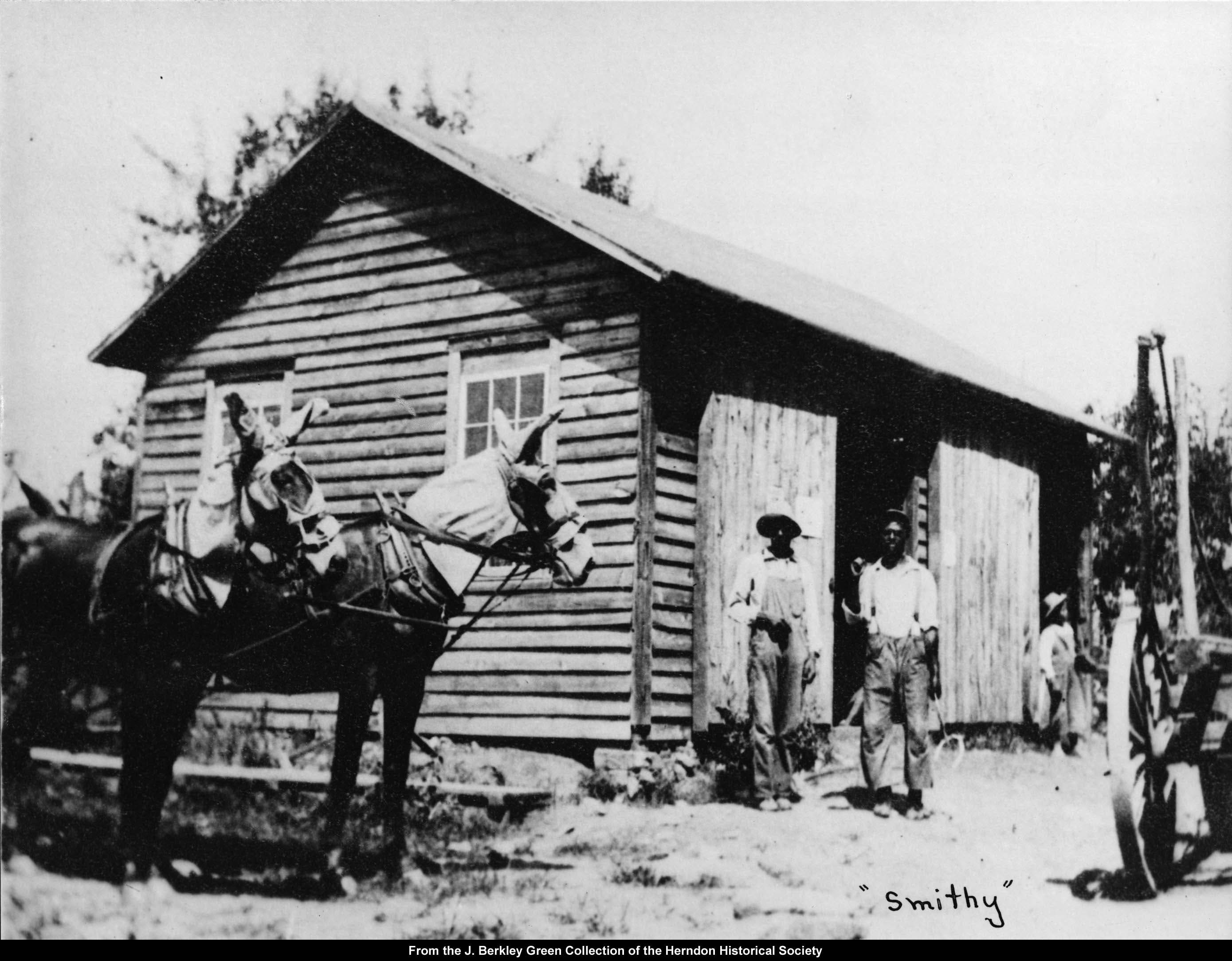
James Simms married Ada Adams in 1936. In the 1940 census, James Simms, was 56, still working as a blacksmith, and living in Herndon with his new wife, Ada. In 1942, James Simms registered for World War II but, again, was not known to have served. His registration card indicated that he lived on Washington Street, which is what Elden Street east of Monroe Street was once called.
Although there are not any sources which talk about the townspeople’s memories of Henry Simms, there were many long-time Herndon residents who remembered his son James and his services as the town’s blacksmith. However, those people called James by his nickname, “Pete.”
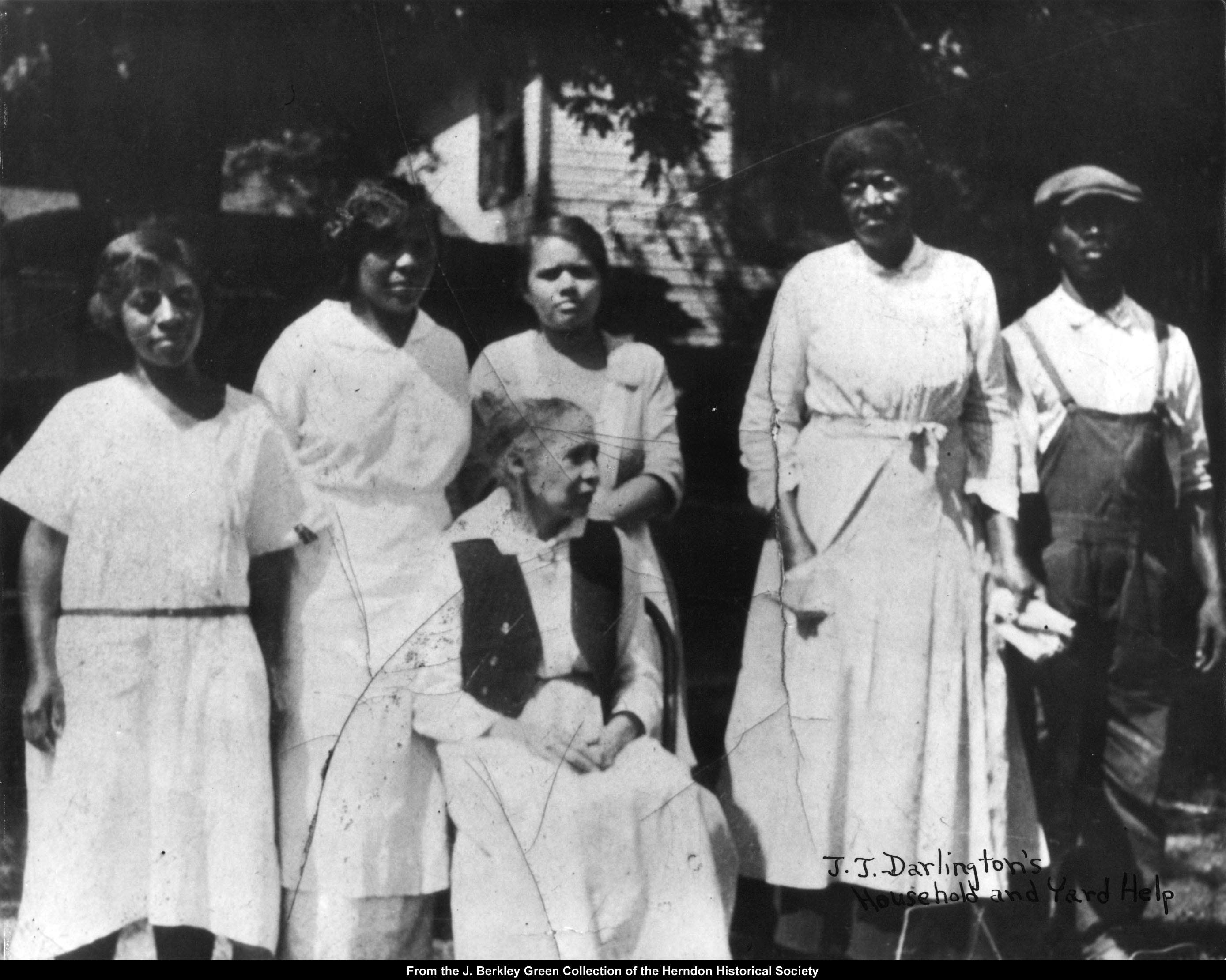
In the early 1900s, when Frances Darlington Simpson (1914-1998) was a young girl, she frequently spent summers in Herndon at her grandfather’s summer home, located near the intersection of Elden and Van Buren streets. The house, the Darlington Estate, was located just across Elden Street from the Simms property. Several members of the extended Simms family were employed at the Darlington Estate, in jobs such as cooks and laundresses. Simpson wrote her book, Virginia Country Life and Cooking, in memory of her favorite employee at the estate, Belle Simms Mitchell (b. 1896), whose family lived in Dranesville and who was the niece of James (“Pete”) and Irene Simms. Simpson recalled:
“Just across the road lived Belle’s Aunt Irene and Uncle Pete Simms. Uncle Pete, the village blacksmith, was known for miles around and enjoyed the respect of all who knew him. People came, bringing their horse to be shod and it was fascinating to sit by the hour in Uncle Pete’s shop and watch him hammering and shaping the red-hot horse shoes on his anvil and then nailing them to the horse hooves. My sister and I never tired of watching him and were always thrilled and delighted when he made rings for us out of horse shoe nails.
“Aunt Irene and Uncle Pete went in strenuously for croquet and when electricity came to Herndon, Uncle Pete wired his back yard and put out several spotlights for night croquet. He and Aunt Irene never seemed to feel the need for electricity inside the house, just outdoors for croquet.
“In the evening after Betsy and I had gone to bed, Belle would join the group at Uncle Pete’s and the games would begin. They played with feverish intensity and passionate zeal and it lasted well into the night. The screaming, cheering, loud applause and roars of excitement sounded more like a college football game than a country evening’s game of croquet.
“Many was the night I drifted off to sleep to the sound of croquet balls cracking and smashing in the distance, and my last thought for the day was to wonder if Belle was winning.”
Looking at historic aerial imagery photographs, it can be seen that the various buildings on the Simms' land were still present in 1960, but by 1962 they were gone. However, the property had likely been abandoned by the Simms family prior to that, as some older Herndon residents remember that property being overgrown in the late 1940s or early 1950s.
The details surrounding the end of Henry and James “Pete” Simm’s lives are unknown. However, history will always remember that they were father and son, two long-time and well-respected Herndon residents who were the village blacksmiths in the town of Herndon.
The Oak Grove Cemetery, located on the west side of Herndon next to the Oak Grove Baptist Church, was once Herndon’s only African American church and cemetery. On the list of people who are interred there are 23 people with the last name Simms. One is “James (Pete) Simms” and another is “H. Simms,” birth and death dates unknown.
About this column: “Remembering Herndon’s History” is a regular Herndon Patch feature offering stories and anecdotes about Herndon’s past. The articles are written by members of the Herndon Historical Society. Barbara Glakas is a member. A complete list of “Remembering Herndon’s History” columns is available on the Historical Society website at www.herndonhistoricalsociety.org.
The Herndon Historical Society operates a small museum that focuses on local history. It is housed in the Herndon Depot in downtown Herndon on Lynn Street and is open every Sunday from noon until 3:00. Visit the Society’s website at www.herndonhistoricalsociety.org, and the Historical Society’s Facebook page at https://www.facebook.com/HerndonHistory for more information.
Note: The Historical Society is seeking volunteers to help keep the museum open each Sunday. If you have an interest in local history and would like to help, contact HerndonHistoricalSociety@gmail.com.
Get more local news delivered straight to your inbox. Sign up for free Patch newsletters and alerts.