Health & Fitness
Ordinary Keys
The Museum of Buford now in the Buford Community Center. Open Thurs-Sat, 11 a.m.- 5 p.m., and during public Community Center theater events. Check BCC for schedules.


Lately I've been writing a lot of posts that are purely historical...the history of Buford's churches, schools, and businesses, etc.. There have been a few personal posts, like the one about Bonnie Rowe, but not many. That's why this week I've decided to write about the thing I keep coming across in the museum that reminds me why I am there every Friday, and why I create these posts that I wonder if anyone ever bothers to read. The thing that reminds me just why I love history the way I do.
My love isn't so much for "big event" history, not the wars or the politics or well known personages. No, my love of history revolves around the ordinary. If I could travel back in time (and oh, how I wish I could), I would chose to find myself standing in a small town crowd in 1908 watching a Fourth of July parade rather than in 1776 witnessing the signing of the Declaration of Independence. For me, history is best experienced in the daily flotsam and jetsam of the past--an interesting photograph, a personal note, even an old utility bill--the simple, every day things that belonged to ordinary people. But no one is really ever ordinary, are they? Everyone has a unique story to tell. It's in the small things that I find hints of those stories--they are the keys that unlock the door and let me step over the threshold of time, if even just for a moment.
Like this--
Find out what's happening in Bufordfor free with the latest updates from Patch.
For the past few weeks I have been reorganizing the museum library, categorizing the holdings, getting a list ready to be posted on the newly updated MOB website with an eye to Lynn Bowman's goal of making the museum a viable research center. As would be expected, there several old books in the collection, including a few text books from Buford's early schools.
As I looked for publication information, I noticed that many of the books had names, dates and sometimes even personal notes penciled inside. Some of the names were familiar to me, Buford folk I'd read about or had seen files on. There were even a couple of books that had belonged to Bona Allen and his wife. And then, there in a History of Georgia text, written in the elaborate handwriting of the era, "Mr. Fred Rowe, Buford, GA 1914." Fred Rowe! Brother to Bonnie Rowe! If you happen to have read my post about the daredevil wing walker, you'll know what Bonnie Rowe meant to me. In my intense research into his life, I had studied Bonnie's family tree, could give you the names and tell you details about his father, mother, sisters and brothers. Two years older than Bonnie, Fred would have been 16 in 1914. This was his high school text book.
Find out what's happening in Bufordfor free with the latest updates from Patch.
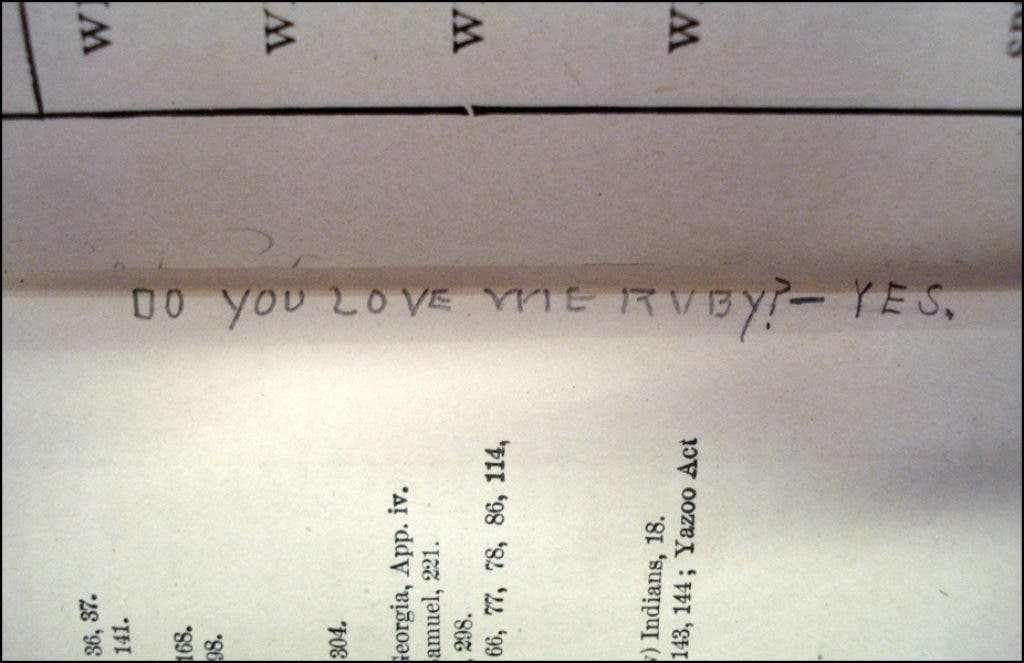
But there was more. The front and back pages of Fred's book weren't filled with the typical study notes I'd found in some of the other old school texts, but rather with cryptic little messages, like "look on page 282," or "look 5 pages from the end." So, I looked. On 282 at the top of a page filled with cameo drawings of Georgia's Senators, I found the penciled question--"who do you love?" and on another page, a message in backwards handwriting, which when reversed read "who is your honey."
Fred, I figured, had been passing this book back and forth in class to a girl. A lovesick teenage boy in 1914. With the perfect hindsight of time and research, I knew how Fred's life had turned out. Knew that he married when he was just 17, and that he and the girl had a child, perhaps out of wedlock, that died soon after being born. I knew the name of the girl. And there, 5 pages from the end, a moment across the threshold. "Do you love me Ruby? -- Yes."
Fred and Ruby settled in Montgomery, Alabama, and had four more children. They stayed married for the rest of their lives, Fred passing away first. Ordinary people. Ordinary lives. Even an ordinary love story, but made romantic and timeless by penciled words found in an old book. And even more, that nearly 100 year old teenage love note made Fred and Ruby real to me, almost tangible and whole, and connected me to their lives in a way that all the historical research in the world could not. Five pages from the end, a simple note, and the door to the past swung wide.
Rebecca