Politics & Government
'Great Wall of Roswell' Draws Ire of Residents
Citizens along and near Coleman Road are pushing for the city to enact guidelines to crack down on large retaining walls.


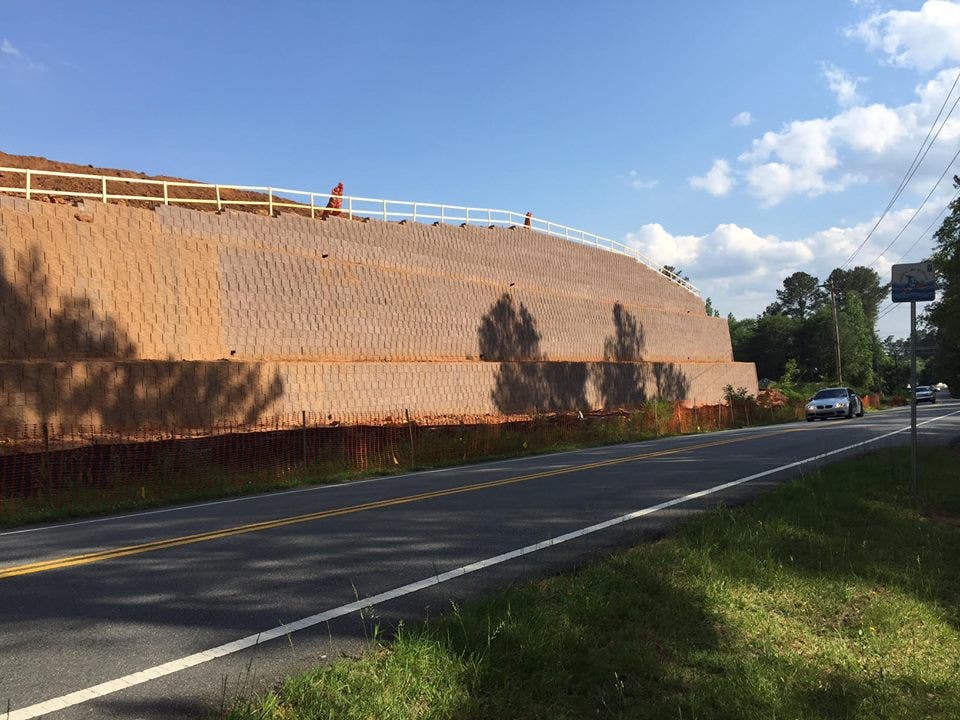


ROSWELL, GA -- The frustration in Lance Polikov's voice when he discusses the unusual structure that's become the elephant in his neighborhood is apparent.
What's been dubbed The Great Wall of Roswell, situated along Coleman Road in the western portion of city, has sparked outrage from Polikov as well as his neighbors and fellow constituents.
"It looks horrible, and the people are upset about it," he added. "People are upset that city staff approved something that needed to be looked at.”
Find out what's happening in Roswellfor free with the latest updates from Patch.
Polikov, who has lived in Roswell since 2006, is among several residents who've spoken out against the construction of three, 12-foot retaining walls stacked on top of each other along the thoroughfare.
How the Great Wall of Roswell came into existence, Polikov said, is a result of what happens when development of a particular project changes hands from one company to the next.
Find out what's happening in Roswellfor free with the latest updates from Patch.
A developer purchased the property with the intention of constructing a neighborhood. Their plans required a rezoning, meaning they'd have to seek approval from Roswell planners and elected officials.
That process also entailed a meeting with surrounding residents and property owners. Residents and community members showed up to those meetings and expressed concerns about the proposed development.
In an effort to come to a compromise, the former developer worked with the community and ended up crafting a project that “made sense to developers as well as to the community," Polikov said.
The initial plan was rejected by the Roswell Planning Commission, so the developer worked with neighbors and community to add 12 conditions that would satisfy any lingering uneasiness about the plans.
This, Polikov said, resulted in the community backing the proposal, as the developer compromised on a lot of things, such as reducing the number of homes, increasing the lot sizes and including appropriate buffers and landscaping.
The teamwork, Polikov added, even garnered "glowing praise" from the Roswell City Council at the time. Those elected officials, he added, suggested developers come up with tips to share with future developers who'd like to successfully engage the community with their plans.
That was in November 2014. However, over the next year, the developer subsequently sold the property to another company. The project began construction in January and February of this year, which is when residents began to see the construction of the walls.
The structures, Polikov stated, were not on the site plan submitted to the city. So, how were they allowed to come out of the ground?
What residents found out, he said, is due to how the Unified Development Code is currently written, a request to add a retaining wall is referred to as a vertical plane and "does not constitute a major site plan change."
Because of that interpretation, Polikov said, the developers did not have to go back through the public hearing process and seek City Council approval.
“They didn’t think that constituted a major site plan change, so they approved it,” he said, referring to city staff.
Polikov reiterated that he believed the city staff members who approved the wall were just doing their jobs, but added "common sense" should come into play when a developer submits a request to build a 37-foot retaining wall.
Coleman Road is not the only area of the city that's been afflicted with the walls.
Jamie Wishert lives in Strafford Woods, which is located off Upper Hembree Road. The wall constructed by Pulte Homes, he added, is situated in the compatibility buffer between his property and the developer's project.
The UDC spells out what kind of buffer is needed based upon the lots that would abut the proposed project. For example, if you have a high-density project abutting a lower density property, the UDC would spell out what would be the appropriate buffer needed to shield the properties from one another.
"We thought we’d get our normal buffer until December last year," he said.
That was when he'd learned of plans to build a retaining wall three feet from his property line that would be 24 feet high. The developer, Wishert said, planned to build houses on top of the wall.
"There is no buffer now between us and the new property," he stated.
At least two Facebook pages -- Preserve Coleman Road and The Great Wall of Roswell -- have been created to give residents an outlet to express their dismay and frustration with the situation.
Additionally, a landscaping plan for the Coleman Road wall will be presented to the city's Design Review Board on Tuesday, July 5. According to plans posted to the Preserve Coleman Road Facebook page, those plans call for planting various trees along each of the three walls.
Both Wishurt and Polikov said they want the city of Roswell to take a more proactive stance on ensuring these types of structures are not constructed.
"These retaining walls are costing the homeowners…a lot of money and equity," Wishurt added. "And it’s an eyesore."
Polikov added that if changes aren't made to the UDC soon, there could be "other things that fall through the cracks" and could change the character of a neighborhood.
He also said he hopes things would change for the better, as many resident spent their time and energy studying the codes and working with developers and the city to make sure their voices are heard.
For more information about Roswell's Unified Development Code, click here.
---
Images via Preserve Coleman Road's Facebook page
Get more local news delivered straight to your inbox. Sign up for free Patch newsletters and alerts.