Health & Fitness
Maryland Overdose Deaths: Fentanyl, Cocaine Fatalities Rising
A report on overdose deaths from the Maryland Department of Health shows that death by intoxication is increasing but the substances vary.


MARYLAND — Deadly overdoses continue to increase in Maryland, where they are up more than 12 percent compared with this time last year, according to new data from the Maryland Department of Health. Fentanyl and cocaine-related deaths are both on the rise, state health officials reported.
Fentanyl was involved in more than 78 percent of fatal overdoses during the first half of 2018. The synthetic opioid has claimed more lives than heroin in the state, a trend that began in the beginning of 2017, officials said.
“We know that fentanyl is so powerful that just a small amount can be deadly,” Clay Stamp, executive director of Maryland's Opioid Operational Command Center, said in a statement. A trace of fentanyl can be lethal.
Find out what's happening in Baltimorefor free with the latest updates from Patch.
Cocaine-related deaths have nearly doubled in Maryland compared with the same time last year, also outpacing heroin-related deaths, according to the state's latest report on fatal overdoses.
In 90 percent of cocaine-related deaths so far in 2018 in Maryland, officials said that opioids were found.
Find out what's happening in Baltimorefor free with the latest updates from Patch.
Many people who use fentanyl are unaware they are consuming the dangerous opioid, which is used to treat severe pain and is 50 to 100 times more potent than morphine. While it is a prescription drug, fentanyl used on the street has generally been made in clandestine laboratories, according to the Drug Enforcement Administration. Distributors often do not know what their products are cut with when they are selling them, and fentanyl may have been added to or used in place of some drugs since it is made of chemicals that can be mass-produced more cheaply than heroin, which requires the cultivation of poppy plants.
-1539554153-5160.jpg)
Pictured is a lethal dose of fentanyl. Photo courtesy of the DEA.
"It is a very lethal drug market," Stamp said in a new Maryland Public Television documentary about opioid addiction.
Here is how the first half of 2018 compares with the first half of 2017 in terms of fatal overdoses, according to the state's report.
Graph by Patch made with data from Maryland Department of Health.
Overall, the number of overdoses is up 12.3 percent based on last year's number, according to state health data.

Graph provided by the Maryland Department of Health.
These Overdose Deaths Dropped In The Year-Over-Year Comparison
- Heroin-related deaths decreased 20 percent.
- Prescription opioid-related deaths declined by 7 percent.
- Carfentanil-related fatalities dropped from 46 deaths to one.
Because heroin-related deaths appeared to have decreased does not mean that it is not still a problem. There were 469 fatal heroin overdoses in the first six months of the year in Maryland, meaning about 2.5 deaths a day were linked to heroin. There were 1,038 fentanyl overdoses, averaging about 5.7 deaths a day statewide.
"Heroin" has become a "catch-all term for a fluctuating melange of psychoactive drugs," researchers studying the heroin market in Baltimore reported in the Journal Of Psychoactive Drugs. Some users told researchers they doubted there was any heroin whatsoever in the drugs sold under that name — that what was billed as "heroin" on the street was usually fentanyl mixed with other substances like Xanax or morphine.
(For more news like this, find your local Patch here. If you have an iPhone, click here to get the free Patch iPhone app; download the free Patch Android app here. And like Patch on Facebook!)
Here is the breakdown of overdoses by jurisdiction in Maryland:
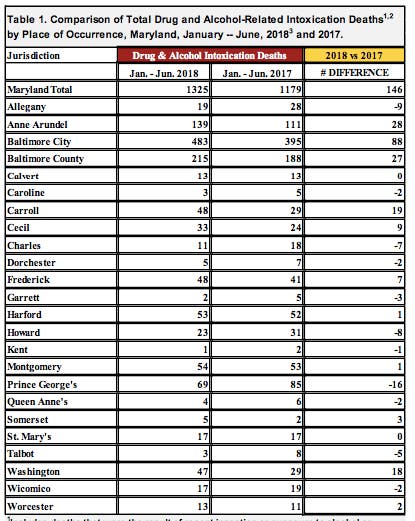
Table by Maryland Department of Health.
See the full report on overdose deaths from the first half of 2018 from the Maryland Department of Health, and find past overdose data from the state.
What Has Helped: Naloxone, Partnerships
Each jurisdiction in Maryland has a local opioid intervention team led by the local emergency manager and health officer, according to state health officials. Every jurisdiction has also participated in naloxone training and distribution programs.
Naloxone can reverse the effects of an opioid overdose, and anyone in Maryland can get naloxone without a prescription. Ten jurisdictions are part of the "EMS Leave Behind program," which provides high-risk individuals with naloxone to administer later if needed.
"With record numbers of opioid overdose deaths and other drug-related harms occurring, naloxone is an indispensable tool in reducing overdose deaths in our community," Crista M. Taylor, president/CEO of Behavioral Health System Baltimore, said in a statement. "Our partnership with the state has allowed us to expand access to naloxone for people using drugs."
Baltimore has also implemented the "Bad Batch Alert" program, so users can get a text immediately if tainted heroin in their area has been linked to an overdose spike.
In Anne Arundel County, first responders have made fire stations into "Safe Stations," where those seeking help with addiction can go to get assistance.
"Every day, more and more people – from Western Maryland to Baltimore to the Eastern Shore – are engaging with us in this fight against the heroin and opioid epidemic," Stamp said in a statement.
He added that Maryland is "stemming the tide of dangerous fentanyl" on a variety of fronts, disrupting drug trafficking organizations through law enforcement and promoting prevention through educational programs in schools, faith-based organizations, businesses and communities.
- Anne Arundel County To Expand Safe Stations Opioid Treatment Program
- To Combat Heroin, Harford Sheriff Unveils H.O.P.E. House
- Maryland Has One Of Highest Overdose Death Rates: CDC
- Suspected Heroin Trafficker Indicted After Harford Probe
- MD Overdose Deaths Hit Record Numbers In 2017, Early 2018
Where to Get Help In Maryland
Marylanders grappling with a substance use disorder can find help at BeforeItsTooLateMD.org, which is a statewide effort to address addiction and help people find pathways to recovery.
"Addiction affects families and individuals of all ages and socioeconomic backgrounds," Maryland Health Secretary Robert R. Neall said in a statement. "If you or someone you know needs assistance, know help is available 24/7 by dialing 211 then press 1."
People can call 211 and "1" to access Maryland Crisis Connect to get connected with resources. Marylanders can also text their zip code to 898-211 or TXT-211; or chat online with state health officials to locate crisis services.
The Substance Abuse and Mental Health Services Administration also offers a tool to find treatment centers.
There are Narcotics Anonymous and Alcoholics Anonymous meetings available locally as well as Nar-Anon and Al-Anon for family members.
Photo of fentanyl courtesy of the DEA. "The next wave of the addiction crisis is fentanyl-laced cocaine," a Boston area police chief told NPR this spring, noting the combination is especially dangerous for cocaine users who have not used opioids before. Cocaine-related deaths have nearly doubled so far this year in Maryland compared with the same time last year. In 90 percent of cocaine-related deaths in the first half of the year, officials said that opioids were found.
Get more local news delivered straight to your inbox. Sign up for free Patch newsletters and alerts.