Politics & Government
Watch As Artemis II Astronauts Make Historic Lunar Flyby
Artemis II, led by an MD native, will mark the historic flyby phase of its mission Monday, taking the crew further than any other astronaut.


BALTIMORE COUNTY, MD — The Artemis II crew, led by Cockeysville native Reid Wiseman, will transit around the moon on Monday, marking a historic point in their mission.
The flyby will mark the farthest point that any human has traveled into space, breaking the record held by the Apollo 13 mission in 1970.
"They’ll sail around the far side of the moon, photographing lunar features never before seen by human eyes," NASA said. "At their closest point, they’ll pass roughly 4,000 miles above the lunar surface."
Find out what's happening in Perry Hallfor free with the latest updates from Patch.
The official seven-hour observation window gets underway at 2:45 p.m. Although the team has 35 viewing targets, they may be able to catch a glimpse of the landing sites for Apollo 12 and 14 missions.
Watch a livestream of the mission below:
Find out what's happening in Perry Hallfor free with the latest updates from Patch.
Breaking A Record And Naming Two Craters
The latest phase of the mission will take place over a period of seven hours. NASA said Monday's flyby will not only include an opportunity for the four-person crew to view never-before-seen parts of Earth's lunar satellite, but they'll also witness a rare solar eclipse.
The Artemis crew broke the Apollo 13 distance record of 248,655 miles from Earth at 1:57 p.m. EST. The Orion ship is set to shatter the record by eventually hitting 252,760 miles from Earth.
"As we surpass the furthest distance humans have ever traveled from planet Earth, we do so in honoring the extraordinary efforts and feats of our predecessors in human space exploration," said Jeremy Hansen, the sole representative of the Canadian Space Agency in the Artemis mission.
"We will continue our journey even further into space before Mother Earth succeeds in pulling us back to everything that we hold dear."
"But we, most importantly, choose this moment to challenge this generation, and the next, to make sure this record is not long lived," he added.
Moments after breaking the distance record, the Artemis crew proposed naming two craters to commemorate the mission.
The first of the two craters is located near the Om Crater. Hansen requested to name the crater Integrity, after their spacecraft.
The second, found near the Glushko crater, was requested to be named Carroll, after Wiseman's wife who died from cancer in 2020. She was 46 years old.
"It's a bright spot on the moon and we would like to call it Carroll," Hansen said.
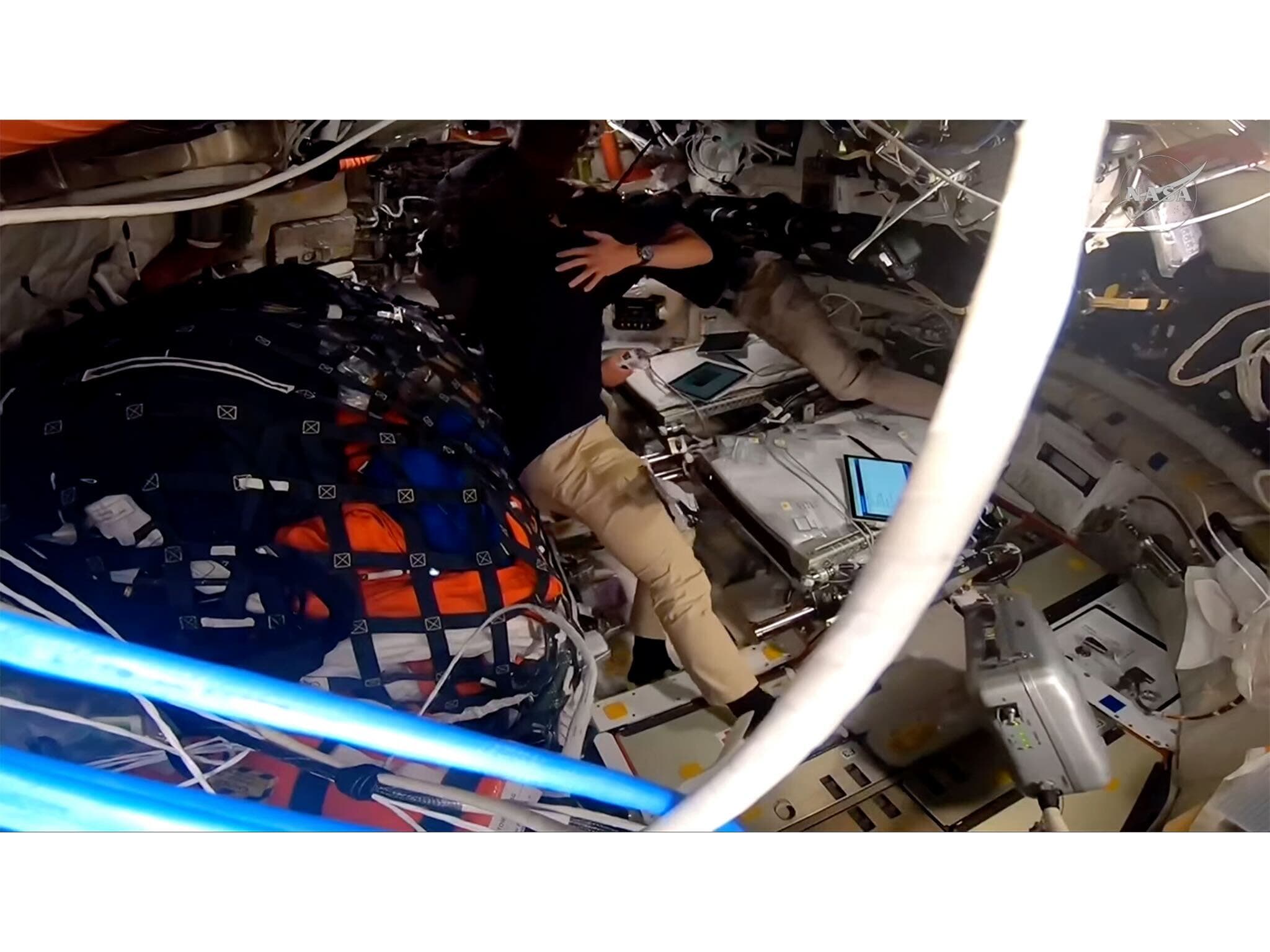
Not long after the transmission, the team could be seen wiping away tears and hugging.
After brief remarks on the distance record, the crew darkened the cabin lights and began prepping cameras and related gear for their flyby.
Related: MD Native Leads NASA's Manned Moon Mission
Time Line
At 6:44 p.m., the crew is expected to lose contact with NASA officials for 40 minutes. It's during this time that Artemis will reach its farthest point from Earth.7
The farthest distance the crew travels is expected at 7:07 p.m. EST.
From 8:35 p.m. to 9:32 p.m., a solar eclipse will be visible, allowing astronauts to analyze the sun's corona, as well as view Mars, Mercury, Venus and Saturn.
A media briefing event is scheduled at 10:50 p.m.
'Welcome To My Old Neighborhood'
Since the manned mission blasted into space, astronauts have been woken by a variety of songs. On Monday, they woke up to a message from Jim Lovell, the Apollo 13 commander who died last year.
The Associated Press reported that Lovell recorded the message two months before he'd died.
"Welcome to my old neighborhood," said Lovell. "It’s a historic day and I know how busy you’ll be, but don’t forget to enjoy the view."
Wiseman, along with astronauts Hansen, Victor Glover and Christina Koch made history as the first crew in decades to make up a manned lunar mission since the end of the Apollo program in the 1970s.
Related: Artemis Mission Makes History
The team blasted off from the Kennedy Space Center Wednesday at 6:35 p.m. after a slight delay.
The trip to the moon and back will test the Orion spacecraft’s life support, communication and navigation systems, as well as its ability to keep the astronauts safe, in preparation for future lunar landings.
Payloads aboard Artemis II will gather data on space radiation, human health and behavior, and space communications to inform future exploration.
Protocol for return operations begin Tuesday, the start of a four-day journey that will see Earth's gravity used to slingshot the Orion craft. A splashdown is anticipated in the Pacific Ocean on Friday, off the coast of San Diego.
Get more local news delivered straight to your inbox. Sign up for free Patch newsletters and alerts.