Community Corner
Think You Know Something About the Potomac River?
These six questions have stumped even the experts. Take a few minutes to test your knowledge.


The River Watch column has been running for about 10 months, so we should be about ready for a quiz.
Just how much have we learned? One thing is that the Potomac is a river full of personality, sometimes of a mischievous sort.
So this quiz skips over such geographical verities as the river’s length (383 miles from the Fairfax Stone to Point Lookout), its average flow (7 billion gallons/day at Washington, D.C.), and the number of people who use the Potomac for drinking water (about 4.3 million).
Find out what's happening in Potomacfor free with the latest updates from Patch.
Each question below refers to a photo. Answers appear at the end.
Find out what's happening in Potomacfor free with the latest updates from Patch.
Question 1:
These four scenes each feature an American flag. Where would you be most likely to run across Donald Trump (go to the link and check out the sound effects in the intro)?
Question 2:
I did a double take when I stumbled out of the underbrush upstream from Edwards Ferry and saw this imposing structure. What is it?
1. The famous Frank Lloyd Wright house called “Flowing Water.”
2. A World War II bunker designed by Bauhaus architect Le Corbusier, built to guard against enemy submarines ascending the Potomac.
3. The trash rake for the water intake structure at Washington Suburban Sanitary Commission’s Potomac River filtration plant.
Question 3:
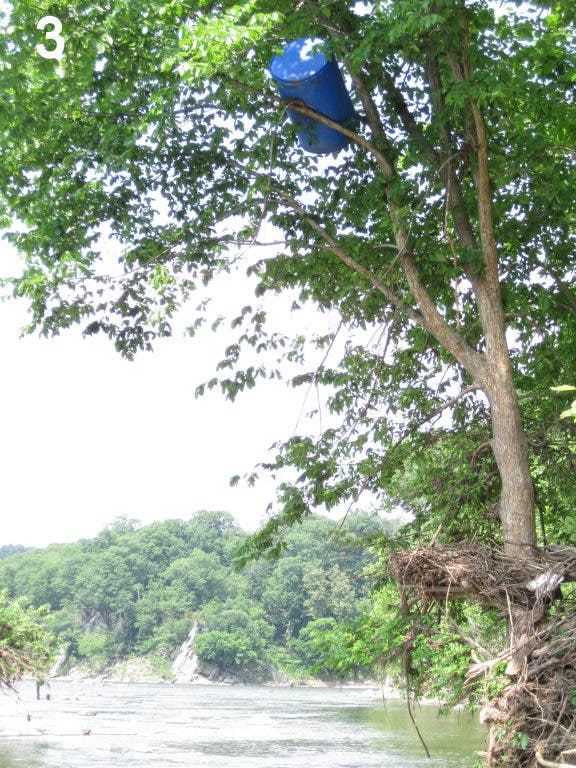
How did this big blue barrel end up in a tree across from Carderock?
1. It was put there by a Maryland Department of Natural Resources biologist as a nesting box for blue-footed boobies (click to see their mating dance).
2. It was the first of what was to have been hundreds of such barrel installations by the artist Christo as a counterpart to his controversial Over The River project, which would suspend 5.9 miles of fabric panels across Colorado’s Arkansas River.
3. It was the work of the river, doing its own Christo imitation.
4. It was a prank by the same people who leave piles of beer cans in the woods.
Question 4:
The C&O Canal’s lock houses were originally painted white. Which of these three white houses fronting the canal is not a lock house?
Question 5:
Most non-English-speakers visiting the Potomac River do not read Vietnamese. How can they figure out what the sign says?
Question 6:
Like an archeologist coming upon the shadowy remains of an ancient civilization, a C&O Canal trekker passes these stone structures heading south from Potomac toward D.C. Where is it?
Answers:
Question 1: The answer is photo “a,” the Trump National Golf Course, directly across the Potomac from Riley’s Lock. You see the golf carts better now that 450 trees along the river bank were removed last summer to “prevent erosion,” as explained by the course’s environmental manager Ed Russo. The flag went up after the trees came down.
Other photos are a used car dealership in Rockville, a saloon in Easton, Maryland, and lastly, 1600 Pennsylvania Ave.
Question 2: The correct answer is number 3. The river landscape is punctuated by piles of wood and trash―some 12 feet high―that floods throw up against heads of islands, rocks, and trees. The WSSC trash rake prevents this debris, as well as smaller things like leaves, plastic bottles, and dead fish, from entering the WSSC water intake.
Question 3: The barrel balancing act was the work of our trickster the river, with the help of spring flood waters.
But where do the barrels come from? They seem to be everywhere, in log jams, quiet backwaters, as well as in trees. There may be a number of sources, including a fruit processing company in Frederick, which buys fruit products packed in the containers. The company sells the empties, which become floating docks, trash containers, or feeding troughs on farms―at least, until flood waters set them free.
Question 4: Clearly, the owner of the house in photo “b” was never roused from his sleep at 3 a.m. by the blast of a horn summoning him to put on his long johns and let a boat pass through the locks.
Question 5: As with Google translate, the U.S. Park Service provides a companion text. It reads: “¡Peligro! ¡Muy fuertes corrientes y contracorrientes! No pase por las rocas, etc.”
Question 6: This is a view of Lock 13, hidden under the approach to the beltway bridge. It is one of the famous Seven Locks built in the 1830s.
The bridge itself was inaugurated in 1963 by Lt. Gen. Lewis B. Hershey, director of the Selective Service System. Hershey was famous for his short-lived directive, aimed at college students, that anyone who demonstrated against a military recruiter could be immediately reclassified.