Politics & Government
Pot Rules Take Shape In Important Week For Retail Marijuana Sales
The Cannabis Control Commission made significant process in what has been a bump road. See what's on the table to be approved.


BOSTON, MA — It's been a bumpy road to toking up ever since Bay State voters approved a legal recreational marijuana industry last year. The new law was supposed to go into effect Dec. 15, 2016. But there have been more questions than answers.
The Cannabis Control Commission that was formed after Question 4 passed made significant progress this week, reaching a tentative agreement on the rules and regulations that will shape what recreational marijuana might look like around Massachusetts.
The CCC is tasked with writing the rules for what many lawmakers and residents hope is a massive new revenue stream that will help tackle municipal issues.
Find out what's happening in Beacon Hillfor free with the latest updates from Patch.
The issues aren't small ones. State law allows to levy a 3 percent tax on pot sales and earn a 3 percent cut of pot company's revenue. Even with that incentive, more than 100 municipalities have completely or heavily restricted marijuana sales in city and town limits.
READ:
Find out what's happening in Beacon Hillfor free with the latest updates from Patch.
- Marijuana In Mass.: Where Are We? What's Next?
- White House Seeks Massachusetts Data On Medical Marijuana Users: Report
- State Sen. Lewis: Moving Forward Safely With Legalization
The Associated Press on Saturday reported on what the CCC came up with over the last week. These are expected to be approved in the coming days. See the AP's reporting on the issues below:
SOCIAL CONSUMPTION
A pot shop typically works much like a liquor store: You go in, buy the product and take it home to consume.
Regulators in Massachusetts and other legal recreational marijuana states have wrestled with the issue of when, where and how to let people use pot in social settings and other establishments.
The commission ultimately settled on two types of on-site consumption licenses.
A primary use license would be for businesses that derive more than 50 percent of their income from marijuana sales. An example of such a business model would be a cannabis bar or cafe where patrons could gather and use marijuana with friends.
A major question, however, is whether smoking would be allowed in such establishments or if customers would be limited to using marijuana in other forms such as edibles. The commission plans to form a working group to make recommendations on "smoking and other forms of social consumption," by July 1.
The second category, a mixed use license, would be available to businesses that may want to make cannabis available to customers in some fashion. Examples could include restaurants, movie theaters, yoga studios or even massage parlors that promote marijuana-infused lotions.
A restaurant, for example, might be able to offer a single-serving dish that has cannabis as an ingredient, but it couldn't leave the premises. So forget takeout or doggy bags.
HOME DELIVERY
Can't make it to the nearest marijuana store? Home delivery may be available under a strict set of rules laid out by the commission.
Upon delivery, drivers must obtain positive identification and proof that a buyer is 21 or older. The recipient must also sign for any delivery.
Products that are delivered must follow the same packaging requirements as if sold in a store. A single delivery of multiple products could not exceed $3,000 in value and deliveries could only be made during a store's normal business hours.
CRAFT COOPERATIVES
Craft cooperatives would allow groups of people - with each member required to have lived in Massachusetts for at least a year - to organize as a limited liability company or similar business structure.
The cooperatives would be licensed to operate up to six marijuana cultivation locations and up to three additional processing or manufacturing facilities. While they could package and brand marijuana products and deliver them to retailers, craft cooperatives would not be permitted to sell directly to consumers.
MARIJUANA RESEARCH FACILITIES
In what could foster greater scientific understanding of the health effects or medicinal value of cannabis, the commission agreed to create a special license category for marijuana research facilities.
Such facilities could cultivate or purchase marijuana, but not sell it.
Any testing done on humans would have to be approved by an institutional review board and test subjects must be 21 or older.
DIVERSITY
State lawmakers have made clear they want opportunities provided in the legal marijuana industry for economically disadvantaged people - particularly residents of minority neighborhoods who were harshly impacted by the so-called "war on drugs" in recent decades.
The commission agreed to designate as yet undefined "areas of disproportionate impact," and offer what it called priority review for applicants for cannabis business licenses from those communities.
Applicants with a majority of owners who have lived in areas of disproportionate impact for at least five of the past 10 years would be offered priority review, as would any company in which at least 51 percent of employees or subcontractors have drug-related arrests on their records.
Priority review of an application would not guarantee a license.
All applicants, regardless of location or ownership makeup, would be required to submit to the commission an employment diversity plan and live up to that plan once licensed.
Reporting and materials from The Associated Press were used in this report.
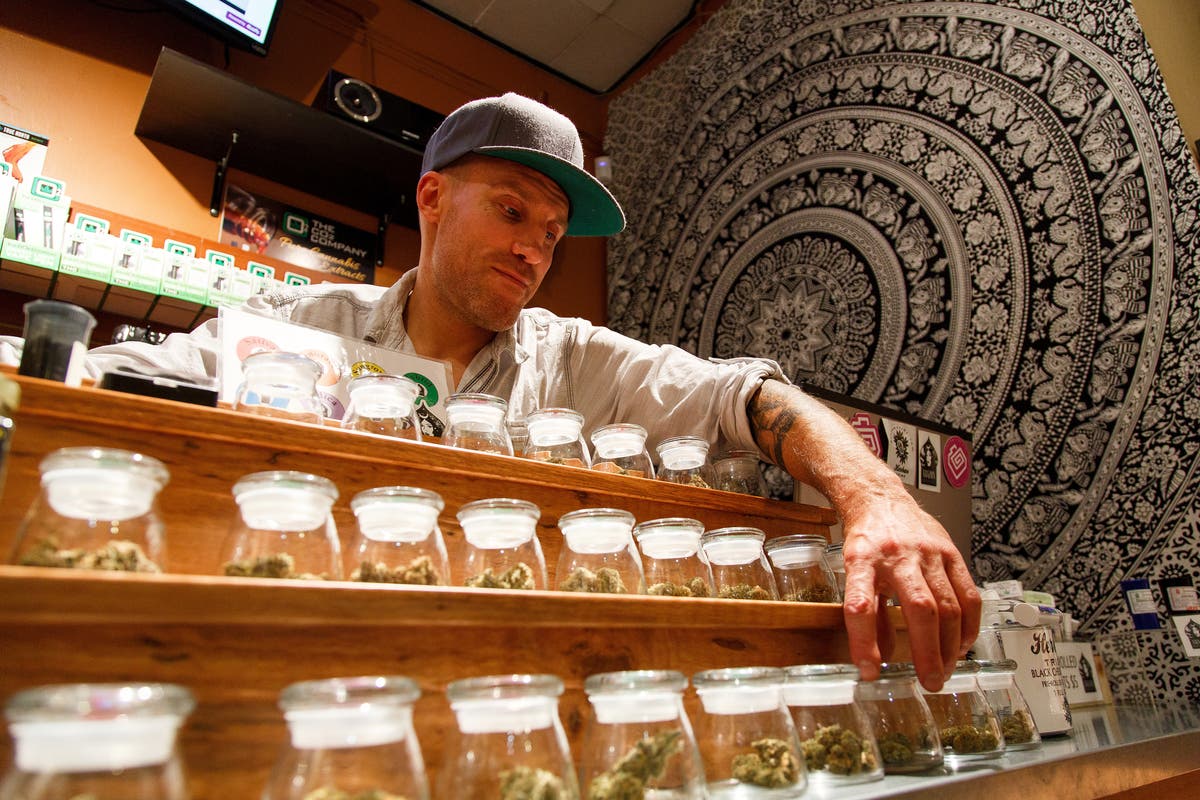
FILE - In this Sept. 28, 2015, file photo, Shane Cavanaugh, owner of Amazon Organics, a pot dispensary in Eugene, Ore., arranges the cannabis display in his store. (AP Photo/Ryan Kang, File)
Get more local news delivered straight to your inbox. Sign up for free Patch newsletters and alerts.