Neighbor News
7th & 8th Graders at Somerville's Argenziano School Win Education Component of Future Cities Regional Competition
Talented 7th & 8th graders capture the education component of a science challenge devised by the National Engineers Week
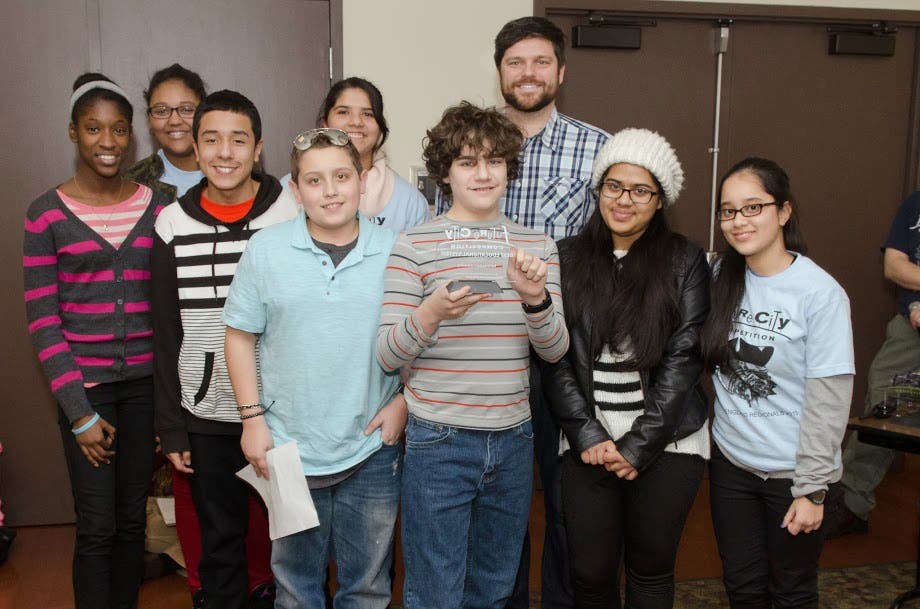

In Fattoria, a fictional city designed by a group of Argenziano School seventh and eighth graders who recently participated in the National Engineers Week Future Cities competition; residents cultivate greens and raise chickens as a way to address food issues in a changing world.
Towers support vertical planting of crops and municipal chicken coops are located in abandoned buildings. In this cardboard and cotton city, imagined, designed and built by Michael Coughlin’s science classes, everyone has an education, a job and enough to eat.
Fattoria was Somerville’s entry in the Future Cities competition, the regional competition was held Jan. 31 at Northeastern University; the finals last month in Washington, D.C. A Michigan school was awarded the grand prize; a trip to space camp in Huntsville, AL.
Find out what's happening in Somervillefor free with the latest updates from Patch.
“We won the “Best Educational System” component of the regional level Future Cities competition,” said Elliott Rodriguez, 14, one of the team captains who, as an eighth grader, has two Future Cities competitions under his belt.
“We had planned an educational component, but there was some improvisation when the judges questioned us about our model,” Elliott admitted.
Find out what's happening in Somervillefor free with the latest updates from Patch.
He said the group had conceptualized an integrated educational system that focused on agricultural method and theory. All curriculum throughout the city centered on these components; starting with lessons taught in pre-school.
The city’s needs were analyzed through this integrated approach and all fields of study; from teaching to engineering, addressed food resource issues.
“Looking at what other teams presented, we definitely deserved the award,” said team leader Dipa Lamsal, 14. The other team leaders, all eighth graders, Rodriguez, Walter Jacobs, 13 and Nikita Puri, 13, agreed.
The work for the youngsters started early in the school year with the planning, designing, building and perfecting their ideas to construct a city that reflected the 2014 theme: “Feeding Future Cities.”
“The kids did an amazing job,” said Coughlin. “I am very proud of them.”
They had expert advice from Jessica Yarmarkovich Project Designer at Nitsch Engineering in Boston and a visit from Groundworks Somerville for help with organic farming questions. And the constant support of Coughlin, their peers and parents.
“All our houses, each had a garden and chickens,” said Puri. “And there were community gardens and growing plots in the playgrounds that served as community centers.”
The group chose to locate their city in a temperate climate and cultivate amaranth, a spinach-like green high in nutritive value. Chickens were chosen as the group’s livestock because they are compact and easily cared for in small urban spaces.
These chickens were raised both privately and publicly, with municipal officials repurposing abandoned and obsolete buildings as automated, free-range chicken coops.
Solar energy, with a nod to nuclear plants, powers these urban farms. Seeds are sown vertically in domes in both soil-based and hydroponic growing mediums.
“We tried for a green city,” Rodriguez said.
“We tried to avoid fossil fuels,” said Puri.
The regional competition saw 21 teams from area schools showing off table-top models built of scrap and recycled material that depicted their conception of the city of the future. In addition to a three-dimensional model, each team used a computer program to create a virtual city which they controlled through the program.
Teams were also required to write an essay about the virtues of their city; from tourist attractions and universities to populations and education as well as a narrative; a blueprint for their community.
The Somerville model was wired for electricity, boasted public transportation and even included a cut-away that showcased the infrastructure and public utilities.
The regional winner, Farmington Valley American Muslim Center in Farmington, CT, presented a city they dubbed Frisch Von Dach (Fresh from the roof). They traveled to Washington for the final competition and a chance for the grand prize.
“It was helpful to go to Northeastern to see what all the other schools were doing,” Lamsal said, adding that while each school presented a unique and interesting idea; theirs was the only model to showcase the urban infrastructure of the city.
“We had a group of seventh graders with us; they will take over the leadership of the program next year,” said Jacobs.
ts_spdy,[|