Health & Fitness
The Maynard Farms on Powder Hill
In 1790, Maynard deeded his pew at the church to a son, packed his personal belongings, abandoned the mansion to the mortgage holders and moved to Barnard, Vermont, never to return to Westborough.


The Maynard Houses
Captain John Maynard was an original grantee and proprietor of Marlborough and a well to do gentleman who married Hepsibath Brigham of Marlborough in 1719. They built an unpretentious house (pictured) in 1720 on the slope of Powder Hill. Maynard was among the first settlers of Westborough and, by virtue of his ancestral status, was granted 400 acres of land on the summit of Powder Hill. Reverend Parkman later referred to the couple as the “salt of the earth.”
Stephen B. Maynard was the only child of John and Hepsibath. Stephen never became a farmer, tradesman or received a formal education. Rather, as the son of a wealthy landowner, he was heir to Maynard/Brigham estates and the title Gentleman. In 1741, he married Thankful Newton and while living in the family cape, the couple had nine children. In 1756, Stephen became the sole heir to the property when seven family members - including his father and mother, wife and four children - died of the Great Mortality of 1756 (measles).
Find out what's happening in Westboroughfor free with the latest updates from Patch.
In 1754, Maynard received a Royal Commission as a Lieutenant in the King’s Army and traveled to Canada to fight for the British in the French and Indian War. However, in 1758, he returned and married widower Mrs. Anna Brigham who moved into the family home and assumed responsibility of Maynard’s five surviving children. Six months later Maynard returned to the war. During the years to follow, the couple - during breaks in the war - managed to have six additional children. During the period while Maynard was away, his slaves maintained the property and domestic servants assisted his wife with the 11 children.
At the end of the war in 1763, Maynard returned to Westborough to build a new home for his extended family. He also became involved in politics and real estate investments. In 1763, Maynard purchased the 8 acre Tomlin Farm on the Northborough Road near the Assabet River (later the Broader Farm) which Maynard gave to his step daughter Anna Brigham and her new husband, Isaac Davis. In 1764, Maynard brokered the original Parkman parsonage sale. Prior to that, he was the mortgage holder of the Bruce Tavern. He developed land that was originally obtained from the Brigham family estate in the relocated center of town as Memorial Cemetery. He also deeded and developed other land to the town for a new county road. Although he was not an active member in church affairs, he was a very generous contributor and confidant to Reverend Parkman.
Find out what's happening in Westboroughfor free with the latest updates from Patch.
In 1768, Maynard was promoted to Captain as the foremost authority of military affairs and was made commander of all military operations and troops in Westborough. Although a Captain, he did not see action in the Revolution, acting only as a consultant.
Stephen Maynard House
Maynard’s new home (see photo) built on the Northborough Road took seven years to construct and was completed in 1770. With 11 rooms, it was called a mansion due to its architectural design, imported carved oak wood, handcrafted moldings, heavy paneled doors and walls and decorative stair banisters. Maynard also had his slaves build large stone walls on the property.
But the end of the Revolutionary War in 1783 took its toll on the financial stability of the new country. Although Maynard was considered to be the wealthiest man in town, he was in fact only land rich. He was overwhelmed in debt and on the verge of bankruptcy. The economy had gone into a deep recession, and foreclosures and debtors were recalling their loans.
In 1784, Maynard began selling off properties to pay his debts. The tanning business that he had established was sold to his son-in-law Isaac Davis. To make matters worse, the Commissioner of the Grafton Indians (Hassanamisco) filed a debt suit in Worcester Superior Court alleging that Maynard had used the Indian trust funds as his own. The funds were never repaid.
Those in debt that became insolvent were sentenced to debtor’s prison. Maynard knew this to be true and so, to avoid an embarrassing situation, made a decision to avoid a trial and a certain jail term. In 1790, Maynard deeded his pew at the church to a son, packed his personal belongings, abandoned the mansion and the remaining properties to the mortgage holders and moved to Barnard, Vermont, never to return to Westborough.
By 1797, the Maynard properties had passed completely from the family with the exception of the original homestead on Powder Hill. The farm lands were subdivided and sold to pay mortgage holders, liens and other debtors. Captain Stephen Maynard lived out the remainder of his life in Vermont with his wife and three sons. After his undocumented death, his wife Anna moved to the Davis Farm with her daughter where she died in 1809.
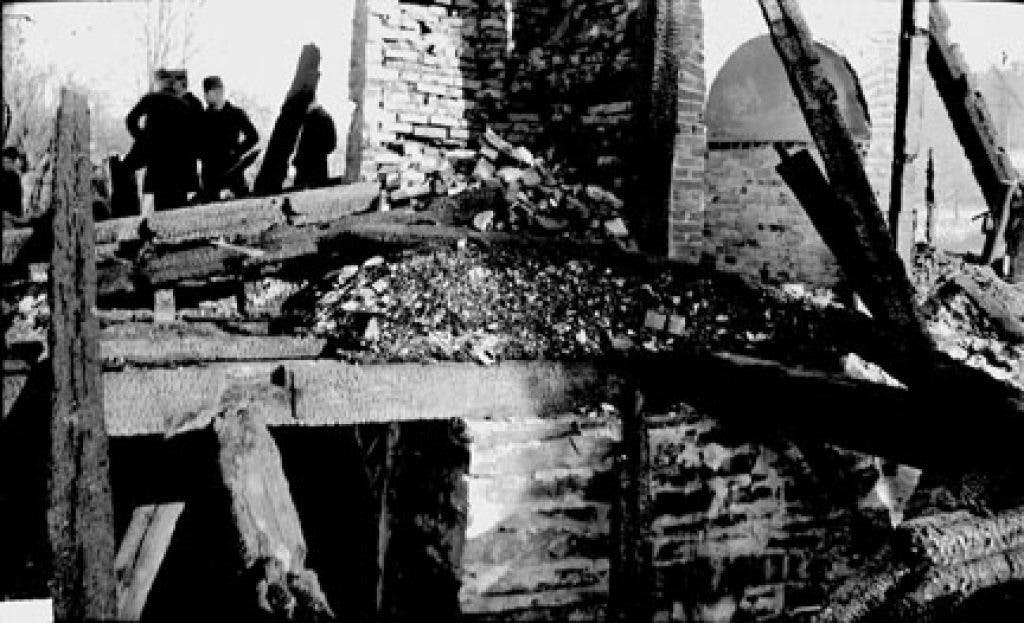
The Maynard Mansion was purchased by Bell J. Stone in 1886 but was totally destroyed by fire in 1891 (see photo).