Politics & Government
City Turns Weed Control Over to Kid Working for Food
The city of Farmington Hills is conducting an eco-friendly pilot project using a goat to remove unwanted vegetation.


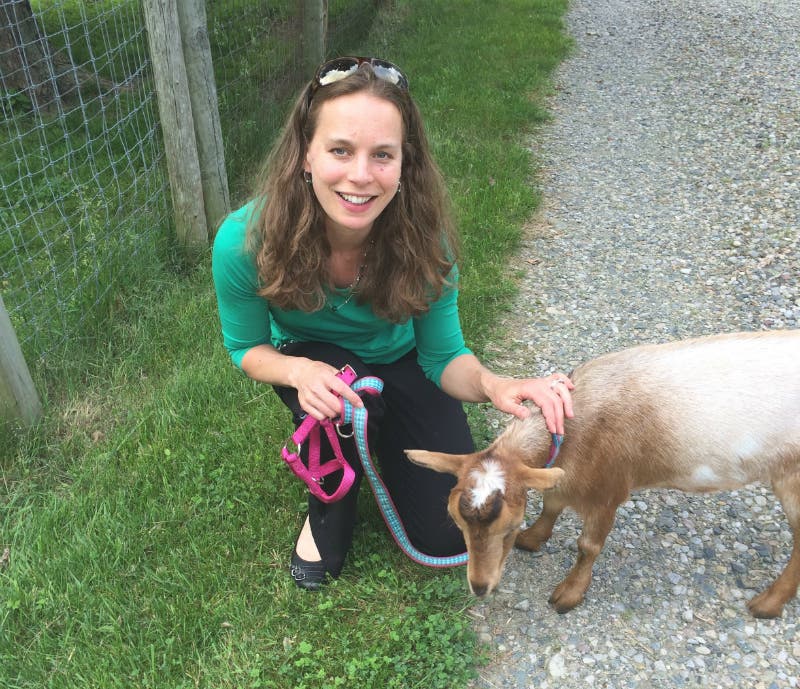

Pilot the goat is pictured with Karen Mondora after a day of “work” at the storm water drainage basin, where he’s assigned to control invasive plants. (Photos submitted)
Forget chemicals, hourly laborers or fuel-guzzling machines.
Find out what's happening in Farmington-Farmington Hillsfor free with the latest updates from Patch.
The city of Farmington Hills has come up with a better weed-control option – a kid willing to work for food.
Pilot, as the industrious new worker is known, isn’t a kid actually, but a full-grown goat currently dispatched to chomp away at invasive plants threatening to overtake the storm water detention basin on the City Hall campus at Eleven Mile and Orchard Lake roads.
Find out what's happening in Farmington-Farmington Hillsfor free with the latest updates from Patch.
Pilot is, well, piloting an eco-friendly project to remove unwanted from open areas. The project mirrors other eco-friendly weed removal projects in the metropolitan areas, including Google campuses.
“Goats provide a safe solution to problem vegetation and enhance the environment instead of harming it,” Public Services Director Gary Mekjian said in a news release. “Pilot will eat the phragmites and several other invasive plant species. Plus, he’ll stomp down the plants with his pointed hooves and keep them from growing back.”
The Department of Public Services acquired the goat from Oakland County Animal Control. On weekdays, Pilot will be safely tethered near the detention basin, where he will be monitored by city staff. He’ll get the weekends off, and head to a nearby home to stay with a local homeowner, who volunteered to care for Pilot and keep him with other neutered goat.
Before deciding to use the goats for vegetation management, department staff members explored issues of public safety and ensured humane treatment of the animal.
Though goats are considered to be domesticated and docile, but the public is asked not to pet or disturb Pilot while he is “working” and eating the vegetation near City Hall.
Goat feces will not be a public health concern, as the animals eat primarily plant matter and will excrement will essentially function as a fertilizer. The droppings will provide nutrient-rich organic matter that will actually improve soil conditions on the land near the detention basin, the city said.
Though herbicides may have provided a faster means of killing a wide range of vegetation, the city of Farmington Hills has long prided itself on being a “green” community with a demonstrated commitment to environmental sustainability. Herbicides pose a danger of toxin build-up in the soil and can contaminate surface and groundwater, causing potentially harmful effects on both animals and humans, and damaging other vegetation.
Pilot the goat will provide a more eco-friendly means of removing the overgrowth of vegetation and he will also eventually help restore the land at the detention basin to its healthy, functioning state, Mekjian said.
Plus, by practicing the centuries-old tradition of using goats to clear land, Farmington Hills will once again be on the cutting edge of the latest environmental trend, he said.
For more information about the city’s innovative, eco-friendly vegetation management program, contact Mekjian at (248) 871-2530.
Get more local news delivered straight to your inbox. Sign up for free Patch newsletters and alerts.