Health & Fitness
NH Coronavirus Update: 65 Test Positive; 750 Being Monitored
More than half of the state's patients are in Rockingham and Grafton counties. Governor bans reusable bags from stores to stop the spread.


CONCORD, NH — Paper or plastic? Well, either, because that's all stores are going to be allowed to use to bag items purchased after New Hampshire's governor banned all reusable bags from stores in an effort to prevent the spread of the new coronavirus. Gov. Chris Sununu banned the reusable bags Saturday via executive order, his 10th, since declaring a state of emergency in the state.
The order applies to grocery stores, supermarkets, convenience stores, retail stores selling any product, or any other similar establishment engaged in in-store sales of any retail products to customers.
"Our grocery store workers are on the front lines of COVID-19, working around the clock to keep New Hampshire families fed," Sununu said. "With identified community transmission, it is important that shoppers keep their reusable bags at home given the potential risk to baggers, grocers and customers. This emergency order directs all grocers and retail stores in the state to temporarily transition to only use new paper or plastic grocery bags provided by stores as soon as feasibly possible."
Find out what's happening in Concordfor free with the latest updates from Patch.
Earlier this year, the House approved bills cracking down on single-use plastics including allowing communities to set their own rules on the use of point-of-sale bags. Last year, the state Senate blocked similar bills from being sent to the governor's desk.
New COVID-19 Infection Numbers
Find out what's happening in Concordfor free with the latest updates from Patch.
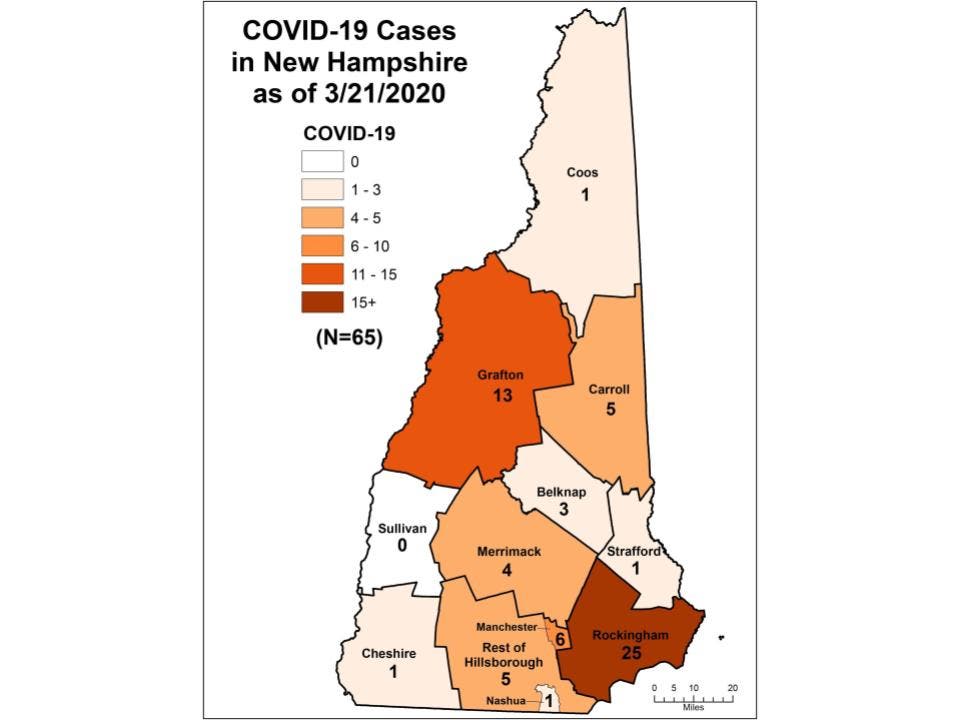
The New Hampshire Department of Health and Human Services also released new coronavirus numbers showing 10 new patients infected with the virus bringing the number statewide to 65.
All of the patients are adults — five men and five women.
According to the state, 25 of those patients live in Rockingham County while 13 live in Grafton County. Manchester has six patients while four are in Merrimack County. Nashua has a single patient while there are five other patients in other communities in Hillsborough County.
The state has 750 people under public health monitoring for the coronavirus with 959 waiting for testing results. So far, 2,212 people have been tested meaning that nearly 1,200 have tested negative.
The new numbers also reflect a single case in Strafford County. The only county without any COVID-19 patients in Sullivan County.
New Testing, Patient Management
The department also issued new recommendations to health care providers on who and who should not be tested.
Don't miss updates about coronavirus precautions and information in New Hampshire as they are announced. Sign up for Patch news alerts and newsletters.
The new recommendations "acknowledge that providers and first responders nationwide lack the equipment they need to safely and accurately test any person who may be exposed to the novel coronavirus," said Jake Leon, a public information officer with the department. The recommendations also acknowledge that more than 80 percent of people who have COVID-19 have mild symptoms. Current supply inventory should be directed to people with severe illness as well as health care workers, Leon said. Personal protective equipment and test supplies are also lacking and any decline in the health care workforce could have a negative impact on Granite Staters access to treatment for coronavirus or any health needs, officials believe.
"The coronavirus has placed an unprecedented burden on our healthcare system, and signs of strain are showing," said Lori Shibinette, the commissioner of the New Hampshire Department of Health and Human Services. "Everyone who works in healthcare wants to test New Hampshire residents who have symptoms of COVID-19. Testing capacity at the State Public Health Laboratories (PHL) and commercial testing companies is not the issue. However, the challenge for our providers and first responders is national shortages in PPE, nasal swabs and retesting agents. Healthcare providers require access to these supplies to collect a specimen for testing. Until national supply chains are able to meet the demand for testing supplies, New Hampshire, like all states, will be forced to limit testing to those most at risk of severe symptoms and those healthcare employees who are critical to ensuring we can serve our residents' health needs."
More, Reiterated Recommendations
Officials are requesting people who are 60 and older or patients with chronic medical problems, since they are at a higher risk for hospitalization and death from coronavirus or other health issues, to stay at home and away from public places. They should also avoid traveling. If they experience symptoms, they should call their health provider.
"If not severely ill, call ahead of time before showing up at a hospital or emergency room," Leon added.
Residents with mild symptoms, whether tested or not, should stay at home until at least seven days have passed since symptoms first appeared and until at least 72 hours have passed since recovery.
Recovery is defined as resolution of fever without the use of a fever-reducing medication or improvements with respiratory symptoms.
People exposed to a coronavirus patient or a presume patient, via close contact, who don't have symptoms, as well as anyone who has traveled from countries with widespread sustained transmission (China, Europe, Iran, Japan, and South Korea) should self-quarantine for 14 days, not be tested because it doesn't change the need to be self-quarantined, and preserve medical supplies by not asking to be tested.
What You Can Do To Stop The Spread
COVID-19, not unlike the flu and other respiratory illnesses, is spread through respiratory droplets, usually through coughing and sneezing, and exposure to others who are sick or might be showing symptoms. Take the same precautions as you would if you were sick:
- Stay home and avoid public places when sick (i.e. social distancing).
- Cover mouth and nose when coughing and sneezing.
- Wash hands frequently.
- Disinfect frequently touched surfaces.
More information from the New Hampshire Department of Health and Human Services about coronavirus can be found here on the department's website.
- Guidance to schools can be found can be found here.
- Instructions for returning travelers to self-observe for symptoms of COVID-19 are available are available here.
- For more information on COVID-19 in NH, visit its site here.
- For the latest information from the CDC, visit its site here.
ALSO READ:
- Concord Hospital Establishes Second Coronavirus Testing Site
- NH Hospitals Request Coronavirus Donations For Staffers
- Portsmouth's State Senator's Husband Contracts Coronavirus
- Market Basket Reducing Hours Due To Coronavirus
- BJ's Wholesale Club In NH Starts Seniors Shopping Hours
- 10,000 Callers Swamp Kuster, Pappas Coronavirus Telephone Town Hall
- Edelblut: Answering Your Questions About Remote Learning
- NH Coronavirus Update: 11 New Cases; Nearly 2,000 Tested
- Coronavirus Causes Thousands In NH To Be Unemployed
- Southern NH Medical Center, Elliot To Limit Coronavirus Testing
- Coronavirus Causes Thousands In NH To Be Unemployed
- Grilled Cheese, Brownies From The Heart, For Kids At Home Due To Coronavirus
- Fish & Game: Battle Coronavirus Mental Fatigue By Going Outside
- Daycare Center Owner Says They Need Help
- Neighbor Post: Don't Abandon Your Pet
- One In Five MA, Southern NH Workers Vulnerable In Coronavirus Downturn
- Concord Hospital Opens Dedicated Coronavirus Eval, Testing Site
- Funerals Being Affected By Coronavirus In NH
Got a news tip? Send it to tony.schinella@patch.com. View videos on Tony Schinella's YouTube channel.
Get more local news delivered straight to your inbox. Sign up for free Patch newsletters and alerts.