Politics & Government
Secretary Of State: Fight For Absentee Ballots In NH Took Decades
Gardner: State constitution still requires in-person voting; around the country, mail-in provisions have not increased participation rates.


CONCORD, NH — Logic dictates that the easier it is to perform a task or duty, the more likely it will be to accomplish that exercise or responsibility.
This ethos has led several states to ease the process of registering to vote, casting ballots, and requesting absentee ballots — by expanding early voting access or allowing for mail-in ballots. But New Hampshire's secretary of state said, while a wonderful attribute, changes to the way people vote in some states has actually lowered turnout while, at the same time, eliminated the sense of civic duty and community that occurs on Election Day in places like the Granite State.
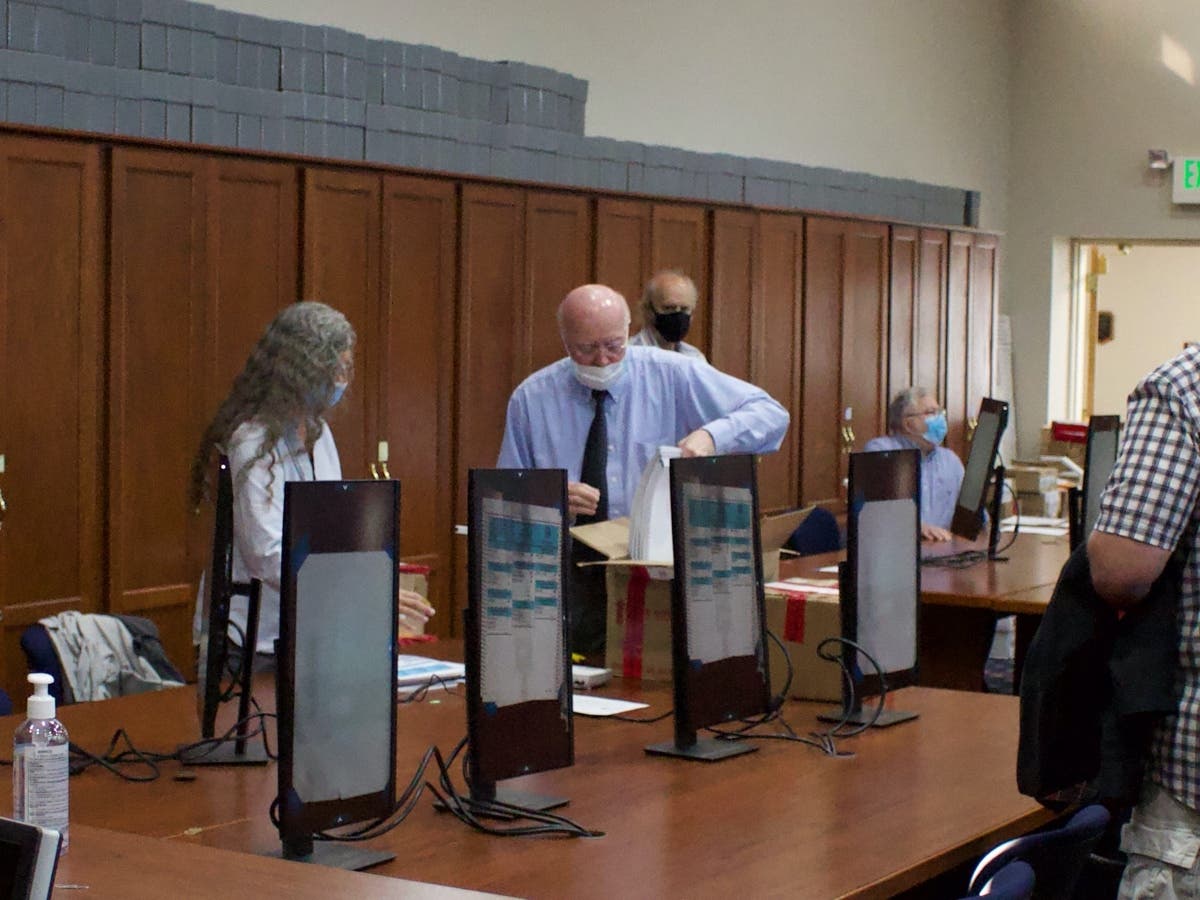
Due to the COVID-19 pandemic, the state approved expanded waivers for absentee balloting earlier this year which led to tens of thousands of absentee ballots cast — about 29 percent of all ballots for the Sept. 8 primary. Normally, absentee ballots could only be requested if a voter knew they would not have the ability to vote in-person on Election Day or due to a "physical disability."
Find out what's happening in Concordfor free with the latest updates from Patch.
Gardner, the longest serving secretary of state in the United States, said changes to the absentee ballot process were difficult since the New Hampshire state constitution requires residents to vote in person. It was a long, hard-fought battle, over many decades, to allow absentee voting at all in the state, Gardner admitted.
"We're unique," he said. "Our constitution requires that you have to be present to vote."
Find out what's happening in Concordfor free with the latest updates from Patch.
The battle to expand access to non-in-person voting in New Hampshire goes back about 156 years and numerous ballot questions and constitutional conventions to loosen the provisions.
During the Civil War, President Abraham Lincoln requested northern states allow soldiers to vote by absentee ballot and the Legislature considered the request. But the state Supreme Court rejected part of the request — soldiers could cast ballots for president by absentee ballot but not local races which would be unconstitutional, Gardner said.
Six decades later, after World War I, a proposal was approved in the House to allow absentee ballots on local races but again, it was rejected by the state Supreme Court, which stated a constitutional convention was needed to change the law.
In 1921, during a convention, the matter was proposed again and lost by four votes. Nine years later, another convention was held and the provision approved and placed on the ballot. The voters, however, rejected the proposal, Gardner said. In 1938, during another convention, it was proposed again. The same arguments were made, Gardner said, but proponents also noted the ballot question was complicated and difficult to understand.
"Just give us a chance to do a better question that people will understand," Gardner said, recalling the proponent's position.
But during the general election, voters again rejected the idea.
Four years later, at the beginning of World War II, the change was floated again and this time, it was approved, adding absent or disabled as acceptable reasons to not vote in person allowing a voter to request an absentee ballot but only for the general election — not state primaries or local elections. Proponents also did not remove the language requiring voters to be present at the polls.
"That's still the way it is now," Gardner said. "That's why you couldn't just have a separate box (for COVID-19 or any other reason other than absent or disabled) unless you change the constitution; the constitution still says that."
In 1956, another question was put before voters to expand the provision to state primaries and it was approved. In 1976, Gardner's first year as secretary of state, the provision was expanded to local elections, too.
ALSO READ:
Averting The Long Lines Of Other States
Before making changes to the absentee ballot process in New Hampshire to assist voters during the pandemic, officials watched what was going on in other states and were able to prepare to avoid long lines at the polls and other issues.
Gardner said, during the spring, as many states assumed people would vote by mail, they closed polling locations. But when a lot of voters still showed up in person to vote, many were frustrated by the long lines and wait times to vote. Who knows how many votes were not cast out of frustration and people leaving, he wondered.
Some officials in New Hampshire suggested closing polling locations, since there was a flood of absentee ballot requests coming in. But Gardner cautioned it could cause problems and required cities and towns to keep the normal number of wards and precincts polling locations open.
"We said, 'No, we are going to prepare,'" Gardner said, "because we don't know how it's going to end up."
In hindsight, keeping more polling locations open was the right move: While there were more than 90,000 absentee ballots cast, much higher than the 4 percent cast in a normal primary election, more than 70 percent of voters still voted in person Sept. 8, making it the highest turnout of a primary in recent memory by total votes cast. The state avoided the long lines, he said, by keeping polling locations open. For this reason, polling locations will not be closed in New Hampshire on Nov. 3 either, regardless of the number of absentee ballots requested.
Mail-In Balloting Has Not Increased Turnout
While the COVID-19 pandemic and fear of infection has made it necessary to expand voter options — and certainly, being sick or infectious should be considered a "physical disability" under the law, mail-in voting has not been the panacea that some believe in other elections, according to Gardner, a registered Democrat, and data he and the state have collected.
Gardner points to Oregon, the first state to move to totally mail-in balloting back in December 1995 for the special election to fill the vacancy of U.S. Sen. Bob Packwood, a Republican who resigned after being accused of abuse and assault of women as well as sexual harassment.
In November 1996, Oregon was the first state to conduct its presidential election voting completely by mail. However, turnout of voting age population dropped from 65.3 percent to 56.3 percent — or about 2.5 percent lower than New Hampshire had that year.
In future presidential elections, Oregon's turnout did increase — to 59.1 percent in 2000 and 67.1 percent in 2004 but dropped to 62.7 percent in 2008. In 2012, Oregon had a 58.7 percent turnout and 61.7 percent turnout in 2016.
These figures, however, were below New Hampshire's turnout during the same years and, in 2012 and 2016, well below the Granite State — which had a 67.8 percent turnout in 2012 and 69.1 percent in 2016, third highest in the nation for both years.
Historically, in every election but one since 1952, New Hampshire had higher turnout than the United States overall. The one year when turnout was lower was 1984 — an election where there were long lines in the state due to 11 ballot questions and voters choosing to leave polls instead of waiting to vote, Gardner said.
At the same time, in many states, even when they've expanded early voting, like Arizona and Florida, turnout is not as high as a percentage of voting age population as it was in the early 1990s, as example.
"Over half a century, states have been trying to find all these ways to make it easier to vote, and easier, and easier to vote," he said. "But it hasn't led to more voting. What they've left out (is) the cognizant side of voting — what is it that makes people make that decision. No matter how easy you make it, there still has to be a reason to vote."
No Voter ID Suppression Either
Data also shows new voter ID laws in New Hampshire have not depressed or suppressed voting in the state although some claim it has.
Gardner pointed to the turnout rankings his office has compiled since 1976 which showed during the last three presidential cycles, turnout has remained between 68 and 69 percent, while vote totals have increased: In 2008, a little less than 708,000 voters cast ballots whereas just shy of 711,000 voters cast ballots in 2012. By 2016, a little less than 756,000 cast ballots — the most ever in a presidential election by actual votes but about 0.5 percent less than 2008, as a percentage of the voting age population.
These turnout and actual votes cast rates were much higher than 57 to 61 percent voter turnouts in the first two presidential elections after same-day voter registration was implemented in the state and much higher than the 53 to 64 percent turnout from 1976 to 1992.
For these reasons, Gardner said, criticism by Pew and other organizations, calling New Hampshire a restrictive voting state because it does not allow early voting, has restrictive absentee balloting, and requires residency, and identification to vote, were not accurate.
"It's about turnout," he said. "Isn't that what it's all about? A state that has a high turnout — shouldn't that be a factor for this stuff?"
New Hampshire, he added, had the third best turnout in the nation in the last three presidential elections — with turnouts of between 12.7 and 14.5 percent higher than the national average.
"You have to go back 50 years, to John Kennedy, to have turnout as high as the last two elections," he said. "And those were the first two presidential elections with voter ID."
In 1960, the state voted at a 15.9 percent higher rate than the nation's average.
Avoiding 2020 General Election Chaos
Unlike other states which have expanded the acceptance date of ballots — potentially casting doubt over the result of the election or having it drag out via lawsuits and contention for many days, weeks, or maybe even months, New Hampshire is not extending the date or time for accepting ballots.
Gardner said the state constitution requires votes to be counted on election night — after the polls close, at the local precinct, ward, or town hall, in front of witnesses, candidates, the press and the public. Any ballot received after the deadline of 5 p.m. will not be counted, he said.
"So, it's going to end that night," Gardner said, barring a recount, of course.
Other states with extended deadlines for acceptance of mail-in ballots include Massachusetts, which will allow absentee ballots to be submitted to local election officials by hand through Nov. 6 and New Jersey, which is allowing ballots to be received through Nov. 10. Other states like California, Connecticut, District of Columbia, Florida, Illinois, Maryland, Michigan, Minnesota, New York, North Carolina, Pennsylvania, and Texas, which will count ballots postmarked on Nov. 3. Other states like Rhode Island and Wisconsin are similar to New Hampshire and requiring the ballots to be returned by 8 p.m. Election Day.
In other words, it is probably going to be a long night Nov. 3 — with final results, outside of New Hampshire that is, dragging on for many days.
Got a news tip? Send it to tony.schinella@patch.com. View videos on Tony Schinella's YouTube channel. Follow the New Hampshire Patch Politics Twitter account @NHPatchPolitics for all our campaign coverage.
Get more local news delivered straight to your inbox. Sign up for free Patch newsletters and alerts.