Neighbor News
Mathnasium Discusses Giant Dinosaurs!
How did dinosaurs get so large? Solve our model for an answer.

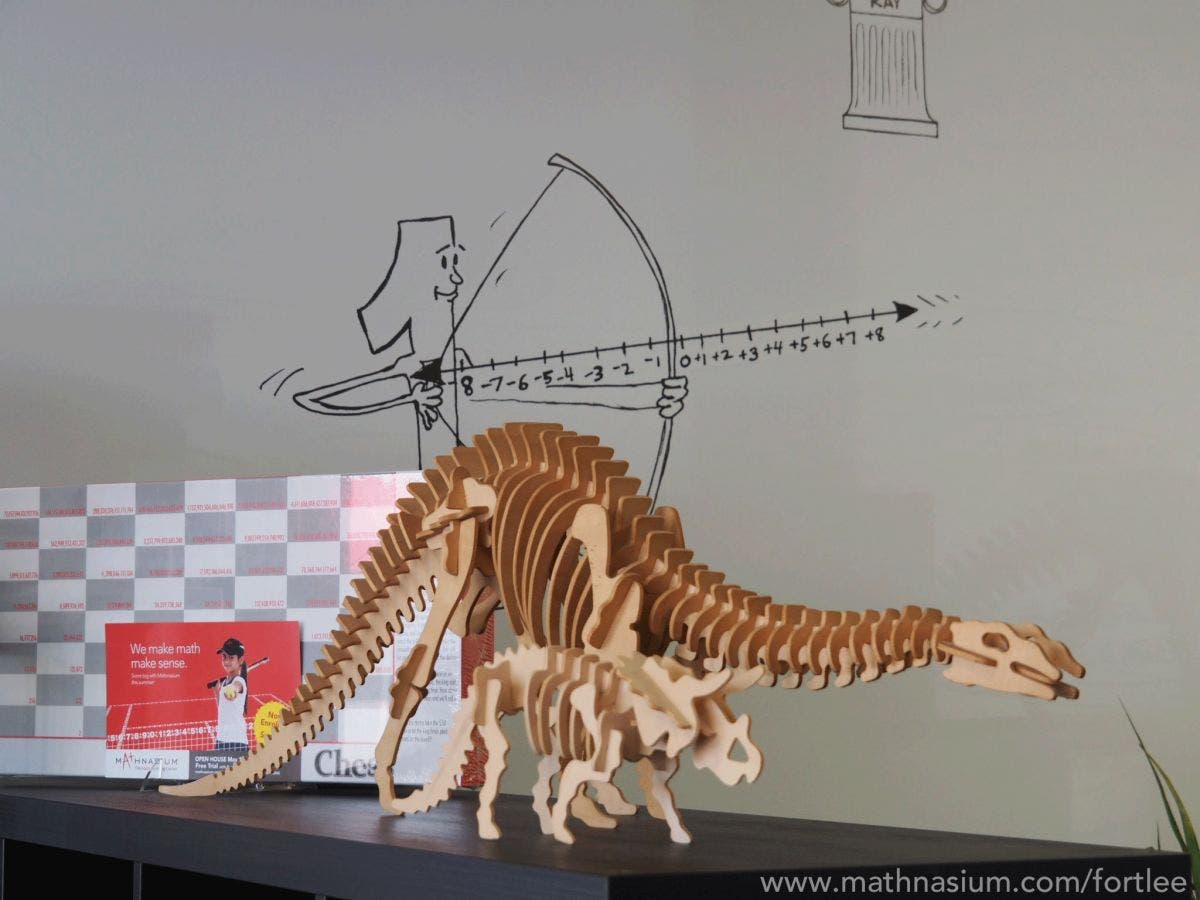


We're fond of dinosaurs in our center, the extinct animal version -- and not ancient Mathematicians! The Sauropod's skeleton reveals a graceful engineering marvel of compression arches held together with muscle and tendon tension; something we'll touch upon when we discuss bridges.
On this word problem, we're looking at an amazing growth fact about dinosaurs. We almost always associate dinosaurs with size, but did you know that the largest of them came from small eggs? A baby Sauropod weighs 6 kg (kilograms) when it hatches. After a week, it weighs 12 kgs. At two weeks, it weighs 24 kgs. At three weeks, it weighs 48 kgs. If the pattern continues, how much will the baby Sauropod weigh when it is 5 weeks old?
Our answer follows after this video that explores using math (but very much glossed over) to model a plausible understanding of Sauropod gigantism.
Find out what's happening in Fort Leefor free with the latest updates from Patch.
We introduce patterns as early as possible at Mathnasium and have dedicated worksheets for asking our students to sleuth for answers. Where we can, we relate patterns to their recurrence in the natural world. We hope that the thrill of discovery becomes relevant and addictive.
This is a problem that we give to our young learners. The Sauropod's weight seems to double every week -- 12 kg is 6 doubled, 24 kg is 12 doubled, 48 kg is 24 doubled. If this pattern continues, then at 4 weeks, it will be 96 kg, and finally at 5 weeks, 192 kg. Most young learners will quickly double up to 24 or 48. But doubling to 96 may pose a problem. We'll show them that 48 doubled is equivalent to 40 (4 tens) doubled and 8 (ones) doubled, or 80 (8 tens) + 16 = 96. Then 96 doubled is 90 doubled + 6 doubled = 180 + 12 = 192. If 80 + 16 is a problem, then it means we have to teach them 80 + 10 + 6, and ask "what is 10 more than 80?", then "what is 6 more?". Mathnasium breaks out each of these question and discovery interactions into individual teachable skills. Including counting, this particular problem requires an understanding of over 8 separate skills linked together into a solution chain. A missing link breaks that chain. Like archaeologists, our highly trained teachers and remarkable assessment process are able to find the missing links that hinder a students understanding and provide a learning plan that fills in those conceptual skills.
Find out what's happening in Fort Leefor free with the latest updates from Patch.
References:
www.bbc.com/news/science-envir...
http://www.amnh.org/exhibition...
Contact:
Ruby Yao and Benedict Zoe, Mathnasium of Fort Lee
201-969-6284 (WOW-MATH), fortlee@mathnasium.com
246 Main St. #A
Fort Lee, NJ 07024
Happily serving communities of Cliffside Park, Edgewater, Fort Lee, Leonia, and Palisades Park.