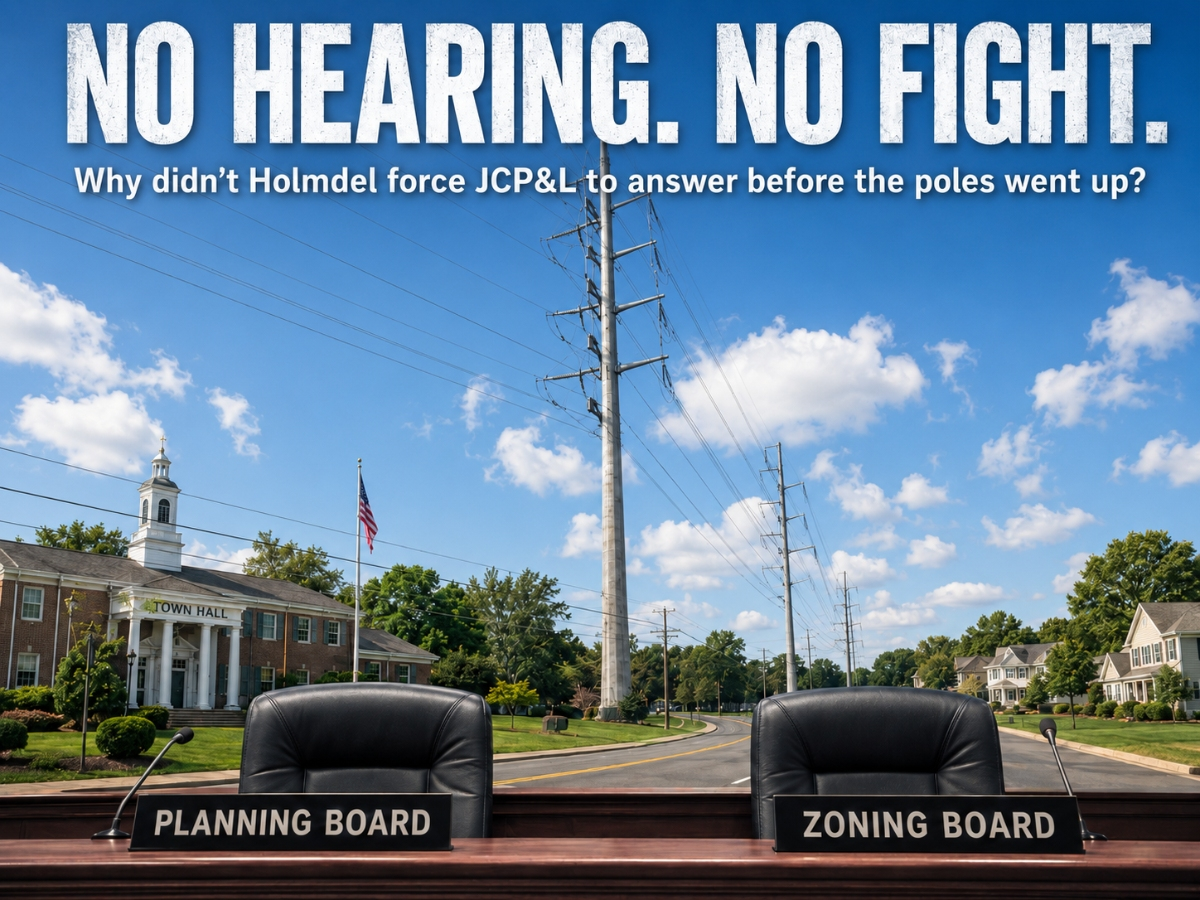
Mayor Rocco Impreveduto now claims Holmdel is taking a “hard line” against JCP&L’s oversized utility poles. But residents deserve to ask: where was that hard line before the poles went up?
JCP&L says this regional project replaces 1970s equipment, upgrades 10 miles of existing power lines, installs stronger poles and wires, and adds a second set of lines across Marlboro, Holmdel, Matawan, Aberdeen, and Middletown. Yet Holmdel residents still lack clear public answers on the exact voltage, pole heights by location, right-of-way authority, BPU approval path, ratepayer cost, or why less intrusive alternatives were rejected.
The mayor now says JCP&L is protected by the BPU and that Holmdel has limited power to stop the work. But that explanation came after residential pole installation was already complete.
Find out what's happening in Holmdel-Hazletfor free with the latest updates from Patch.
Other towns did not simply accept JCP&L’s word. Allenhurst forced JCP&L into a formal Planning Board process for a 34.5-kV project, requiring applications, site plans, pole and foundation details, configurations, and technical review materials. Officials and residents questioned undergrounding, alternate routes, cost, pole height, rate of return, and visual impact. When Allenhurst denied approvals, JCP&L appealed to the BPU — and its own filing said it redesigned and lowered proposed poles.
Millstone Township put JCP&L’s Clean Energy Corridor project before its Zoning Board for use variance and major site-plan review, forcing public disclosure of proposed structures, affected lots, easement width, tree clearing, and pole heights up to about 197 feet. And Millstone appears to have won at least this round: after being forced through that public Zoning Board process, JCP&L’s application was withdrawn, and the official Millstone calendar now states that JCP&L “will NOT be heard.”
Find out what's happening in Holmdel-Hazletfor free with the latest updates from Patch.
Jackson Township also forced JCP&L through formal Zoning Board review, requiring disclosure on pole heights, double-circuit upgrades, easements, undergrounding, environmental impacts, fall zones, and access.
So why didn’t Holmdel do the same?
Where was the emergency hearing? Where was the voltage and pole-height map? Where was the alternatives analysis? Where was the demand for a pause, redesign, undergrounding review, or shorter-pole option?
After-the-fact outrage is not leadership.
If the mayor was truly on the residents’ side, why wasn’t JCP&L forced to answer the same questions here that other towns forced them to answer there?
Prakash Santhana
Former Holmdel Deputy Mayor