Politics & Government
Conifer Presents Smaller Plan; Town Board Receptive
A new version of the Chappaqua Station affordable housing plan calls for fewer units and stories than previously proposed.


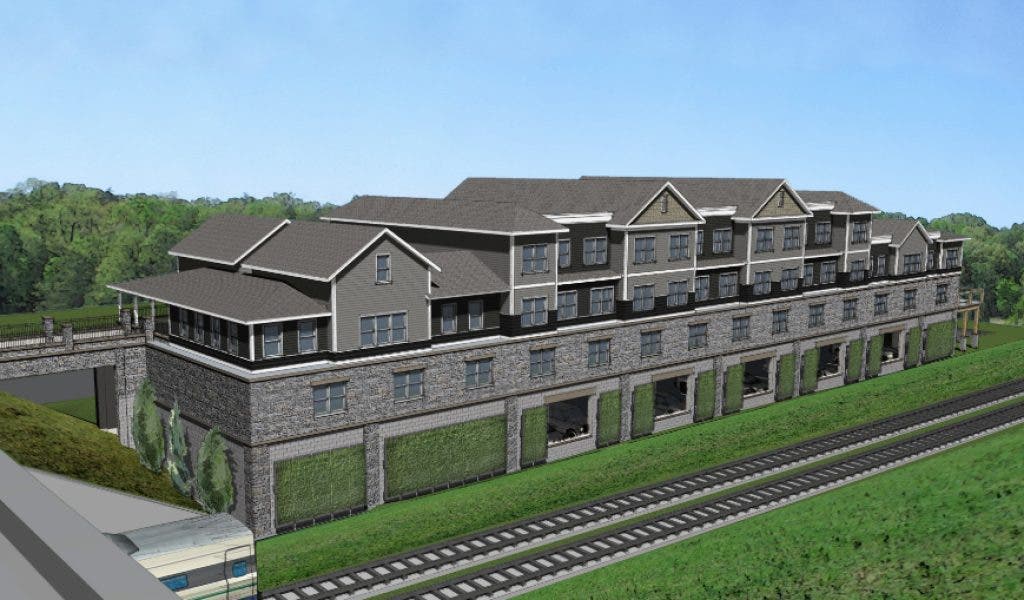

Responding to feedback and concerns in the community, Conifer Realty presented a smaller version of its Chappaqua Station affordable housing proposal at Tuesday’s New Castle Town Board work session.
The new version has 28 apartments, including 14 1-bedroom units and 14 2-bedroom units, versus 36 in earlier ones. It also ranges from three to four stories, down from a 3-to-5-story range in the last version. The project’s alteration was publicly disclosed roughly a month and a half after the town board adopted a “sense of the board” resolution, where members called on Conifer to keep the building at three stories - an exception would be unless going higher could reduce massing - and to remove a planned pedestrian walkway onto the Route 120 bridge due to safety concerns. Other resolution items included opposition to using municipal parking for overflow as Conifer requested and stating that the building was out of place visually.
Conifer needs a special permit in order to build on the site, which is zoned as General Industrial (I-G). The apartments would also count towards Westchester County’s 2009 federal housing settlement, which calls for the construction of 750 affordable housing units in predominantly white communities by 2016
Find out what's happening in Chappaqua-Mount Kiscofor free with the latest updates from Patch.
Mindful of the change, Andrew Bodewes, a principal with Conifer, said that “it's a very different concept than what we've shared previously.”
The plan calls for a footprint similar to what was previously proposed, according to Stephen Schoch, an architect for the developer, and will would be along the property line for the first two stories. However, the massing would get smaller for the third and fourth floors.
Find out what's happening in Chappaqua-Mount Kiscofor free with the latest updates from Patch.
The first floor would be for a parking garage area and have a masonry siding, while the second floor, which Schoch called a “podium” would have some apartments and continue with the same exterior material. However, the upper two floors appear to have been visually broken up in their massing, with siding that looks similar to wood; Schoch said the exact upper material has not been decided on yet. Several of the units will have two stories, including the third and fourth floors, Schoch said.
The project will also include a terrace space on the north side of the podium floor, while the southern end would still have a pedestrian walkway onto the Route 120 bridge, although it would be reduced to a narrower structure.
The concept is the fourth major version of the proposal, which would be on a downtown Chappaqua site at 54 Hunts Place that is less than an acre. The first version had a uniform 5-story height with 36 units, while a second one unveiled in 2012 had the same unit count but was four stories. The third version, unveiled several months later, had a sliding scale height of three to five stories and shared the same apartment count.
Last year, Conifer was wary of the idea of reducing the number of units because it was believed that state funding awarded for the project would be lost. The drop in the number of units was made possible, Bodewes stated, because the state was willing to let it change. For project financing, Conifer would get tax credits from the New York State Office of Homes and Community Renewal. The credits come from the federal government but each state is allotted use of some, Bodewes explained.
Bodewes explained, however, that a unit count could not diverge much from 28 because enough rental income needs to be collected in order to fund operations and maintenance. In going lower, Conifer would be at a point where “that becomes a real challenge and that's not something I think would be beneficial to us or or to the community,” he said.
The project will include 32 parking spots on site. Conifer will not seek any off-site overflow parking for the new version, Bodewes confirmed.
Conifer, in its various plan iterations, has encountered local concerns and opposition. The arguments against the earlier plans included ones of safety and quality of life, with some noting the site being near train tracks to the east and a Saw Mill River Parkway exit ramp to the west as an example. They also involved a belief that prospective residents would be isolated and that the design was out of aesthetic character for Chappaqua.
Town Board members were receptive to the new version.
Supervisor Susan Carpenter said that she thought it would be “visually much better” for the town, and described it as a significant improvement.
Deputy Supervisor Elise Kessler Mottel said “definitely an improvement in the right direction,” while Councilman Jason Chapin said that “we are going in the right direction.”
Board members still shared some concerns, however.
Carpenter felt that more play space on the site would be better. Schoch responded by noting the small site’s constraint, and that the building would be walkable to “a lot of activity spaces,” such as ballfields and a playground. However, he also expressed a willingness to work with the town on the issue.
Asked by Mottel why a walkway to the bridge, which the board was concerned about, was included in the project, Schoch explained that it was a matter of its convenience for transportation and walking.
“Not having the bridge really would create a physically isolated condition,” he said.
Councilman John Buckley asked whether viewshed renderings, which would show renderings of the building from nearby vantage points, would be available. Schoch responded that created them is expensive and that they would be done if officials were receptive in the plan
Asked after the meeting what he felt about the board’s feedback, Bodewes was satisfied.
“I think it was overwhelmingly positive and we're pleased to hear that it's a direction that the town wants to go and we hope we can come to an agreement with the town to move forward with this concept.”
A public hearing for the special permit, which the town board first opened last summer, is slated to continue on May 14.
Get more local news delivered straight to your inbox. Sign up for free Patch newsletters and alerts.