Politics & Government
Suffolk County Asks Residents to Vote to Fund Water Quality Improvements
Residents would pay $1 per 1,000 gallons, or about $75 a year. Will you support the referendum? Take our poll.


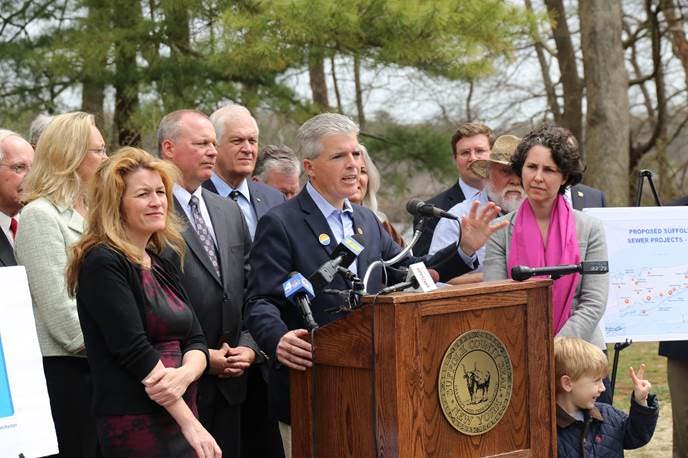


After years of degradation to local drinking and surface waters, Suffolk County plans to put the hope for future clean water directly in the hands of the people.
Suffolk County Executive Steve Bellone, as well as other officials and environmental advocates gathered Monday to announce that in November, residents will be asked to vote in a public referendum on whether to establish a dedicated funding source to pay for clean water infrastructure and alternative wastewater treatment systems.
The fund would be created to fight back against the escalating nitrogen pollution crisis affecting drinking and surface waters.
Taxpayers would fund the initiative, if approved, paying $1 per 1,000 gallons, or approximately $75 per year — a step that Bellone said would generate $75 million annually.
The majority of Suffolk County’s wastewater treatment relies on more than 360,000 individual cesspools and septic systems; Suffolk County has more unsewered homes than the entire state of New Jersey, Bellone said.
In western Suffolk, the funding would be used for sewering, and on the East End, the monies would be used to help residents install alternative wastewater treatment systems, he said.
"This is an important day for Suffolk County," Bellone said. "What we have seen over the past decade is the decimation of our surface waters."
Latest statistics indicate that the "overwhelming cause of that nitrogen pollution" is the 360,000 homes still relying upon cesspools and outdated systems.
The escalating crisis has let to red and brown tides and last year's "unprecedented fish kills," Bellone said. "We know what the problem is — and largely, we know what the solution is. Water quality infrastructure."
New York State Governor Andrew Cuomo has demonstrated "great leadership", allocating $83 million in Suffolk County alone to fund sewerage around four main river corridors. In addition, the Center for Clean Water Technology was created at Stony Brook University, he said. The Long Island Nitrogen Action Plan is also ongoing, Bellone said.
"What we are talking about here today is the ability to act, to implement solutions to this problem," Belllone said.
The water quality crisis has developed over decades, with a failure to implement the infrastructure that could have prevented the outcome, despite the fact that today's concerns were predicted, the county executive said. "The question is now are we going to turn the tide and reverse decades of decline — and make progress every single year on this issue?"
The referendum in November will be attached to the water bill, which is appropriate, Bellone said. As it stands, the Suffolk County Water Authority is pulling water out of the ground and providing the resource to residents; the goal is to make an investment now not only to protect groundwater but to avoid having to treat the water supply later.
"Every water body in the region is impaired," Bellone said, and the plan will affect the future of the entire region.
Currently, he added, the question is in the hands of politicians. "Personally, I will be much more comfortable when we get it into the hands of the people."
Mark Herbst, executive director of the Long Island Contractors' Assocation, spoke to the economic benefits of creating new infrastructure and alternative systems, including job creation.
Bellone added that water quality underpins the tourism industry and clean water is critically important.
Dick Amper, executive director of the Long Island Pine Barrens Society, applauded the plan. "This is absolutely critical."
Two thirds of the nitrogen in the waterways today originates in those 360,000 homes, he said. "It's time for action."
The cost to homeowners, at $75, he said, is less than the cost of a meal out to celebrate at a local restaurant, he said. "You can't buy a bottle of water for less than a buck." The total cost averages out to 20 cents a day, he said.
He added that Suffolk County is charging less for its water than 97 percent of water purveyors in the United States. The increase, he said, "is a drop in the bucket. It's a painless, almost unnoticeable cost."
Amper said he had confidence in voters to continue a long legacy of preserving land and water quality on Long Island.
All Suffolk County water districts and smaller districts would pay the fee, Bellone said; both commercial and residential customers would pay. The fee might even encourage water conservation, he said.
Those who do not tap into public water currently would still pay, but Bellone said discussions are ongoing with New York State to work out those details.
There is no sunset date for the $1 surcharge, he said; it's a recurring fee.
In order to get the referendum on the ballot, state authorization is needed, Bellone said, with the measure passed in both the Senate and Assembly.
As for alternative wastewater treatment systems being tested across Suffolk County in pilot programs, Bellone said they are close to approval. The goal is to amend Suffolk County's sanitary code for as of right approval, rather than the current approval before a board of review. The new systems could be available after the pilot programs have been tested for six months, with a timeline of late summer and early fall expected for approval of the new systems.
Get more local news delivered straight to your inbox. Sign up for free Patch newsletters and alerts.