Crime & Safety
Harlem Line Tragedy: The Front Car Filled with Smoke
The last press briefing by the National Transportation Safety Board covered new details from interviews and examinations.


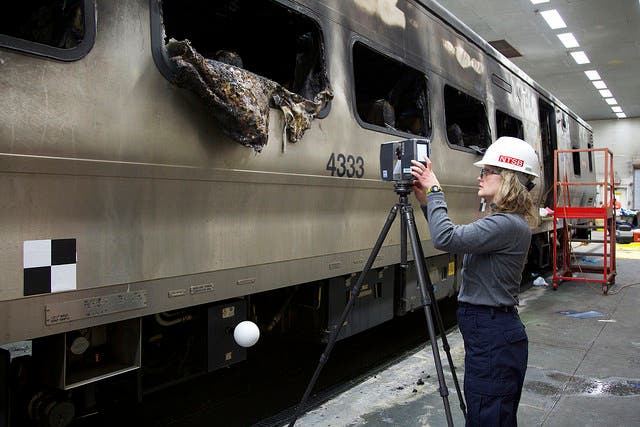
Between the time the Metro North train hit the SUV at the Commerce Street grade crossing and the time it came to a halt—about 26 seconds—a dozen pieces of the electrified third rail had peeled off and sliced up into the front car in 39-foot sections.
Some of the sections were at ceiling height, including one that pierced through the back of the first car and into the second car.
Those are among the facts the forensics team from the National Transportation Safety Board has collected since starting the probe into the crash that killed six during Tuesday’s evening commute.
Find out what's happening in New Rochellefor free with the latest updates from Patch.
His 5 p.m. briefing today was his last, NTSB vice-president Robert Sumwalt told the media. The team will remain in Westchester County for another couple of days, and then they and all the data they have collected so far will return to Washington to begin their analysis of the factors and conditions that led to the crash.
“The NTSB is here to collect facts,” he said, when asked if the train crew had been absolved of wrongdoing. “We do not determine fault, we don’t assign blame; we determine facts and conditions and then we determine probable cause.”
Find out what's happening in New Rochellefor free with the latest updates from Patch.
Another reporter asked why no bells had rung when a train went by the crossing during an early afternoon press conference by U.S. senators and congressional representatives.
No bells are regulated on crossings of that type, he said.
“Part of our investigation will be to see if putting bells on other grade crossings would improve safety,” Sumwalt said.
There are many things still to be learned, he said. For one thing, what sparked the fire.
Sumwalt talked at length about what investigators have learned from interviews with the engineer and conductor.
Conductor
The conductor was in the sixth car of the eight-car train. He heard and felt the emergency brake, talked to the engineer on the radio, made a PA announcement and asked the passengers to stay calm and remain on the train.
He radioed the dispatch center of their location and then in accordance with his training he walked to the rear of the train, checking on passengers. When he got to the last car, the last car was positioned over the grade crossing, and there he saw an emergency responder. The decision was made to evacuate.
As the evacuation was being made he walked forward checking to make sure all the passengers had successfully gotten out.
When he got to the third car, emergency responders advised him to get off the train himself.
He said he stayed on the train till he was sure that all the passengers on all the cars he had walked through had evacuated. He described the evacuation as happening in an orderly manner.
Engineer
The engineer had reported to work at 9:37 a.m. on Tuesday and operated three previous trains. This was scheduled to be his last trip of the day. Starting out, he had made all required tests of horn, headlights, radio and brakes.
In the operator’s booth at the front of the first car, he saw a reflection as the train approached the crossing at Commerce Street and then realized it was the front of a car on the track.
He put the train into emergency braking and then saw the car advance fully onto the tracks, and saw it disappear beneath his line of sight.
He said he did not hear any explosion; he noted sparks.
The train came to a stop and smoke immediately began to fill the operator’s compartment.
He got on the radio, said “emergency emergency emergency” and that they had struck a vehicle.
He came out of the compartment and saw fire in the rear part of the rail car, behind the bathroom. There was heavy smoke and the fire was moving very quickly toward the front of the train.
He assisted with evacuating five or six passengers. When the smoke got too dense he exited the train from the forward side passenger door. But then he saw a passenger who was crawling toward the door. The passenger could not walk so he picked him up, held him in a fireman’s carry and handed him to an emergency responder.
He said that he tried to go back into the car to rescue someone else but was unable to do so because of the fire.
“Our investigators described his demeanor as very professional,” Sumwalt said. “I think it goes without saying that he’s very traumatized.”
HARLEM LINE TRAGEDY:
- Harlem Line Tragedy: The Front Car Filled with Smoke
- Harlem Line Tragedy: Safety Systems at Crossing Were Working, Investigators Say
- Phone, E-Mail, Twitter: NTSB, Metro-North Reach Out
- Ossining Resident Joseph Nadol Among Victims in Metro-North Tragedy
- Deadly Train Crash Puts the Spotlight on Metro-North’s Recent Safety Record -- Again
- Harlem Line Tragedy: Engineer Credited With Saving Lives
- Chappaqua Resident Robert Dirks Among Victims in Metro-North Tragedy
- Bedford Hills Resident Walter Liedtke Among Victims in Metro North Tragedy
- Edgemont Resident Ellen Brody Among Victims in Metro North Tragedy
- Danbury Resident Aditya Tomar Among Victims in Metro-North Tragedy
- Bedford Resident Eric Vandercar Among Victims
- Metro-North Harlem Line Tragedy: Timeline; Feds Collecting Evidence
- Car vs. Train Crash, Fire in Valhalla
Get more local news delivered straight to your inbox. Sign up for free Patch newsletters and alerts.