Politics & Government
National, Local Officials Call for Ban on Crude Oil Train Shipments
They discussed the dangers to Rockland County at a press conference in West Nyack.


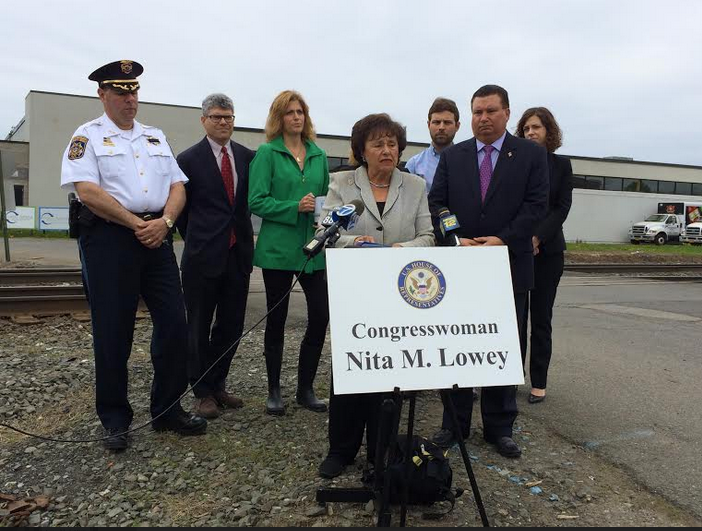
Congresswoman Nita M. Lowey was joined in West Nyack yesterday by local elected officials, law enforcement, and environmental leaders to announce new legislation that would immediately ban interstate shipment of high-volatility crude oil via rail, and direct federal agencies to set a national standard for crude volatility when shipped on the nation’s rail networks.
“No one should have to live with dangerously explosive materials rumbling through their back yards,” said Lowey,who is Ranking Member on the House Appropriations Committee. “Progress is being made on the safe transport of crude oil, but we need to act faster to guarantee the security of Americans – including my constituents in Rockland County – who live near America’s extensive railways. My proposal would immediately ban interstate shipment of the most volatile forms of crude oil so that we can prevent the next tragic crude oil event.”
The press conference took place the same day an oil train derailed and caught fire in North Dakota. Read about it and previous accidents at The DOT-111 Reader.
Find out what's happening in Nyack-Piermontfor free with the latest updates from Patch.
RELATED:
Lowey’s legislation would immediately prohibit the interstate rail shipment of crude oil with an average Reid Vapor Pressure volatility level greater than 8.5 pounds per square inch (psi). Reid Vapor Pressure (RVP) is a common measurement of how quickly a liquid fuel evaporates and emits gasses, and a higher number means a more combustible liquid fuel. Bakken crude has an RVP of 8.56 psi or higher, compared to the lower volatilities of Eagle Ford Shale (8 psi), Brent (6.17 psi), and Basrah Light (4.8 psi), among other oil varieties
Find out what's happening in Nyack-Piermontfor free with the latest updates from Patch.
Upwards of 80 rail tank cars carry the highly-volatile form of crude oil through Rockland County each day, endangering homes, schools, and businesses near the tracks, officials said.
“CSX trains with 100 tanker cars loaded with highly volatile Bakken crude oil pass within 100 feet of Lake DeForest, Rockland’s sole reservoir, threatening our water supply,” said Rockland County Legislator Harriet Cornell.
Lowey’s bill would permit rail shipments of Bakken crude that has been treated to make it less volatile and would also direct the U.S. Department of Transportation, in consultation with the U.S. Department of Energy, to establish a national standard for the maximum volatility of crude to be shipped by rail. Only crude oil below that standard could be shipped.
Riverkeeper President Paul Gallay called on the rest of the New York delegation to back Lowey on the bill.
“The National Transportation Safety Board says that the accidents involving crude oil shipments are going to continue at a rate of five to 15 derailments a year, with potentially fatal consequences,” he said. “ We must do everything we can to prevent such disasters and Congresswoman Lowey’s bill would be a big step in the right direction.”
The National Transportation Safety Board (NTSB) recently announced recommendations and the Department of Transportation recently issued a final rule for stronger crude oil transport regulations.
But the rule announced by the U.S. Department of Transportation last week fails to protect our communities and the Hudson River, said Scenic Hudson Environmental Advocacy Attorney Hayley Carlock.
”We must get deficient tank cars off the tracks as quickly as possible,” Carlock said. “The dramatic increase in the volume of crude oil being transported down the Hudson River makes our communities and natural resources far more vulnerable to serious accidents. A crude oil spill into the Hudson River would be catastrophic for the public health and environment of our region.”
Lowey is an original co-sponsor of the Crude-by-Rail Safety Act that would authorize $40 million for first responder training programs, establish grants for local communities to update emergency response plans, and improve emergency notification procedures.
PHOTO: (L-R) William Barbera, Police Chief, Rockland County Sheriff’s Office; Paul Gallay, President, Riverkeeper; Sarah McTasney, Concerned West Nyack Parent; Congresswoman Nita Lowey; Elijah Reichlin-Melnick, Office of Town of Orangetown Supervisor Andy Stewart; Alex Gromack, Town of Clarkstown Supervisor; Hayley Carlock, Environmental Advocacy Attorney, Scenic Hudson. Credit: Office of Congresswoman Nita Lowey.
Get more local news delivered straight to your inbox. Sign up for free Patch newsletters and alerts.