Neighbor News
The Bells of St. Mary's
From Villahermosa, Tabasco, to Scarborough, New York: The Mysterious Journey of a Mexican Church Bell

One Hundred and seventy-three years ago the United States and Mexico were at war and in the end; vast amounts of Mexican territory became American property along with other things once owned by Mexicans. As happens in every war American soldiers carried home war trophies such as photographs, uniforms, medals flags, rifles, pistols and even cannons that once belonged to the former enemy. This is the story of one of those trophies, a church bell that once hung in the belfry of a Roman Catholic Church called “Iglesia de la Virgen de la Concepción” in the City of Villahermosa, the capital of the State of Tabasco, in the Republic of Mexico. It seems that this church was the successor of several church buildings (known by various names) that have stood in the central square of Villahermosa (once known as San Juan Bautista) since 1614. The “Iglesia de la Virgen de la Concepción” no longer stands as it was shelled by American naval artillery during an engagement between the American and the Mexican forces in mid June of 1847, known as the “Second battle of Tabasco.” The Iglesia was subsequently replaced by several other churches in this site since then the latest being the Catedral del Señor (Cathedral of the Lord).
During the Second Battle of Villahermosa the Americans under the personal command of Commodore Matthew C. Perry stormed ashore with a force of 1200 sailors and marines and took a defensive fortification known as Fort Acachapan manned by 600 troops under the command of Colonel Claro Hidalgo. Perry unlimbered his artillery and shelled the fort then ordered a charge. With his sword in hand, Perry personally led the troops that drove the Mexicans back and he briefly occupied the town and subsequently abandoned it when he realized that he did not have enough troops to hold it. It was probably at this time that he or one of his troops found the bell among the ruins of the bombed out church and decided that it was a worthy commemorative trophy and later took it back to the U.S. “ In those times church bells were considered legitimate prizes of war.
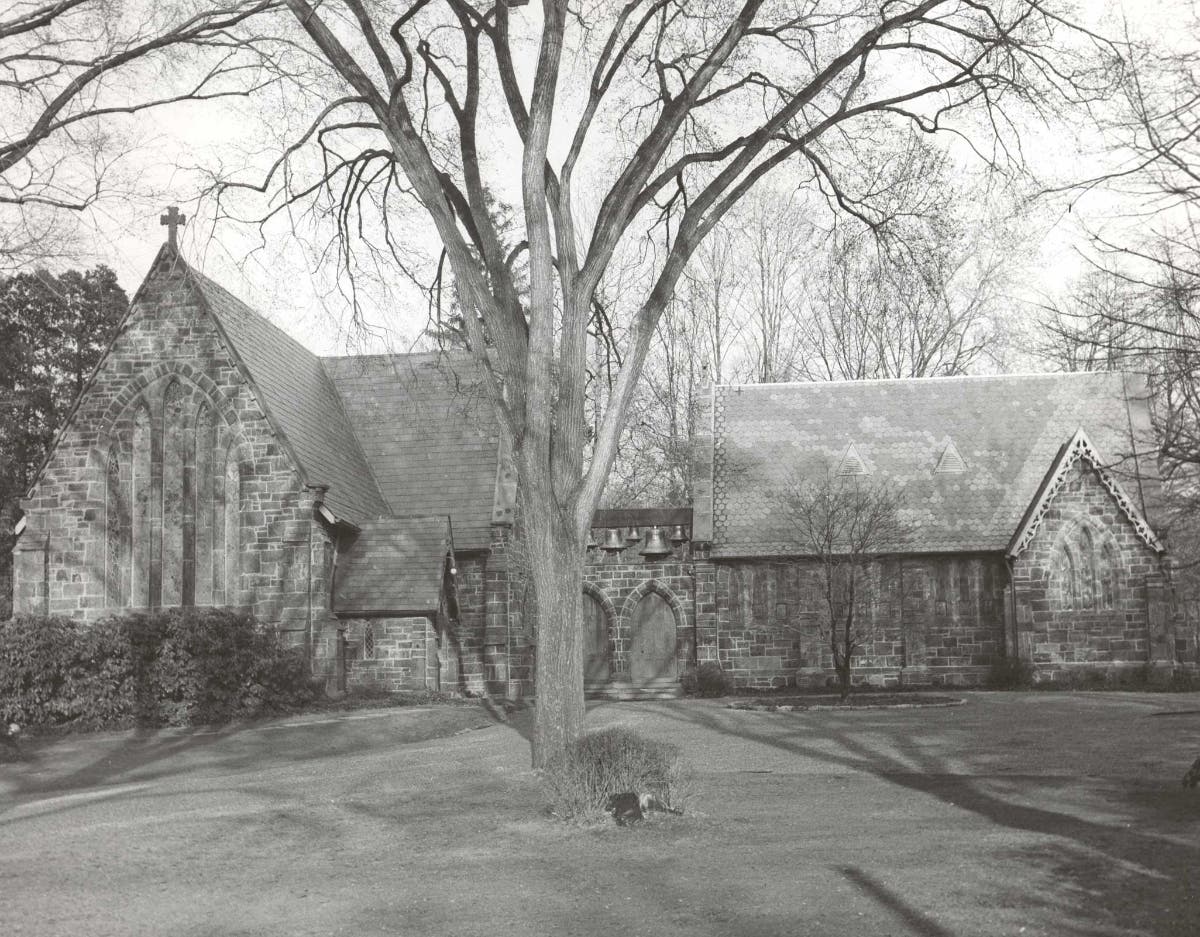
As it happened, Commodore Perry was a resident of the hamlet of Scarborough, NY where he built a home he called, The Moorings ” on 125 acres of land on the shores of the Hudson River near to where Rookwood Park a section of Rockefeller State Park now stands. Perry was among the founding members of the Episcopal Church called St. Mary’s Beechwood located in the hamlet of Scarborough on Route 9 about 2 miles south of the Village of Ossining. This church was modeled after the thirteenth-century Scarborough Parish Church in Yorkshire England. The Rev. Edward Mead, who served as assistant of a predecessor church called St. Mary’s Beechwood designed it, and Rev. William Creighton who founded the original congregation in 1839, donated the property and funds. Local stone masons used native granite to complete the building in 1851. The church features the only complete set of stained glass windows by renowned artist John Jay Bolton. Along with his brother William, The Bolton brothers were considered to be the only serious stained glass artists in the United States at the time. Images depicted by the window designs include the unusual “Pelican-in-her-Piety,” a symbol of the atonement. The west window is a noteworthy example of the grisaille technique. Ivy that covered the walls of the church descended from cuttings planted by Washington Irving, a life-long friend of Dr. Creighton. The cuttings had been given to Irving by Sir Walter Scott during a visit by Irving to “Abbotsford,” Scott’s Gothic Revival English residence. Ivy climbing the parish hall walls was brought back and planted by Mrs. Frank Vanderlip from a post-World War I trip to the Argonne.
At some point after he returned to his home, perhaps in 1851, Commodore Perry presented the bell to the church and had it inscribed as follows: “ Captured At Tobasco (sic) 1847” and below that, “Presented by Commodore M.C. Perry, Recast.” The bronze bell is 20 inches tall and has a diameter of 18 inches at the bottom end. Most likely the bell was an alloy comprised of copper and other base metals that was locally mined and cast into bronze at a nearby forge. This historical bell was replaced by a larger modern bell in early November of 1910 , donated by the financier, August Belmont, Commodore Perry’s son-in-law. The old bell was placed on an outside corner of St Mary’s to the left of the main entrance where it can be seen today. A bronze tablet just above it reads: “Commodore Matthew C. Perry 1794—1856. Father of the Steam Navy and Opener of Japan Who Made His Home Here For Many Years At The Moorings. A Founder Of This Church And Donor.”