Community Corner
Historic Dale Cemetery
Former Ossining Mayor Miguel Hernandez responds to a recent article about historic Dale Cemetery, written by Town of Ossining town board candidate Kim Izzarelli.
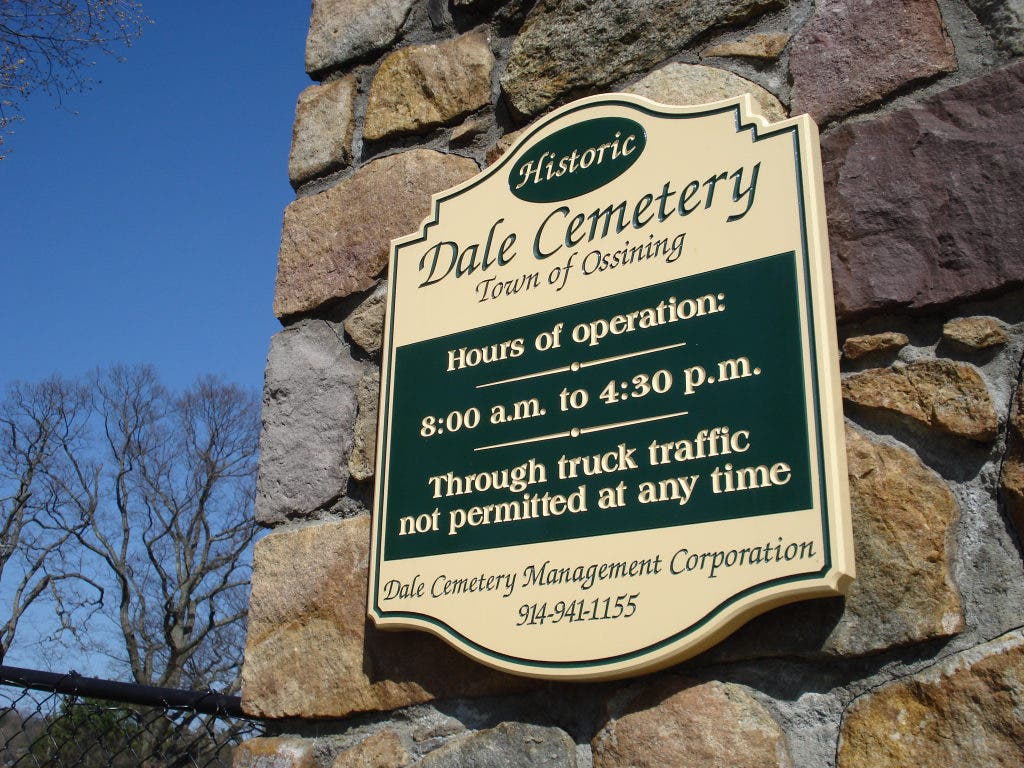
A recent article about Historic Dale Cemetery by Ms. Kim Izzarelli, a candidate for a seat on the Town of Ossining, alleged (in essence) that Dale Cemetery is a financial drain on Ossining taxpayers. I am not familiar enough with the financial details of the cemetery to offer contradictory evidence and will leave that aspect to the experts. I do agree with her point that “Very little is known to the general public about Dale Cemetery, 37 hilly acres between Havell Street and Dale Avenue in Ossining and I trust that the following facts will familiarize others who are intimately familiar with its financial operations speak on that issue. Nonetheless as a credentialed historian and organizer of tours that cover the various houses of worship and cemeteries called, “Holy Ossining: Its Sacred Spaces and Peaceful Places” I do know quite a bit about the intrinsic value of Dale Cemetery to the community.
In the interest of brevity I won’t recount here the entire 160 year history of Dale Cemetery except to say that it was founded in 1851 as a not for profit organization and was among the first “Rural Cemeteries” in New York State and the nation. Rural Cemeteries were landscaped to mimic the pastoral countryside to counter the overcrowded, malodorous, unhealthy, middle of town burial grounds that literally plagued U.S cities towns and villages. Dale was designed by one of the most prominent landscape architects of the 19th century. Howard Daniels. In addition to Dale, he designed 15 other such cemeteries around the nation as well as Druid Hill, Baltimore, Maryland’s “Central Park.” He in fact placed fourth in the contest to design the actual Central Park. More importantly, Dale Cemetery is the final resting place of many of Ossining’s founders and many other persons who made significant contributions to the history of the community, the State of New York and to the nation. As a result of its design and the people buried there Dale is eligible for inclusion on the prestigious National Register of Historic Places and its nomination is in process. This placement and a Historic Tourism Initiative that the Town Board is considering along with a historic signage program I am proposing will have a positive economic benefit on the cemetery and downtown Ossining.
Finally let me say that in addition to its architectural and historic significance Dale is the burial place of many unheralded citizens who in their own quiet contributions to Ossining's communal life, and yes, even to the nation. Hundreds of veterans of every war are buried here and their marked graves make Dale a virtual National Cemetery. I do not believe that the minimal three times a year mowing that Ms. Izzarelli favors honors the memory of Ossining’s ancestors and I am sure that turning Dale over to a private, non-governmental organization would not automatically result in savings or other efficiencies. One only has to look at the massive failures of corporate America to realize that privatization is not a panacea. There is a book out called “Priceless: On Knowing the Price of Everything and the Value of Nothing.” It takes a critical look at the economic method of cost-benefit analysis which is often used to direct public policy. The authors' conclusion is that using cost-benefit analysis too often leads to sub-optimal and unjust outcomes and where everything is reduced to monetary terms. In closing I quote Sir William Gladstone who said, “Show me the manner in which a nation cares for its dead and I will measure with mathematical exactness the tender mercies of its people, their respect for the laws of the land and their loyalty to high ideals.”