Politics & Government
Supreme Court Rules in Favor of Gay Marriage
For New York same-sex couples it means they won't lose marriage rights when traveling from state to state.


Written by BETH DALBEY (Patch Staff)
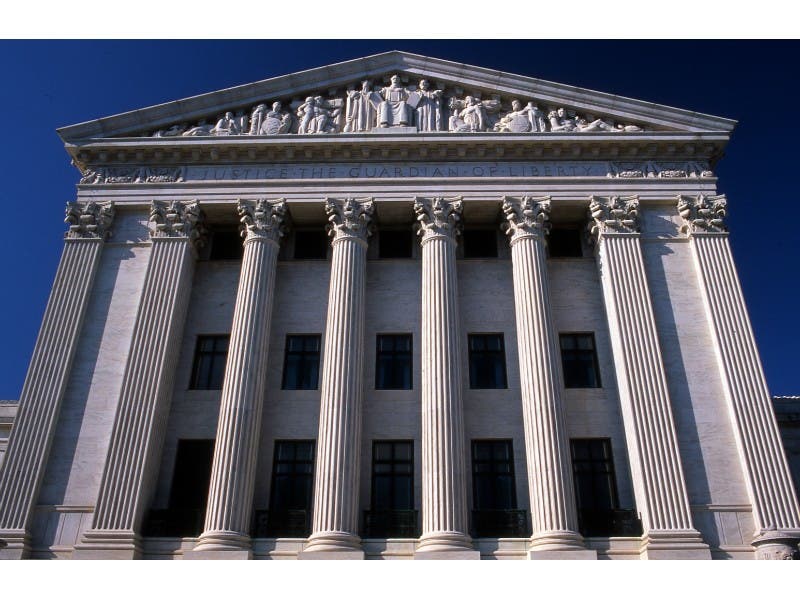
The U.S. Supreme Court issued a watershed ruling Friday that resolves the legal issues surrounding one of the most contentious civil rights issues of modern times, finally ending a decades-long battle for marriage equality fought in state legislatures, courts and at the ballot box.
The 5-4 ruling upholds the right of states to issue marriage licenses to same-sex couples, and to recognize a marriage between two people of the same sex when a marriage was lawfully licensed and performed out of state, according to the U.S. Supreme Court blog.
Find out what's happening in Rivertownsfor free with the latest updates from Patch.
“I’m thrilled that as I travel across the United States, I don’t have to worry about whether or not my marriage has legal force or not,” said John Deuel of Ossining, who had been watching the Internet all morning waiting for the decision to come down. “ I’m also thrilled for all of my friends who’ve been living in states that didn’t recognize their union. This is great for them and really great for their kids!”
New York has recognized same sex marriage since 2011, becoming the seventh state to institute gay marriage.
Find out what's happening in Rivertownsfor free with the latest updates from Patch.
The case before the justices – Obergefell v. Hodges, a consolidation of cases in Michigan, Ohio, Kentucky and Tennessee – pitted states’ rights against individuals’ right to marry, and traditional marriage against more modern iterations of the union.
“President Obama called today a victory for America. And he is right,” said Sleepy Hollow resident Lisa Linsky, a lawyer with McDermott Will & Emery LLP, and one of the lead writers of that firm’s amicus brief in the consolidated cases heard by SCOTUS. “Today’s Supreme Court decision furthers equality and love. These are values that we all want. These are values that level the playing field of life. As it should be.”
Today’s ruling comes during a time of historic support for same-sex-marriage. American’s attitudes have shifted swiftly and dramatically in the last decade, according to public opinion polls. Only 27 percent of Americans thought gay marriage should be legal when the Gallup Poll began posing the question in 1996; last month, support had soared to 60 percent, up from 55 percent just a year ago.
Congresswoman Nita Lowey (D-Westchester/Rockland) praised the decision.
“Today, the United States Supreme Court upheld one of the fundamental principles of our country: equal treatment under the law,” said Lowey in a statement. “On the anniversary of other important decisions, this is an exciting day for all of us who believe in equality and justice. For too long, LGBT couples have been restricted from exercising their fundamental rights. Now, all men and women have equal protection and are free to marry whomever they love regardless of what state they call home.”
She added, “Millions of Americans now know that the government values their bond, their commitment, and their family. I applaud the Court for standing with the Constitution and on the right side of history.”
The reaction drew swift condemnation from New Yorkers for Constitutional Freedoms, a conservative Christian group. Its Executive Director, the Rev. Jason J. McGuire, said in a statement on its website, “Today, the Supreme Court betrayed the United States Constitution and betrayed the citizens of our nation by inventing a constitutional ‘right’ to same-sex ‘marriage’ and forcing that fictitious ‘right’ upon all 50 states. The outcome of this case had nothing whatever to do with the law or the Constitution; no reasonable interpretation of the Constitution could possibly lead any court to today’s result. The majority of the Court has simply imposed its trendy, elitist policy preferences upon 318 million Americans.”
The justices addressed two key questions: whether gay marriage bans – currently in place in 13 states – are constitutional, and whether states can refuse to recognize marriages performed outside their borders.
The justices agreed in January to hear the case. A three-judge panel of the 6th U.S. Circuit Court dealt gay marriage advocates their first federal appeals court defeat last fall, upholding the bans in the four states and setting the stage for the Supreme Court showdown.
The cases involved 12 couples and two widowers. They cases are:
Michigan: On March 21, 2014, U.S. District Judge Bernard Friedman ruled against Michigan’s voter-backed ban on same-sex marriage in DeBoer V. Snyder. The case was filed by a lesbian couple who wanted to jointly adopt children, but were prohibited from doing so by the 2004 voter-backed ban on same-sex marriage.
Kentucky: On July 1, 2014, U.S. District Judge John G. Heyburn III ruled in Love v. Beshear against a provision forbidding the commonwealth from performing same-sex marriages. That ruling followed a Feb. 12 ruling in Bourke v. Besher that said the Commonwealth could not refuse to recognize valid same-sex marriages performed in other states.
Ohio: Two Ohio cases were consolidated in the appeal before the 6th Circuit. On Dec. 23, 2013, U.S. District Judge Timothy Black ruled in Obergefell v. Hodges that Ohio’s refusal to recognize a same-sex marriage performed in another jurisdiction was unconstitutional. The case was filed on behalf of Jim Obergefell and John Arthur, who wanted their Maryland marriage to be recognized on Arthur’s death certificate before he died. The court ordered the state to recognize the marriage when Arthur died in October 2013.
Tennessee: On March 14, U.S. District Judge Aleta Trauger ordered Tennessee officials to recognize three same-sex marriages performed in other jurisdictions. The ruling was later stayed by the 6th Circuit.
Patch Editor Lanning Taliaferro contributed to this report.
Get more local news delivered straight to your inbox. Sign up for free Patch newsletters and alerts.