Politics & Government
More Than 170 Tons of Bunker Removed From Shinnecock Bay: Supervisor
BREAKING: Cleanup efforts are difficult in Southampton Village due to fragile coastal marshlands, Supervisor Jay Schneiderman said.


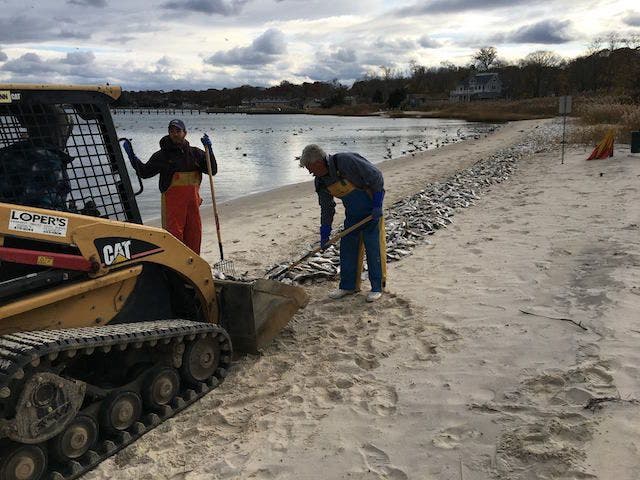
SOUTHAMPTON, NY — More than 170 tons of decaying, smelly dead bunker fish have been removed from Shinnecock Bay since a massive fish kill recently, said Southampton Town Supervisor Jay Schneiderman.
In an update Monday, Schneiderman said, since the fish kill on Nov. 13 — which was caused by millions of pounds of live manheden, or "bunker" exhausting their oxygen supply and dying —Southampton Town has been engaged in a monumental cleanup.
To date, more than 342,000 lbs. of rotting fished have been hauled away, the supervisor said.
Find out what's happening in Southamptonfor free with the latest updates from Patch.
Originally, most of the dead bunker was located at the mouth of, and within, the Shinnecock Canal, Schneiderman said in a release. The outgoing tides and opening of canal tidal gates carried the dead bunker into the bay, where some sank and others were washed out through the Shinnecock Inlet, he added.
"After a few days, decomposing fish from the bay bottom rose to the surface. Winds and currents moved these foul smelling fish onto bay beaches and into marinas and coves," Schneiderman said.
Find out what's happening in Southamptonfor free with the latest updates from Patch.
Schneiderman convened a meeting that included the town's parks department, highway department, municipal works, trustees, bay constables and New York State Department of Environmental Conservation to address the initial fish kill and to plan for the cleanup, he said.
The supervisor said he reached out to Suffolk County Department of Public Works to cycle the Shinnecock Canal lock system, draw in oxygenated water, and avoid a possible recurrence of the event on following days since the population of live bunker was predicted to remain quite high.
Southampton Town officials also called for town trustees and parks department employees to help with marina clean-up, he said.
C. Well Fish, a local commercial bunker fishing company, was contracted by the town to assist with clean-up efforts on bay beaches.
Initially, some of the dead bunker were harvested for bait for the Maine lobster industry. Some were transported to a private composting facility. The bulk of the remaining fish have gone to the town’s Jackson Avenue compost facility to be turned into compost eventually to be made available to the public, Schneiderman said.
Private residents who are cleaning their own beaches are allowed to bring the fish collected to the Hampton Bays transfer station on Jackson Avenue at no cost, he added.
Schneiderman said he's received calls from residents worried about the "noxious" smell.
“Most of the problem areas have been addressed. The massive clean-up efforts and the natural occurrences of wind and tide are creating improving conditions. However”, he added, “Southampton Village still has a significant problem along Meadow Lane. Cleanup efforts in this area are being hampered by environmental constraints where fish have collected in the fragile coastal marshlands.”
Scheiderman thanked William Caldwell, owner of C. Well Fish, for his assistance as well as town trustees, bay constables, and parks department and municipal works for the "team effort."
More Than 1 Million Lbs. of Smelly Fish in Village
The after effects of the massive fish kill in the Shinnecock Canal continued to pile up in the Hamptons — and most recently, more than a million pounds of smelly bunker washed up near Meadow Lane, one of the wealthiest areas in Southampton.
Cleanup efforts are underway, both Schneiderman and Southampton Village Mayor Mark Epley said recently, with Will Caldwell of C Well Fish leading the efforts.
"We removed 12 tons of fish today," Epley said last Monday. "The town hired the same company, Will Caldwell, to remove the fish."
The village, Epley said, is working to get a permit from the New York State Department of Environmental Conservation to go into the marsh and collect the dead bunker.
Something rotten in Southampton
But the deluge of dead fish has meant something's rotten in the Village of Southampton.
"Unfortunately the locks were opened after the fish died and the village along Meadow Lane is impacted greatly. The smell is bad. I have received complaints. Fortunately this happened now not in the middle of the summer," Epley said.
Schneiderman said Caldwell and his crew removed approximately 57,000 pounds, or 28.5 tons of "dead, smelly fish from Shinnecock Bay beaches in three days over last weekend. "That's a lot of fish."
Southampton Town will take the fish into its facility, where it will become fertilizer; the town will also take the village's bunker and charge no tipping fees, Schneiderman said.
"Our facility is capable of taking in another hundred yards of material. We will end up with excellent compost next year," the supervisor said.
The Meadow Lane fish, Schneiderman said, "go on for a very long stretch. It's just tremendous." All the fish that died in the Shinnecock Canal got pushed out with the outgoing tide, and, as they began to decompose, began to float. Prevailing winds pushed them in a southeasterly direction to Meadow Lane, where many multi-million dollar estates are located, the supervisor said.
"I think some people were surprised when they came out for the weekend and the smell was unbearable," Schneiderman said.
Caldwell said neighbors on Meadow Lane have approached him as he commenced with the cleanup.
Two homeowners, he said, walked out and begged him to come to their house. "They said they can't turn on the heat because the smell coming from the vent is atrocious. They've been living in the cold."
Another woman, a caretaker for an "enormous mansion," said the homeowners came out this weekend. "They said they're not coming back until this is over with."
The homeowners, Caldwell said, wanted to write a letter to the mayor to complain.
"I told her she needed to write the mayor to thank him. This is a huge expense for these municipalities, they just can't handle it," he said.
Southampton Town contracted $6,000 for cleanup for three days, Friday through Sunday; Southampton Village, Caldwell said, has contracted for four days at a price of $10,000.
"But this project could go into a month," Caldwell said. "We are seeing if this can be declared a natural disaster and can receive some Federal Emergency Management funding." The village, he said, "can't afford something like this."
Caldwell said he's working at half his normal rate because he lives in town but "it's still expensive."
The supervisor said he's very pleased with the efforts of Southampton Town trustees and the baymen.
In total, the amount of fish to be removed from Southampton Village, Caldwell said, is 1.4 million pounds.
"It's unbelievable," he said. "It's huge." It's the biggest fish kill he's faced, "by tenfold," Caldwell said.
Caldwell said a Bobcat-type machine is used, with men raking the fish into rows and using pitchforks to put them into buckets for removal; no heavier equipment can be used on the beach for fear of hurting the beach or grass, he said.
Caldwell said when he surveys the scene, its enormity astounds. "All I can say is, 'Wow, this is crazy,'" he said.
Photo by Will Caldwell
Get more local news delivered straight to your inbox. Sign up for free Patch newsletters and alerts.