Schools
Stony Brook Southampton - Marine Science Lecture
Dr. Christopher Gobler of Stony Brook University will present a lecture "State of the Bays, 2016: Challenges, victories, solutions".
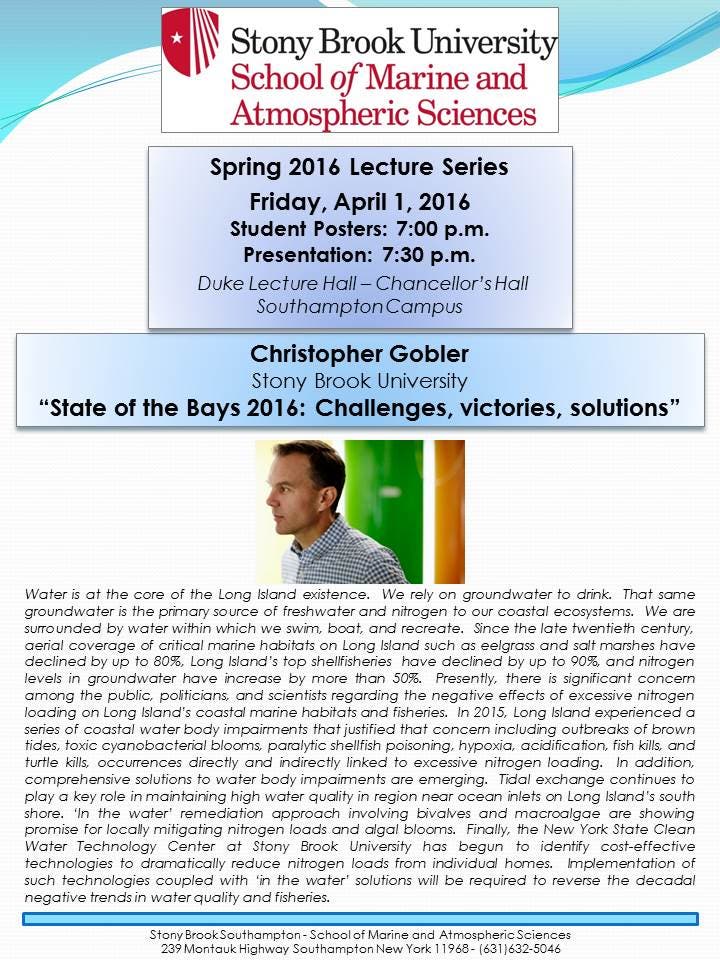
Student poster presentations will begin at 7:00pm and Dr. Gobler's lecture will begin at 7:30pm.
Water is at the core of the Long Island existence. We rely on groundwater to drink. That same groundwater is the primary source of freshwater and nitrogen to our coastal ecosystems. We are surrounded by water within which we swim, boat, and recreate. Since the late twentieth century, aerial coverage of critical marine habitats on Long Island such as eelgrass and salt marshes have declined by up to 80%, Long Island’s top shellfisheries have declined by up to 90%, and nitrogen levels in groundwater have increase by more than 50%. Presently, there is significant concern among the public, politicians, and scientists regarding the negative effects of excessive nitrogen loading on Long Island’s coastal marine habitats and fisheries. In 2015, Long Island experienced a series of coastal water body impairments that justified that concern including outbreaks of brown tides, toxic cyanobacterial blooms, paralytic shellfish poisoning, hypoxia, acidification, fish kills, and turtle kills, occurrences directly and indirectly linked to excessive nitrogen loading. In addition, comprehensive solutions to water body impairments are emerging. Tidal exchange continues to play a key role in maintaining high water quality in region near ocean inlets on Long Island’s south shore. ‘In the water’ remediation approach involving bivalves and macroalgae are showing promise for locally mitigating nitrogen loads and algal blooms. Finally, the New York State Clean Water Technology Center at Stony Brook University has begun to identify cost-effective technologies to dramatically reduce nitrogen loads from individual homes. Implementation of such technologies coupled with ‘in the water’ solutions will be required to reverse the decadal negative trends in water quality and fisheries.